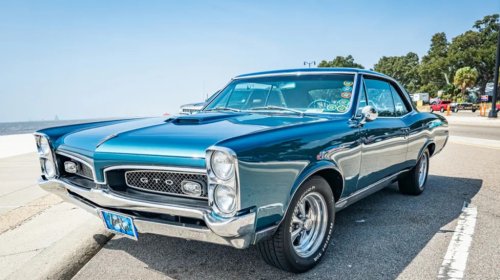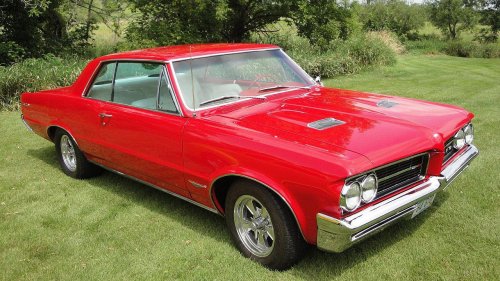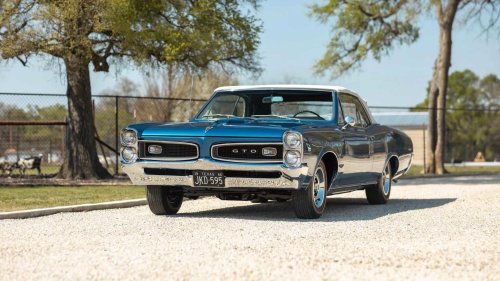



















The mid-2000s were a fever dream, weren’t they? No social media, barely any internet as we’d recognize it today, and we even had a foreign sports coupe masquerading as one of GM’s all-time great muscle cars. At the time, this revelation shook the American automotive scene to its very core. For more reasons than one, it’ll almost certainly never happen again. This is the story of how General Motors revived an icon with help from the opposite side of the globe. GM’s Australian Muscle Cars: A Complicated History CarCollector Via Wikimedia CommonsThe debate over what make or model constitutes the legitimate first muscle car in American history will rage long into the future. But nearly 9,500 miles away in Australia, their own domestic auto industry had its own great muscle car renaissance. For decades, the discourse over whether you were a Holden (GM) fan or a Ford fan was nearly as boisterous as local rugby rivalries.On the Holden side of things, their historic lineup of muscle cars was championed by icons like the mid-size Torana and its special SLR 5000 trim, as well as HSV-spec Commodore sedans in later years. But through it all, perhaps the most globally recognizable name in Australian muscle cars is the beloved Monaro. Launched in 1968 at the height of the first muscle car era, the Monaro was the crowning achievement of American GM designer John Schinella’s time in Australia. With direct oversight from a Detroit-trained automotive designer, it was only natural the Monaro became a Coke bottle muscle car.Holden Its first generation was a roughly Nova-sized two-door hardtop, one that you could option with the first-ever Aussie-designed Holden V8. Or, more famous globally, an American small-block Chevy motor. With four-on-the-floor and a 350-cubic-inch engine under the hood, the late ‘60s flagship HT Monaro GTS 350 was a global-level sports car, not just an Aussie muscle car.Later gen-II Monaros grew larger, sprouted an optional four-door sedan body style, and focused most of the range on its in-house Holden V8. The Yankee Chevy small-block was reserved only for the range-topper GTS-350. The model switched up the formula by offering an optional four-door hard top body style as well, before the name went dormant after 1979. Gen-III Monaro: Aussie-Built, American-Bound General Motors 25 long years came and went without a Holden representative in the full-size coupe segment. It was only in the late 1990s that GM’s future Vice President of Global Design, a native Aussie named Mike Simcoe, resurrected the nameplate with a clean-slate design. In an interview with Which Car Holden designer Peter Hughes described Simcoe’s design team’s early days, sketching a new Monaro on weekends, without management’s approval, alongside powerhouse like Peter Hanenburger and Tony Hyde.“That project was done on Sundays, in my own time, in the studio with some other guys. It was never designed as a show car,” said Hughes of his time working under the Simcoe-led design team. “It was a rolling concept car. Tony gave Mike $300,000 to do a rolling prototype. Imagine doing a Holden Coupe again.” In the end, it took all of 22 months to gain approval from GM to move ahead with the Monaro project and bring a product to launch.The model made its debut in concept form at the 1998 Australian International Motor Show to considerable fanfare, and entered production in 2001. With the choice of a supercharged Buick-based 3.8-liter V6 or an LS1 V8, the new Monaro was a return to form for the brand. Something that could challenge any BMW, Audi, or Ford in the looks department. It was brash, it was brutish, and it was quintessentially Australian in its aura. Well, at least it was, until the bosses in Detroit came calling. Fifth-Generation Pontiac GTO: A Return of an Icon, With Help From Down Under General Motors You could write a novel based solely around the third-generation Holden Monaro’s transformation into the fifth-generation Pontiac GTO. The generation prior left production all the way back in 1974, the subject of a gradual reduction in power and gravitas at the hands of emissions restrictions stemming from the oil crisis of 1973. By the end of production, the GTO was a shell of what it once was. Bloated, under-powered, and subjectively ugly to almost every publication that tested it, the GTO nameplate wouldn’t appear in any form again until a retro-inspired concept car hit the spotlight at the 1999 Detroit Auto Show.This concept did indeed look inspired by the iconic late-60s GTO that spawned it, but it certainly wasn’t a clear path towards production. For goodness sake, the thing didn’t even have an engine. If Pontiac wanted to put a GTO in a real showroom again, someone of genuine substance and circumstance would have to get behind the project. In the end, that person was GM’s then North American Chairman and notorious Euro Domestic Market admirer, Bob Lutz. In the early 2000s, Lutz was dead set on turning Pontiac into a refined, sporty brand on par with BMW. Ultimately, Lutz failed in this endeavor, but certainly not for a lack of effort.Spurred on by rave reviews of the V8 Commodore SS sedan, Lutz made the bold decision to take the V2-series Monaro, slap some Pontiac badges and an exclusive body kit over the top, and resurrect what’s commonly hailed as the original American muscle car. Examples were assembled at Holden’s plant in Elizabeth, South Australia, with the only mechanical difference between the GTO and Monaro being small modifications for NHTSA compliance. Its 5.7-liter LS1 V8 was the same you’d find in a C5 Corvette or a gen-IV Camaro. With 350 horsepower at its disposal, six-speed manual ‘04 GTOs could sprint to 60 mph in 5.3 seconds. A Legit Performance Sedan, Built To Compete With the Germans Credit: Bring a TrailerThat bumped up to 5.4 seconds with a four-speed automatic equipped. It’s not all that far off from the E46 BMW M3 Bob Lutz clearly wanted to compete against. Admittedly, the iconic E46 M3 is a touch faster, all thanks to a lighter curb weight and its rev-happy straight-six engine. But with its docile demeanor and an engine just as happy turning 1,000 RPM as it was at 6,000, the GTO was a supremely capable entry-level grand touring car. In practice, it was more akin to a budget Mercedes CLK500 or Infiniti G35 alternative than something built to compete with AMG or M Division.With a base MSRP of $32,495 in 2004, you could almost buy two GTOs for the price of one Merc. In a nation-wide marketing campaign, the new GTO began its journeyman story as rolling billboard for Bob Lutz’ considerable ambition.The car was an instant movie star, appearing in films like the 2005 cult classic “Herbie: Fully Loaded.” Additionally, the GTO became a stalwart of EA’s Need for Speed series of video games, as well as appearances in the competing Test Drive series by THQ, and later, Xbox’s flagship Forza series. All the spotlight made the GTO an instant pin-up poster dream car for a generation of American youth we now identify as late millennials and the very first of Gen-Z. An Iconic Mid-2000s Muscle Car, a Decade Too Early General Motors A 2005 refresh based on the updated VZ-series Monaro brought a 400-hp, 6.0-L LS2 out of a base C6 Corvette and Cadillac CTS-V to the party. It also introduced a redesigned front fascia, but kept the aggressive air scoops on the hood introduced at launch. With the new powertrain, the GTO hit 60 in just 4.8 seconds from a dig in real-world tests. At least in performance, these Pontiacs were closer to an Aston Martin V8 Vantage, Jaguar XK, orthe ubiquitous E46 M3 than anything American. Still, it failed to translate into long term viability. Only a touch over 40,800 GTOs were sold between 2004 and 2006. It’s estimated that BMW sold that many E46 M3s in North America alone before it bit the dust in 2006, and effectively doubled that number with global sales.It's worth noting that Lutz did intend to bring a sixth-gen GTO to production, had it survived past 2009. A clay mock-up was even formedbefore Pontiac shut up shop for good, leaving fans to wonder what could’ve been for the last 15-plus years. Even now, rumors still pop up that GM might be planning to bring back the GTO and the Pontiac brand one more time. It never amounts to much, but the hope, and indeed the want, is certainly there.Sources: General Motors, Hemmings, Which Car,