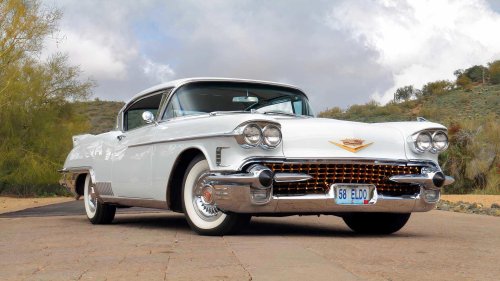
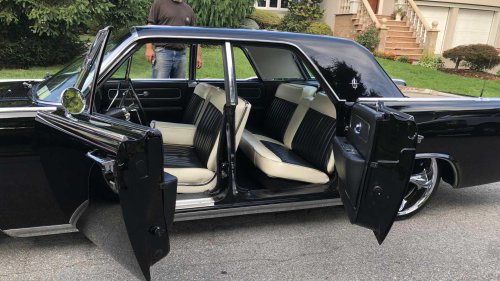
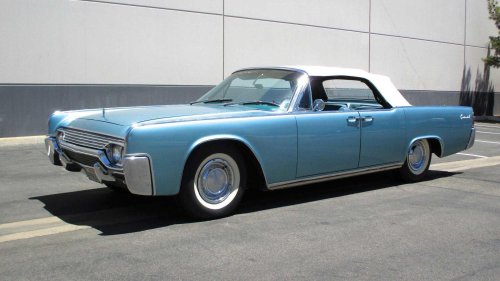
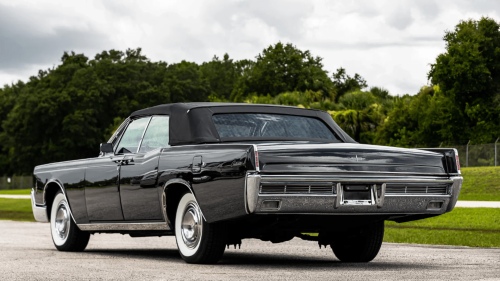
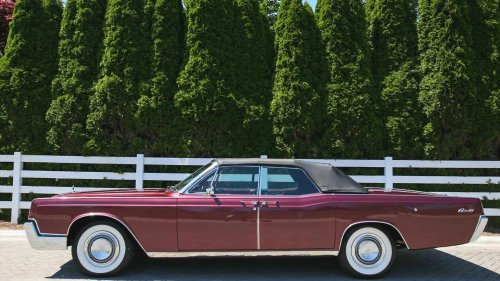
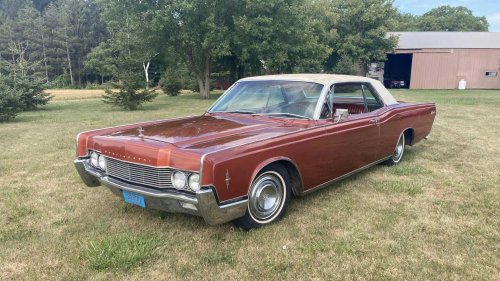



















The car that helped cool America’s fever for fins, chrome, and space-age swagger wasn’t a Lincoln per se. It began as a Thunderbird idea that lost its own fight, got pushed aside, and should have died as another styling-room footnote. Instead, that castoff sketch landed in the one corner of Ford where failure carried danger. Lincoln needed a save fast, because its giant late-1950s cars looked expensive, heavy, and out of step with a market drunk on excess.What followed gave Detroit a plot twist. A rejected personal-luxury proposal turned into a formal four-door flagship, and then into something bigger—a design reset for American luxury and, later, a car welded to national memory. The 1950s Luxury Market Was Bloated, Ornate, And Obsessed With Excess Via: Bring A Trailer By the end of the 1950s, Detroit luxury cars had become rolling billboards for design obsolescence. Cadillac kept growing its fins year after year because the industry wanted buyers to feel old the second a newer model showed up. The cars grew bigger, heavier, and more loaded with chrome, and the visual arms race started to look less like elegance and more like a neighborhood cookout where everyone brought too much potato salad. By 1959, some of those fins looked less like bodywork and more like launch equipment borrowed from Cape Canaveral. The whole market had started mistaking visual volume for sophistication.Lincoln joined that game, and it paid dearly for the privilege. The 1958-1960 Lincolns came out huge, expensive, and awkwardly styled, with the 1960 car stretching past 227 inches on a 131-inch wheelbase. Even by American standards, that was a lot of sheetmetal to explain in one sales pitch. Sales never matched the ambition, and Lincoln lost around $60 million on those cars alone. That kind of number got executives staring at org charts and reaching for sharp pencils. It also explains why the next Lincoln could not simply be another annual trim-and-grille shuffle.Mecum Then, the 1958 recession hit, Edsel collapsed in public, and Ford had little patience left for a luxury division that kept burning cash. Robert McNamara, who cared deeply about cost and discipline, looked at Lincoln’s weak sales and seriously considered killing the brand rather than funding another oversized mistake. He was not blind to style, but he hated waste, and Lincoln had become a very expensive way to manufacture disappointment.That was the opening. The market still loved prestige, but excess had started to feel tired, even if buyers had not fully admitted it yet. A clean luxury car could suddenly look bold precisely because everything else had become so noisy. Even enthusiasts who enjoy a sky-high fin can admit there comes a point where a taillight starts to look like airport equipment. Lincoln needed something cleaner, more modern, and more credible. One Car’s Greatest Features Were Actually Problems To Solve Cooper Classic CarsThe hidden force behind that car’s shape was packaging. Ford wanted Lincoln to shrink, share more underneath, and stop pretending size alone could solve every problem. The new luxury car would ride on a stretched version of the proposed Thunderbird architecture, and that meant a 123-inch wheelbase, short by the standards of Detroit’s big-money sedans. The finished car would still measure 212.4 inches long, but that was nearly 15 inches shorter than the beast it replaced.Elwood Engel’s original proposal sat closer to Thunderbird territory, about 205 inches long on a 113-inch wheelbase. Turning that into a proper four-door Lincoln meant adding wheelbase, widening the body, and still keeping the whole thing tighter than the bloated cars it replaced. Executive engineer Harold Johnson soon found the ugly truth – rear passengers could fit, but getting them in and out gracefully was another matter. For a luxury car, awkward entry was a full alarm bell. Nobody paying Lincoln money wanted to fold into the back seat like a pocketknife, especially when Cadillac still sold roomier theater on wheels.Other celebrated details grew from the same fight. The low roof looked crisp, but Lincoln still had to protect headroom, so engineers lowered the driveshaft tunnel with a special double-Cardan joint. The new body used unit construction like the Thunderbird, which helped give the car its rigid, precise feel, but it also locked the team into tough decisions on structure and space.Inside, the Continental ended up closer to its Thunderbird cousin than to some full-size rivals. Even trunk space became a sore point, and Lincoln had to raise the rear deck on 1963 models in a late attempt to make luggage fit more convincingly. The pretty shape did not arrive with free space inside it. The Rejected Thunderbird Proposal Became The 1961 Lincoln Continental Bring a Trailer The car, of course, was the 1961 Lincoln Continental. Elwood Engel had drawn the basic theme as a proposal for the 1961 Thunderbird, but Ford rejected it because decision-makers thought it looked too formal and not sporty enough for Thunderbird buyers. Joe Oros’s proposal won that internal battle instead. In one of those rare moments when a defeat improves a design, Engel’s proposal did not leave the building, but just changed departments and changed history.Ben Mills at Lincoln liked what he saw, and McNamara soon did too. After the rejected Thunderbird clay sat in Engel’s studio, McNamara came through, studied it, and asked the question that mattered – could it become a four-door Lincoln? Lincoln got a stay of execution on that condition. If Engel's team could turn that elegant coupe idea into a viable sedan without exceeding the size and cost targets, the brand would live to fight again. The team then worked punishing overtime to turn that clay into a believable production proposal before the window closed.Bring A Trailer They did more than that. The finished Continental arrived for 1961 as a radically cleaner answer to the chrome-heavy luxury norm. It dropped the old Capri and Premiere lines, offered only a four-door sedan and a four-door convertible, and wore flat body sides, crisp edges, and almost shocking restraint for the moment. Lincoln itself later described the design as a dramatic break from fins and heavy chrome, which sounds clinical until one remembers the monsters parked beside it in 1960 showrooms. The car looked expensive without having to shout, which might be the hardest trick in American luxury design.Critics noticed right away. The Continental won Car Life’s 1961 Engineering Excellence Award and even earned recognition from the Industrial Design Institute, which rarely handed out medals to automobiles. Sales did not explode overnight, though – Lincoln sold 25,164 cars for 1961, only a slight gain over 1960, and Cadillac still outsold the division by a wide margin in the following years. Even so, Lincoln returned to profitability, however modestly, and the division survived. How Constraints Created Every Continental Hallmark Via BaT Start with the rear doors, because that is the detail everyone remembers first. The rear-hinged openings were because Lincoln needed a better way to get passengers into the back seat on a short-wheelbase car, and the convertible complicated hinge placement even more because it lacked a solid center pillar to support a conventional rear-door hinge. So the famous “suicide doors” arrived as a packaging answer – sometimes the best way forward really is backward.But the irony runs deeper. Engel’s team had hoped to make the sedan a true pillarless hardtop, latching the doors to the floor and to each other, but cost forced Lincoln to keep narrow B-pillars in production. On the early convertibles, the curved side glass added another bit of theater and another bit of engineering cleverness—the rear windows dropped slightly when the doors opened so the glass could clear the roof molding. That is a feature we would see on many cars decades later.Bring A Trailer Then came the structure. The Continental’s unit body made the car feel tight and substantial, and Lincoln backed that up with obsessive quality control, including a 189-point inspection checklist, extensive pre-delivery testing, and a 12-mile road test before delivery. The warranty stretched to two years and 24,000 miles, which beat domestic rivals and helped signal that Lincoln meant business this time.But “downsized” did not mean light. The shorter Continental remained almost as heavy as the giant car it replaced, and period weight comparisons showed the sedan could outweigh comparable Cadillacs and Imperials. On the convertible, extra bracing and even hefty damping weights added more mass. The cleanest luxury car in Detroit turned out to be built like a bank vault. History Gave It A Meaning No Designer Could Have Planned If the story ended there, the Continental would still rank as one of the smartest American luxury cars ever built. But history attached a heavier meaning to it. Lincoln already held a long relationship with official transport and parade duty, and the Continental’s formal shape, smooth ride, and open four-door convertible body made it a natural base for ceremonial use. That practical fit soon placed the car on a far larger stage than any designer or engineer could have planned.President John F. Kennedy’s parade car began as a stock 1961 Lincoln Continental four-door convertible built in Wixom, Michigan. Ford then sent it to Hess & Eisenhardt in Cincinnati, where the coachbuilder cut the car in half, added a 3.5-foot center section, fitted jump seats, handholds, communications gear, flashing lights, and created a roof system with multiple removable panels. The Secret Service called it the X-100.In technical terms, it was a custom limousine. In emotional terms, it was still recognizably a Continental, right down to the clean body and formal stance that had made the production car feel so different in the first place. Even stretched for presidential duty, the original design theme still held together.That connection fixed the model in American memory forever. Kennedy rode in that Continental limousine in Dallas on November 22, 1963, when he was assassinated. The car later returned to service after a full rebuild, continued in presidential duty for years, and now sits in The Henry Ford’s collection. The Continental became part of the way the country remembers it, which is a very different kind of fame from the one any automaker wants. It is hard to think of another American production-based car whose identity split so completely between design triumph and national tragedy.Source: Lincoln, Ford