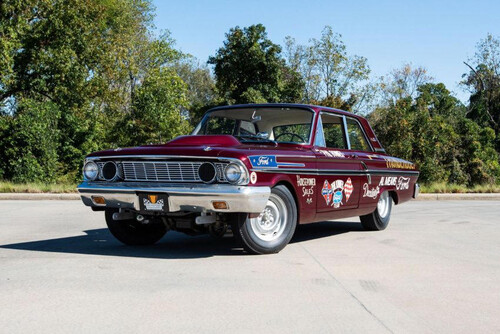
There was a time when automakers weren’t chasing lap records or Nürburgring bragging rights. They were chasing one thing: the quarter mile. Win on Sunday, sell on Monday wasn’t just a saying, it was the entire strategy. And in the early ’60s, Ford wasn’t playing around.That mindset is exactly what gave us the Fairlane Thunderbolt. And calling it a “car” almost feels generous. Yes, it had a VIN. Yes, you could technically drive it on the street. But everything about it was built with one goal in mind, and it wasn’t comfort, usability, or longevity. It was winning drag races and that’s it.FordFord didn't set out to build something rare. It didn’t care about future collectors or auction values. It built just enough of these to satisfy NHRA homologation rules, handed them to people who were going to race them hard, and moved on. The funny part is, that exact mindset is what made it one of the rarest muscle cars ever today. Ford Built The Fairlane Thunderbolt To Win Races, Not To Last Mecum AuctionsThe Thunderbolt wasn’t developed the way most production cars were. There was no balancing act between performance and comfort, no attempt to make it appealing to a wide audience. Ford took a Fairlane, looked at everything that didn’t make it faster, and started removing it. As crude as that process sounds, it fit the vibe of the Thunderbolt.Weight savings came first. Steel panels were replaced with fiberglass. Sound deadening was gone, and the interior trim was minimal at best. You weren’t getting a polished cabin; you were getting exactly what you needed to stage, launch, and get down the strip as quickly as possible. Even the battery got moved to the trunk to help with traction off the line.Mecum AuctionsAnd then there’s how these cars actually made it into people’s hands. They weren’t sitting on dealer lots waiting for someone to wander in on a Saturday afternoon. Ford sent them directly to racers. People who were going to use them immediately and push them as far as they could go. From day one, these cars were treated like tools, not something you preserved. Which, looking back, kind of tells you exactly where this story is headed.Fun Fact: The Thunderbolt was so focused on drag racing that even its stance and weight distribution were tuned specifically for straight-line launches, not normal driving. A 427 V8 That Was Already Pushing Limits At the center of the Thunderbolt was Ford’s 427 cubic-inch FE V8, and this is where things get really interesting. Officially, Ford rated it at 425 horsepower. Unofficially, nobody really believed that number. This wasn’t a conservative, everyday engine. It was built to win. It had a high-rise intake, dual four-barrel Holley carburetors, and a setup that was clearly designed to breathe and pull hard at full throttle. Everything about it felt like it was operating just a little closer to the edge than most engines of the time.And it worked. Right out of the box, these cars were running low 11-second quarter-mile times. In 1964, that wasn't just quick—that was dominant. This was the sort of performance that immediately made an impact in Super Stock competition and gave Ford exactly what it wanted.MecumAnd the key thing here is that none of this was built with restraint in mind. It wasn’t about making something that would last forever, it was about making something that could win right now. Most Were Raced Hard And Lost Over Time Here’s where the Thunderbolt story really separates itself from other muscle cars. These weren’t garage queens. They weren’t weekend cruisers. They were raced, constantly. Most of them were modified almost immediately with rebuilt engines, swapped parts, and whatever else needed changing as racers chased every possible advantage. And because they were being pushed that hard, things broke, cars got damaged, and some were better repaired than others.MecumOver time, that cycle took its toll. Even though Ford built around 100 of them to meet homologation rules, far fewer survived in anything close to original condition. That's why they go for so much these days—there just weren't that many that actually made it through decades of hard use.Fun Fact: Despite being a factory-backed effort, many Thunderbolts were essentially hand-prepped and varied slightly depending on who was finishing or racing them. Why It Became Ultra-Rare Without Trying To Mecum AuctionsFord didn’t build the Thunderbolt to be rare, they built it to qualify for racing and to win. They only made 100 because that was the requirement. There was no long-term plan, no limited-edition strategy, no thought about what these cars would be worth decades later.But when you combine low production with the fact that almost every single one was used exactly as intended, you get a completely different outcome. Cars got modified, damaged, lost, or worn out. And over time, the number of surviving, original examples drops fast. That’s what makes the Thunderbolt feel like a true “accidental” rarity. Not because production was low, but because survival was even lower. Today, It’s One Of The Most Valuable Drag-Era Muscle Cars Mecum AuctionsFast forward to today, and the Thunderbolt sits in a completely different world than it did in 1964. What started as a purpose-built racing tool is now one of the most sought-after American muscle cars out there. Collectors are buying a direct connection to Ford’s most aggressive racing era, and to a time when automakers were willing to build something this focused just to win.Fun Fact: Some cars left the factory without heaters or radios, and a few didn’t even have proper seam sealing, which tells you how little Ford cared about comfort.Mecum AuctionsThunderbolt values today reflect how difficult these cars are to find, especially in original condition. A few went unsold in the last few years, but most others have come in over $200,000. Documentation, racing history, and matching components all matter, and the best examples command serious money because there just aren’t many left to choose from.And that’s what makes the Fairlane Thunderbolt so interesting to look back on. Ford set out to build a winner. It did exactly that. It just also happened to create one of the rarest muscle cars in the process, without ever trying to.