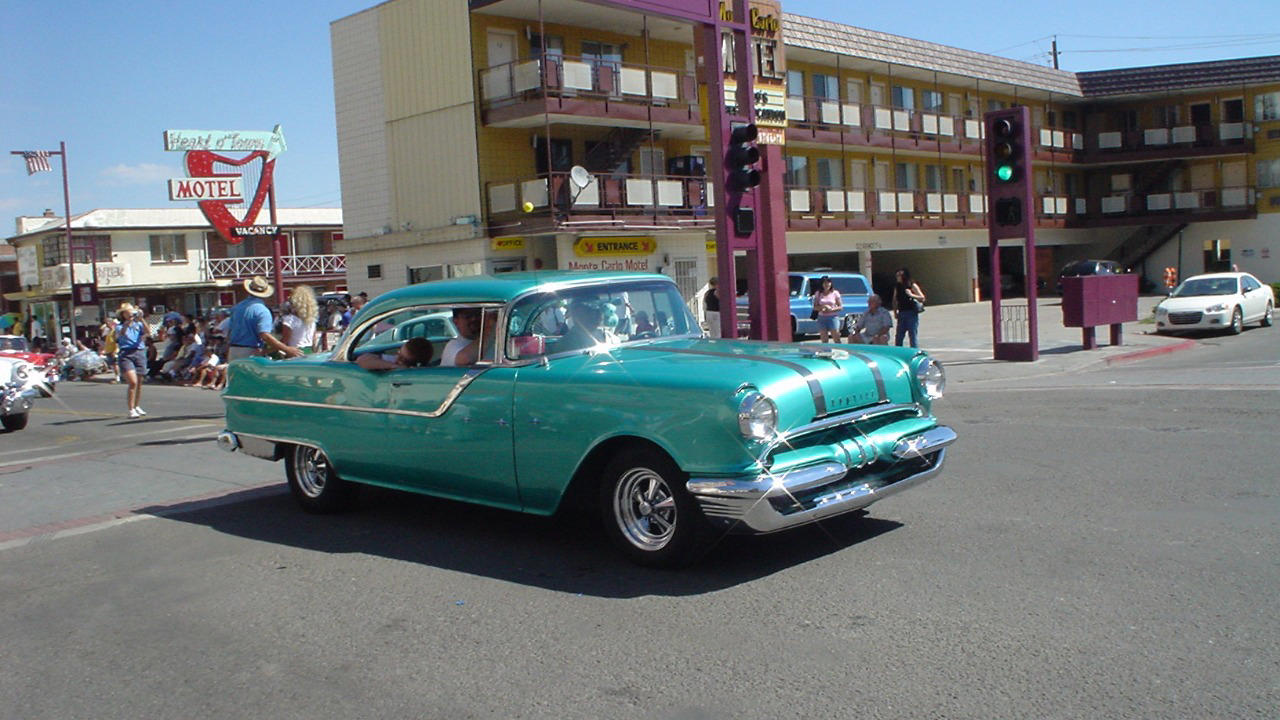



















The 1955 Pontiac Star Chief arrived as more than Pontiac’s new flagship. It was General Motors’ calculated attempt to pull aspirational buyers away from Buick showrooms by offering comparable glamour, size, and power at a slightly more approachable rung on the corporate ladder. Wrapped in chrome and two-tone paint, the car translated mid‑century American optimism into sheet metal while quietly redrawing the boundaries between GM’s mid‑priced divisions. Today it is widely regarded as a symbol of 1950s Americana, yet the Pontiac Star Chief was engineered, styled, and marketed for the same families who might otherwise have driven home in a Buick Super or Special. Understanding why it targeted Buick buyers reveals how intensely GM managed brand hierarchy during the golden age of Detroit excess. The flagship that had to look upward Within Pontiac’s own lineup, the 1955 Pontiac Star Chief sat at the top, promoted as a luxurious step above the Chieftain and as a showcase for new styling and technology. Contemporary descriptions highlight how the Pontiac Star Chief embodied mid‑20th‑century American cars, with sweeping lines and heavy use of brightwork that placed it firmly in the aspirational category. The model quickly became associated with the golden age of style and power, often described as a true expression of 1950s Americana. Enthusiasts still refer to the 1955 Pontiac Star Chief in exactly those terms, linking it directly to what one source calls the Golden Age, a phrase that underlines how deliberately Pontiac aimed above its traditional, value‑oriented image. Size, stance, and the Buick benchmark To compete credibly with Buick, Pontiac could not rely on trim alone. It needed physical presence. Both the Chieftain and the Star Chief were built on the same A‑body shell, yet period information notes that both cars shared that basic structure, while the new Star Chief had an 11‑inch extension added to its frame, specified in one summary as 280 m. That stretch created the long‑wheelbase proportions that Buick buyers expected, particularly in the Super and Roadmaster lines. Other documentation reinforces that the Star Chief, described as based on the Pontiac Chieftain, rode on a 124-inch wheelbase, a figure that moved it firmly into Buick territory in terms of cabin space and road presence. Auction notes for a 1955 Pontiac Star Chief Convertible similarly describe the top‑of‑the‑line Star Chief as riding on a frame that was 11 inches longer than other models in the range. In the 1950s marketplace, length signaled luxury. By stretching the chassis and emphasizing a low, sweeping profile, Pontiac created a silhouette that could stand beside a Buick in any driveway without looking like the cheaper cousin. Styling the aspirational Pontiac Visual drama was essential if the Star Chief was to tempt shoppers away from Buick’s porthole‑lined fenders. Accounts of the car emphasize its two‑tone paint schemes and chrome‑laden exterior, qualities that one enthusiast group describes as making Its look a true representation of 1950s Americana. The long side spears, abundant brightwork, and generous use of contrasting colors were not subtle. They were designed to catch the eye of buyers who might otherwise be drawn to Buick’s similarly flamboyant styling. Further descriptions of the 1955 Pontiac Star Chief highlight how the car stood out in Pontiac’s lineup during what is often called the golden era of American automotive design. One overview notes that the model was a standout in Pontiac showrooms, with styling that signaled a clear step up from the Chieftain and aligned more closely with the visual language of Buick and even Cadillac. Powertrain and the prestige of “Strato Streak” Targeting Buick buyers also required credible performance. Pontiac introduced its modern overhead‑valve V8 under the marketing name “Strato Streak,” and that branding carried clear aspirational overtones. Later Star Chief models were advertised with a 316 cubic inch Strato Streak V8, explicitly identified as part of the “Engine and Performance” story for the Star Chief and presented as a key factor in the car’s upscale appearance and character. For 1955, auction literature describes the 1955 Pontiac Star Chief Convertible as powered by a 287 cubic inch Strato Streak V8, again tying the engine branding directly to the flagship model. In an era when Buick promoted its own overhead‑valve V8 as a mark of technical sophistication, Pontiac’s use of the Strato Streak name signaled that it was playing in the same league, not merely offering a warmed‑over six‑cylinder sedan. Interior comfort and the Buick buyer’s expectations Inside, the Star Chief leaned heavily on soft materials and generous space to justify its positioning. Descriptions from enthusiast communities emphasize that the Pontiac Star Chief was known for its luxurious interior and smooth ride, a combination that made it attractive to families who wanted Buick levels of comfort without fully stepping into Buick’s price band. The extended wheelbase that produced the 124-inch figure translated directly into legroom and a more composed ride over imperfect pavement. In a period when long‑distance highway travel was becoming part of middle‑class life, that extra comfort mattered. Pontiac’s decision to reserve these benefits for its flagship signaled a clear attempt to catch buyers who might otherwise have moved up to a Buick for similar qualities. GM’s internal ladder and the Star Chief’s role Within General Motors, Pontiac sat between Chevrolet and Oldsmobile, while Buick and Cadillac occupied the upper tiers. The Star Chief complicated that neat ladder. Historical commentary on the model notes that whether the Star became either a deluxe Catalina or a cheaper Bonneville in 1959 depends on the observer’s point of view, which hints at how Pontiac’s upper trims blurred boundaries with more expensive GM offerings. By the mid‑1950s, Pontiac’s top model was already encroaching on Buick’s territory. The Star Chief’s size, features, and pricing placed it in direct comparison with Buick Special and Buick Super models, and GM appears to have accepted a degree of internal competition in exchange for keeping buyers inside the corporate family. Culture, image, and the Buick comparison The Star Chief did not operate only on the showroom floor. It occupied a visible place in American culture that helped validate it as a Buick alternative. One account of the model’s early history notes that whenthe storyline of “I Love Lucy” shifted toward a Hollywood setting in the 1954 to 1955 season, the characters were associated with a Pontiac Star Chief, linking the car to aspirational, entertainment‑driven lifestyles in the public imagination. Enthusiast recollections also place the Star Chief in the same family conversations as Buicks. One narrative recalls that another favorite uncle bought a 1955 De Soto, and Bill’s parents ended up with a Buick, illustrating how shoppers weighed Pontiacs, Buicks, and other mid‑priced brands against one another when choosing a family car. The Star Chief’s presence in that mix underlines its role as a genuine alternative to Buick ownership. Legacy among collectors and the Buick shadow Modern collectors often describe the 1955 Pontiac Star Chief as an overlooked classic, a car that delivered Buick‑like style and comfort without achieving the same long‑term name recognition. Enthusiast groups highlight the Pontiac Star Chief as a classic example of 1950s American automotive elegance, while another community post simply calls it an “Awesome” and absolutely gorgeous 1955 Pontiac Star Chief. Polling among enthusiasts sometimes frames the choice explicitly as “1955 Pontiac Star Chief or Buick Special,” inviting voters to decide which they like best. One such comparison notes that under the hood, the 1955 Pontiac Star Chief delivered performance and style that keep it popular among vintage car enthusiasts today, which suggests that the original cross‑shop between Pontiac and Buick has carried into the collector era. In retrospect, the 1955 Pontiac Star Chief can be seen as Pontiac’s boldest attempt to climb toward Buick’s prestige without abandoning its own identity. By stretching the chassis, dressing the body in dramatic two‑tone paint, and pairing a Strato Streak V8 with a plush interior, Pontiac crafted a car that spoke directly to Buick buyers’ desires. The fact that enthusiasts still debate Star Chief versus Buick Special seven decades later shows how effectively that strategy worked. More from Fast Lane Only Unboxing the WWII Jeep in a Crate 15 rare Chevys collectors are quietly buying 10 underrated V8s still worth hunting down Police notice this before you even roll window down