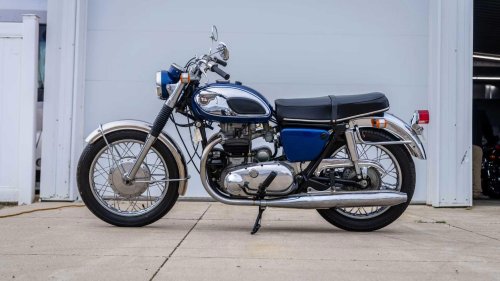
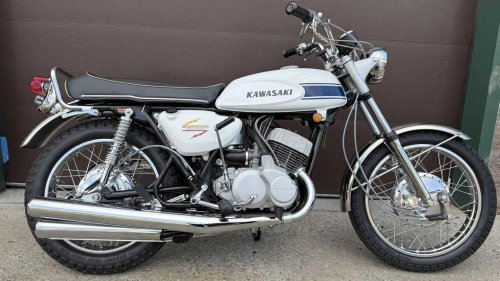
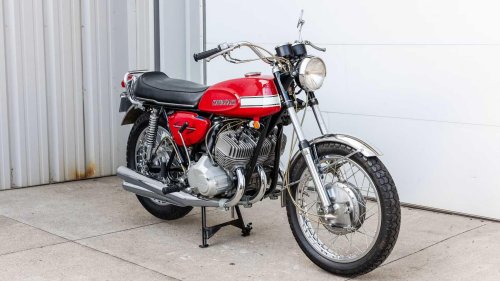
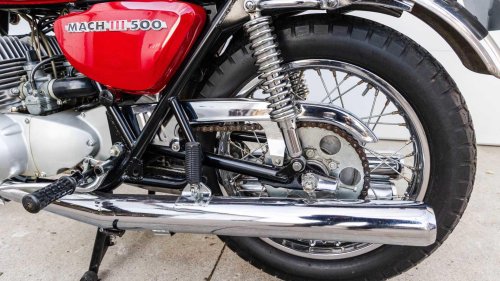
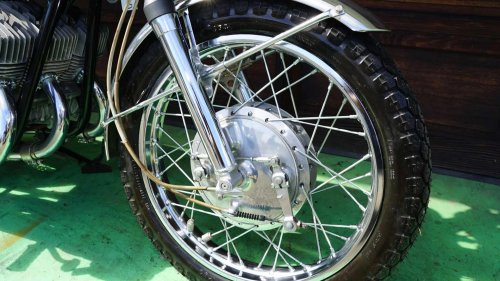
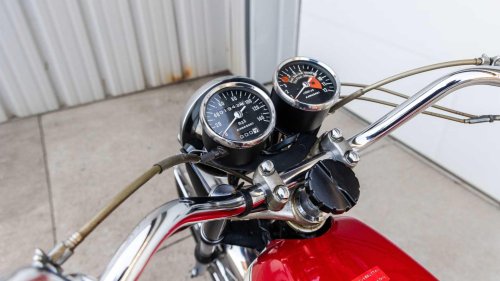

















By the late 1960s, Kawasaki had earned a reputation for making good, if not exciting motorcycles. It'd seen success with smaller bikes and had released a larger one in the W1, but still weren't seen as a brand that could forge into elite performance territory. That was until it released one bike that transformed both motorcycling and Kawasaki’s reputation in one fell swoop. The Two-Stroke Golden Age MecumBy the late 1960s, two-stroke bikes were increasing in popularity. Four-strokes were still the dominant engine type in motorcycles, as they offered greater fuel efficiency and broader, more usable torque than their two-stroke equivalents, but Japanese manufacturers had been exploring two-strokes.The light weight, simpler mechanics, and higher power-to-weight ratios made two-strokes an attractive option, particularly for mass production, and they’d already started to prove their worth in racing as a Suzuki two-stroke took the 1963 125cc Grand Prix Motorcycle Racing title, with the 250cc class being won a year later by a Yamaha two-stroke. Riders would have to wait until 1971 for a 500cc two-stroke race win, with the first title coming in 1975, but the groundwork was being laid. And while Japanese manufacturers were pushing the two-stroke motorcycle in both racing and road, one notable exception was Kawasaki. By The Late 1960s, Kawasaki Was Conservative Rather Than Competitive MecumThough it had started making motorcycles in 1953, Kawasaki didn’t actually release them under its own name until 1961. The Kawasaki B7 was a two-stroke 125cc bike, followed a year later by the B8. The bikes were commercial successes, particularly in Kawasaki’s native Japan, but its W1 went after a new demographic.At 624cc, the W1 was the largest-displacement motorcycle produced in Japan at the time. It was heavily inspired by British bikes, being loosely based on the BSA A7 and A10. While it was well-received by the riding public, it did little to establish Kawasaki as a high-performance motorcycle brand. That needed to change, so Kawasaki released a bike intended to shake that reputation and put it firmly into the elite performance bracket. The Kawasaki H1 Mach III Emerges Bring a TrailerKawasaki’s W1 had shown promise at the higher capacities and found some followers in the US, but it wasn’t enough for the brand. The British-looking, Japanese-made bike did have the accolade of being the largest Japanese bike, but it was still less popular than smaller alternatives like the Honda CB450 and Suzuki T500, while anyone after a British-styled bike could simply buy an actual British bike.A year after the W1’s 1966 launch, Kawasaki started working on its N100 Plan to develop a 500cc engine capable of exciting the American market. 60 HP and a 13-second standing quarter mile were the performance targets set for the engineers, and in 1969, both those targets would be met by the H1 Mach III. The bike's air-cooled 499cc engine fit the displacement requirement while, in the hands of motorcycle drag racer and H1 development rider Tony Nicosia, it set a quarter mile run of 12.96 seconds (becoming the first production bike to do so in the process).Not only was the H1 powerful, but it was eminently affordable. Coming in at $999 new ($9,065 today), it was cheaper than both Honda’s CB750 at $1,495, and the CB450 at around $1,050. It was also cheaper than British equivalents like the Triumph 500 Daytona, which shared a similar price to the CB450.MecumThe bike had the exciting combination of unbridled power and incredible lightness that it needed to achieve the speeds Kawasaki demanded. While that would usually be a good thing, there were early reports that it had an adverse effect on handling—something that the bike would later become known for. Despite Its Widowmaker Nickname, The H1 Mach III Was A Hit MecumKawasaki’s focus on what was, for the time, unheard of performance pushed the bike into dangerous territory. It had succeeded in creating the bike with the highest power-to-weight ratio of any production motorcycle, but it had done so at the cost of the rest of the bike itself. The frame was unsubstantial and flexed underneath the copious power, the weight distribution was rearwards enough to induce wheelies in the unprepared, and the power suddenly kicked in around 6,000 RPM.Brakes and suspension were also an afterthought, given that the stated goal of the bike was to break the 13-second quarter mile from the off. With a top speed of 125 MPH, the bike’s 180 mm front drum brake and 180 mm rear drum were never going to be enough, especially considering their proclivity to fade under hard braking. This was upgraded to hydraulic brakes on the front by 1972 (the rear drum remained). However, the unrivaled power, mediocre brakes, and eagerness to wheelie under power contributed to the bike's untamed reputation.The sound of the bike was another big reason that the bike was a hit. It was the marque’s first triple-cylinder bike, and its exhaust howl became as recognizable as the bike itself.MecumWhat Kawasaki had created was a bike that was exciting, powerful, and affordable. It was less a case of being able to afford one, and more a case of having the mental fortitude to allow yourself to get into one. Cycle World wrote at the time that “Many will have the cash to buy it, but fewer will have the ‘hair’ to ride it to its limit."Despite the copious reasons not to buy the bike, it was still a sales success. Buyers flocked to it during its seven-year stint on Kawasaki’s catalogs, selling an estimated 110,000 bikes across the seven variations.An important distinction is that although the H1 was the first of Kawasaki’s bikes to be referred to as “widowmaker”, the H2 Mach IV that came two years later took that reputation from it. The Mach IV was a follow-up to the Mach III, and was a 74 HP, 750 cc two-stroke with a similarly lightweight frame, rear-biased weight distribution, and inadequate brakes. Like the Mach III, its brutal power and flexy frame made it an exciting, albeit unpredictable, ride. The H1 Mach III’s Legacy And Collector Status MecumThough the H2 arguably stole the widowmaker moniker, the H1 Mach III is still every bit the powerful, aggressive, enrapturing ride it was over 50 years ago. It reshaped Kawasaki’s image into one of bold performance, forcing other manufacturers to catch up to it after it had spent time finding its feet in the motorcycle world.The bike still commands a high asking price to this day. 1969 models are worth around $12,000 on average per Hagerty, with later models going for slightly cheaper.While the H1 Mach III wasn’t a perfect bike, it didn’t need to be. Kawasaki wasn’t interested in putting out a bike that was very good in every conceivable way. It wanted to create the fastest bike in the world, and it did it. It didn’t ask riders if they had the money to buy the bike, it asked them if they had the bravery to do it. And in doing so, it created a bike still revered and feared today.