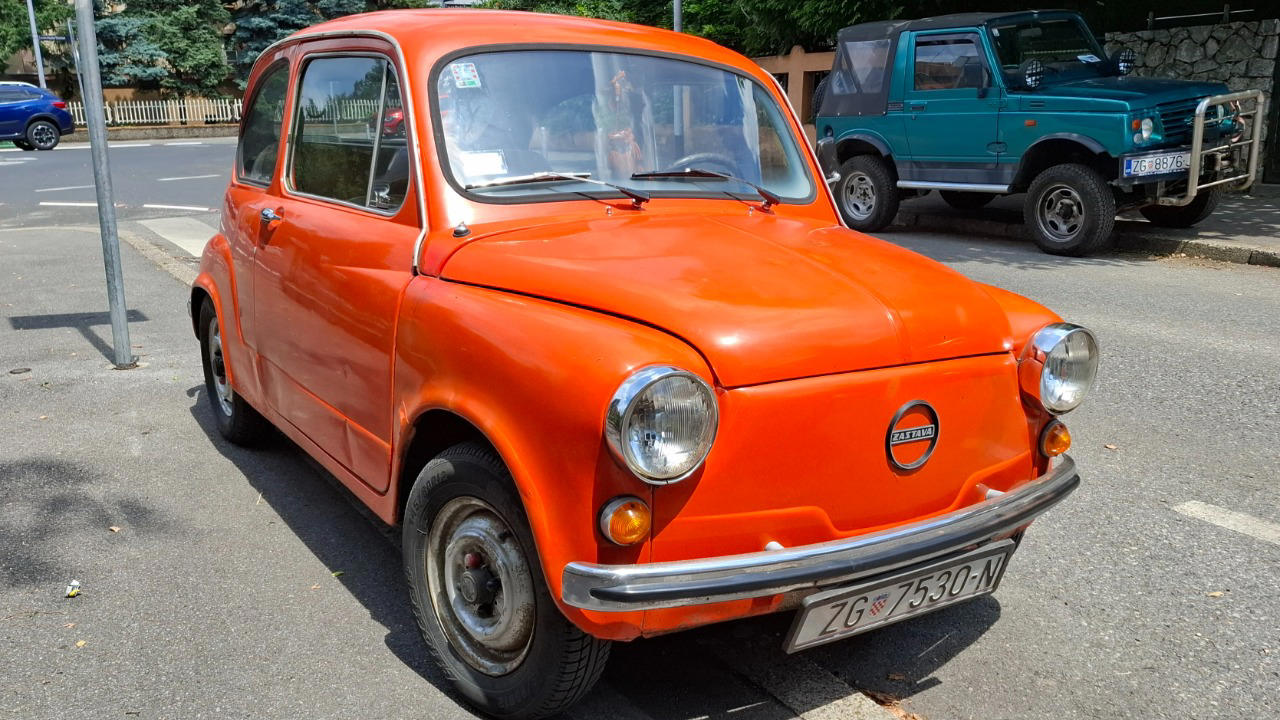




















The 1969 Zastava 750 feels familiar until you realize where it came fromThe 1969 Zastava 750 looks instantly recognizable to anyone who has ever seen a Fiat 600, with the same pert nose, rounded roofline, and rear engine stance. That familiarity is disarming until the story behind it comes into focus, a tale of licensed production that evolved into a Yugoslav icon with its own engineering, political meaning, and cultural weight. By the time this small car began to diverge from its Italian template, it had become a symbol of mobility for a socialist society and a reminder that automotive history did not run only through Turin or Detroit. From Turin blueprint to Kragujevac identity On paper, the Zastava 750 began life as a straightforward copy. The Zastava factory in Kragujevac built the car under license from Fiat, mirroring the compact proportions and rear mounted engine of the Fiat 600. Period test drives still describe a Zasta 750 as “obviously this is a Fiat 600” before quickly adding that it feels slightly different in character once on the move, a distinction captured in a short video that puts the car through its paces on British roads. The licensing deal did more than fill Yugoslav streets with Italian shapes; it anchored an industrial strategy. Fiat Licensed Models built by Zastava Automobili in Kragujevac, in what was then Yugoslavia and is now Serbia, were meant to give a domestic manufacturer a modern platform and a pathway to export markets. According to technical histories of Fiat Licensed Models, the agreement allowed production of the basic 600 design to continue in Kragujevac significantly longer than in Italy, which kept the car central to Yugoslav roads long after its Italian relatives had been replaced. The Zastava story itself stretched back to a different era. After World War II, the plant that would build the 750 was renamed Zavodi Crvena Zastava, translated as Red Flag Factories, a title that captured both its industrial ambitions and its political setting. Company histories of Zavodi Crvena Zastava describe how the factory moved from military hardware into licensed passenger cars, turning imported designs into local products that could be sold across the federation. 1969: the year the copy started to change The year 1969 marked a turning point. Fiat ceased production of the 600 model in Italy that year, which is when the Zastava 750 began to diverge more noticeably from its Italian ancestor. One detailed account of the car’s evolution notes that in 1969, Fiat stopped building the 600, while Zastava in Kragujevac actually kept the basic shape alive and used the opportunity to introduce its own mechanical changes. The most visible shift came under the rear lid. The Zastava 750 carried a slightly larger engine than the original 600, which gave the tiny car a bit more usable power for Yugoslav highways and mountain roads. Technical descriptions of The Zastava 750, written in Serbo and Croatian Cyrillic, describe it as a supermini made by the Yugoslav car maker Zavod Crvena Zastava in Kragu, with the 750 engine having a larger capacity than the earlier 600 unit. That lineage is captured in summaries of The Zastava 750, which emphasize that the car was no longer just a direct clone but a locally adapted variant. Performance figures remained modest yet meaningful for the time. Contemporary descriptions of the late 1960s Zastava 750 mention a top speed in the region of 120 kilometers per hour, or 78 miles per hour, which was enough to keep up with traffic on open roads. One detailed retrospective on the model explains that the 750 could reach that 120 kilometer per hour figure, a small but important step up from the 600 m car that had inspired it, and that this change arrived just as Fiat ended its. The divergence continued into the early 1970s. In 1970, Zastava rolled out the 750M, fitted with a new 795cm3 engine and a thermostat controlled closed cooling system. Company heritage material on Zastava development describes how this version modernized the drivetrain and relied on a domestic supplier, Rakovica’s Industrija Motora Maj, for engines. By then, the car’s mechanical heart was firmly Yugoslav. A people’s car for a Yugoslav middle class While the Zastava 750 started as a licensed Fiat, it became something different in the streets of Belgrade, Zagreb, Sarajevo, and Novi Bečej. The model established Zastava as a mass producer of small family cars and gave many urban families their first taste of private motoring. One historical overview of the company notes that Zastava’s annual production climbed to 13,719 units in 1960, a figure that signaled how quickly the plant was scaling up to meet demand for cars like the 600 and, later, the 750. That number appears in a compact history of Zastava output in the 1960s, which traces how the factory moved from a few thousand vehicles to tens of thousands per year. The 750 was more than a product of industrial planning. In the former Yugoslavia it became a cultural reference point, often affectionately called Fića or Fićo. Local histories describe it as a car that became synonymous with the Yugoslav automotive industry and left an indelible mark in the memories of generations. One detailed profile of the model explains that the Zastava 750 became a symbol of progress for Yugoslav drivers, who associated it with new jobs, holidays on the Adriatic, and a sense of catching up with Western Europe. That sentiment runs through accounts of the car as legendary Yugoslav model that defined an era. For many owners, the 750 also served as a practical tool in a centrally planned economy. It was compact enough for crowded city streets yet could carry a family of four and luggage. Spare parts were widely available through Zastava’s dealer network, and simple mechanicals made backyard repairs possible. A Facebook description of a 1983 Zastava 750, a Yugoslav built version of the Fiat 600 powered by a 767cc rear mounted inline four, captures how enthusiasts still appreciate its simplicity and how unusual it now looks on UK roads. That post, which refers to the Apr listing of a Zastava 750, underlines how the car remains a curiosity outside its home region. Travel writers who encounter surviving examples in Serbia today often remark on the same mix of nostalgia and utility. One account from Sep describes how Astute readers may be thinking “mi scusi, but isn’t that a Fiat 600” when they see a Fića parked on a Belgrade side street, before conceding that, yes, it pretty much is, yet it also carries a different social history. That writer, addressing the reader as You, admits to loving the sight of these cars around town, a feeling captured in a lighthearted piece on Zastava 750 Fića. Engineering tweaks that changed the feel Mechanically, the 1969 Zastava 750 and its successors looked conservative, yet a series of tweaks gradually shifted the driving experience away from the original Fiat 600 template. The larger 750 engine, and later the 795cm3 unit in the 750M, gave the car more flexibility on hills and with a full load. Cooling system improvements reduced overheating, a key concern in hotter parts of Yugoslavia and on long summer drives to the coast. Technical summaries in multiple languages, including entries in bs, de, es, and fr versions of Wikipedia that were Discovered through citation trails, consistently describe the Zastava 750 as a small rear engine car that retained the basic Fiat layout while adding capacity and local components. The shared terminology across these Wikipedia summaries underlines how the model is now treated as a distinct branch of the 600 family tree rather than a mere footnote. Factory documentation on Zastava’s heritage site adds more detail about the progression. It records how the 750M’s thermostat controlled closed cooling system was designed to improve warm up times and reduce wear, and how domestic suppliers were integrated into the engine program. The same heritage material, mirrored in a second entry on Zastava heritage, describes the model as a bridge between earlier licensed Fiats and later, more independent designs. Driving impressions from enthusiasts today often emphasize the car’s light steering, soft suspension, and willingness to rev. In the Brightwells sale video of a Zasta 750, the presenter notes how the car feels slightly more eager than an early Fiat 600, a difference that likely reflects the incremental power increase and local tuning. That sense of familiarity with a twist is central to the car’s appeal for collectors who grew up far from Yugoslav roads yet recognize the silhouette instantly. From domestic staple to export curiosity Although the Zastava 750 was primarily a car for the domestic and regional market, it did reach foreign buyers. English language descriptions of the model often frame it as a Yugoslav built version of the Fiat 600 that occasionally surfaced in Western Europe through gray imports or small official channels. A handful of survivors in the United Kingdom, such as the 1983 example highlighted on Facebook, now attract attention at classic car shows precisely because they look familiar yet carry Zastava badges instead of Fiat roundels. Inside Yugoslavia, the car’s ubiquity gave it a social role that outlasted its production. Local histories from Novi Bečej describe how the Zastava 750 became a legend of Yugoslav roads and remains a powerful memory for those who learned to drive in one. A detailed narrative on the model’s legacy explains that the Zastava 750 remains a symbol of an era, with many people recalling family trips, driving schools, and even police fleets built around the little rear engine car. That sentiment is expressed clearly in a profile of the Zastava 750 legacy, which argues that the car still holds a place in the hearts of many. As the global car industry shifted, Zastava’s priorities changed as well. English language histories of The Zastava 750 explain that the model was eventually phased out as the company turned to newer, more profitable Japanese cars through partnership deals. One concise summary notes that The Zastava 750 was also gradually replaced as Zastava sought to build more modern vehicles, a shift that is documented in an overview of model’s final years. By that stage, the 750 had already done its work. It had carried workers to factories, students to universities, and families to seaside holidays. It had given Zastava a production base and a reputation as a maker of reliable small cars. It had also embedded itself in popular culture, appearing in films, television, and personal photo albums across the federation. A familiar shape with an unexpected story Seen in isolation, a 1969 Zastava 750 parked on a side street looks like any other small European city car of its era. The rounded body, rear engine layout, and minimalist interior are all straight out of the Fiat 600 playbook. Yet the car’s journey from Turin blueprint to Kragujevac production line, and then into the daily lives of Yugoslav citizens, gives it a distinct identity. More from Fast Lane Only Unboxing the WWII Jeep in a Crate 15 rare Chevys collectors are quietly buying 10 underrated V8s still worth hunting down Police notice this before you even roll window down