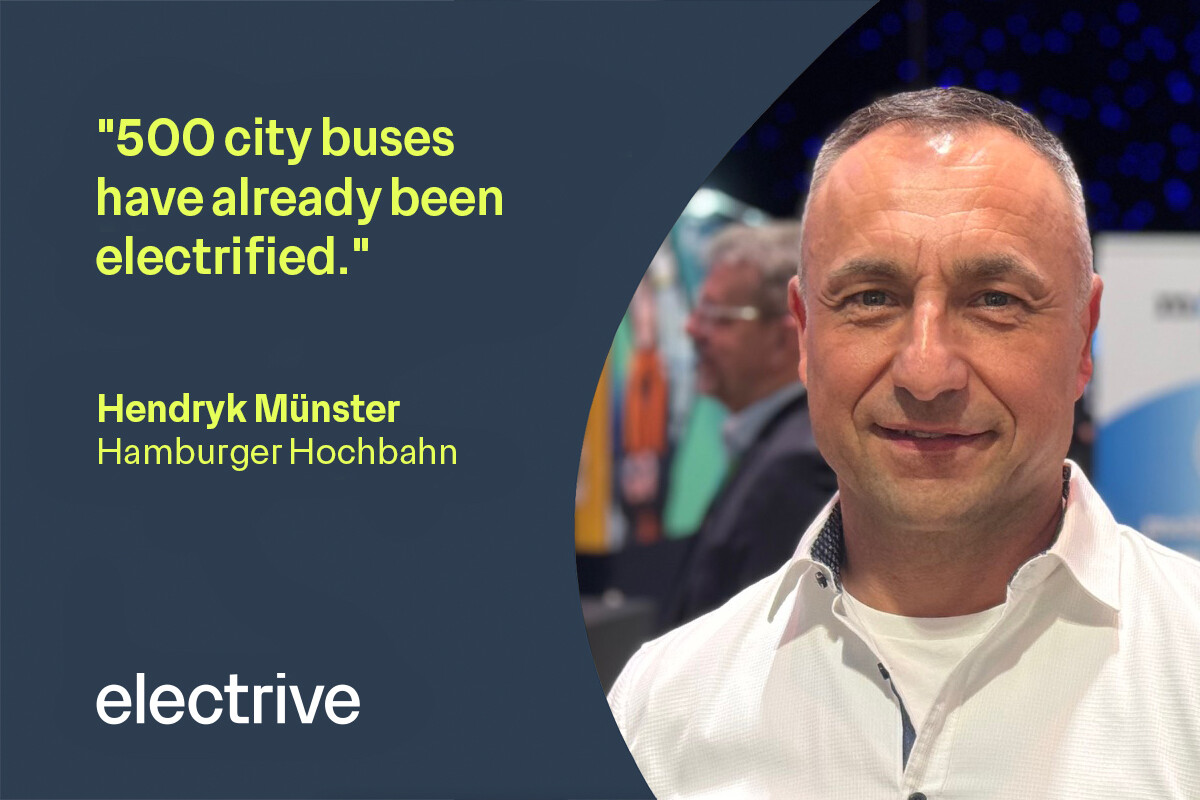
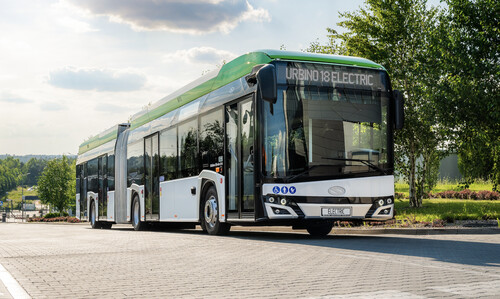
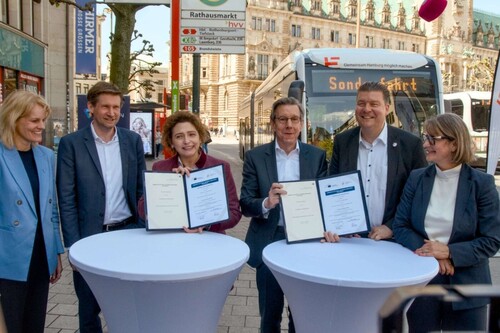
Hamburger Hochbahn has emerged as one of Europe’s leading examples of large-scale bus electrification. With around 500 battery-electric buses already in operation out of a fleet of 1,200 vehicles, the company has moved well beyond pilot projects and into industrial-scale deployment. At the same time, the operator is expanding its depot infrastructure, with more than 750 electrified parking bays expected by the end of 2026.In this interview, Hendryk Münster, who has been responsible for the programme for around a decade, outlines how the transition was implemented in close coordination with local grid operators. He also highlights the growing role of energy management as a core competence for transport companies.A key focus is the integration of stationary battery storage, initially tested within the KoLa research project and now part of daily operations. Beyond stabilising depot operations, the system enables participation in energy markets and optimisation of procurement strategies. Münster explains why such systems are becoming increasingly relevant for operators and how falling storage costs could accelerate adoption.Looking ahead, he expects depots to become more deeply integrated into urban energy systems, with efficiency, transparency and economic optimisation shaping the next phase of electrification.The interview is available as a video in German. You can activate subtitles on YouTube, or read the full transcript below for convenience.Hamburger Hochbahn is widely seen as a benchmark for electrifying city bus fleets. All the more reason I’m pleased to speak with Hendryk Münster, who heads the relevant department and has been driving the rollout of electric buses for around ten years. How do you look back on this period?Certainly an exciting time. We experienced a lot, celebrated many successes and also implemented a very stable system.How big is the fleet at present, and what kind of charging infrastructure have you built for it?At present, we operate around 1,200 city buses at Hamburger Hochbahn, of which just under 500 are electrified, and by the end of 2026, the charging infrastructure will supply more than 750 parking bays.That is quite an achievement. Given all the challenges associated with an urban power grid, how did you manage that?We have maintained a long-standing, collaborative partnership with Hamburg’s energy networks. We are constantly in dialogue with our colleagues, and so far we have found solutions for virtually everything.You are also testing a stationary battery storage system at a depot. What is the thinking behind this – and what benefits do you expect from it?The battery storage system was initially introduced as part of the KoLa (coordination function and load management) research project to simulate a bidirectional depot. At Hamburger Hochbahn, it has since become an integral part of operations. The company now also markets the storage system and uses it to optimise its energy procurement.Would you recommend that every bus operator who electrifies install such a battery storage system at their depot?If you ask me, I would say that, given the current state of the art, it is essential to engage with the topic and definitely factor it in. Ultimately, it is also a question of investment, and the financiers must be convinced that it is a sound investment. From our perspective, we can say that we can operate this battery storage system in a way that pays off and has a clearly positive effect on running such an electric network.But does that not also increase the complexity of a bus operator’s work, whose main job is, put simply, to transport people from A to B?Ultimately, conventional vehicle technology was much simpler than electric buses, but we have mastered both. And we are very good at operating networks, especially electrical networks. This is a new component, and it integrates very well.What is your vision when you look further into the future? In Hamburg, the electrification of city buses is now essentially a done deal. What else could be considered? You are already participating in the energy market with the storage system – what could come next?In the future, the depot will definitely be more integrated into the overall urban energy network, and I believe it will be significantly optimised. Efficiencies will increase, charging technology will become more efficient, energy transmission will become more efficient and more transparent. Energy management will play a major role, as will economic optimisation.We keep hearing that the power grid is full and everyone wants access to it. We have already discussed battery storage, electric trucks are coming, and heat pumps for heating are on the rise. What advice would you give to bus operators who are just starting to electrify?At this point, I would say: talk to your energy supplier, find solutions together, address your issues, bring them along on the journey and be bold.That is a very important message. We have already discussed the vision; bidirectional charging could also become a topic for buses. You use an external storage system to simulate this. Would you also do it with your buses, or do you say: no, they should be on the road?Our core task is to transport passengers from A to B, whether on the road or on the rails. That is why these vehicles are optimised as much as possible for operation on routes. It means they have very optimised deployment times and rotations and are therefore not primarily available for bidirectional charging. A battery storage system, on the other hand, is available 24/7 and therefore offers significantly greater potential in terms of both energy intake and output. At the same time, battery storage prices are falling sharply, which means that considerations around building stationary storage systems will become increasingly relevant and move further into focus.Thank you, Hendryk Münster, from the beautiful Hanseatic city of Hamburg. Thank you for the insights.