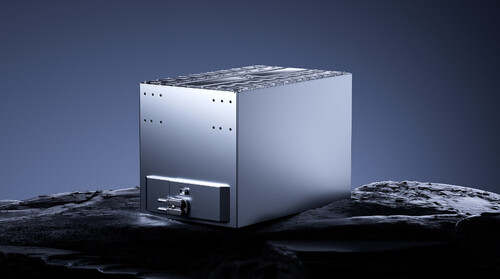
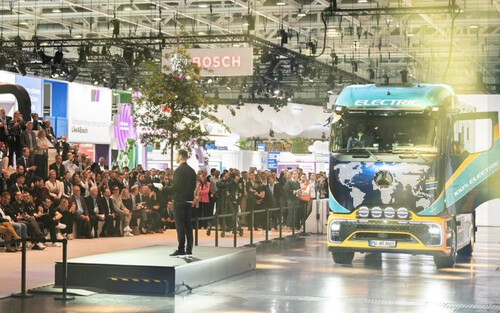
The mood around electric buses at the Mobility Move in Berlin was clearly optimistic. Markus Fischer, Head of Sales for public authorities and public transport operators in Germany at Daimler Buses, struck a confident tone: “Daimler Buses was once again market leader in Germany in 2025 with the eCitaro. We want to defend that position in 2026.” In the video interview with electrive, he explains how the company plans to achieve this.At the centre of the technological development is the new NMC4 battery generation. By switching from cylindrical to prismatic cells, Daimler Buses has improved packaging efficiency and increased energy density by 13 per cent compared to the previous version. At the same time, the updated cell chemistry enables charging capacities of up to 300 kW for opportunity charging without negatively affecting battery life. Fischer underlines the operational relevance: “We need to reach 300 kilometres of range. That allows us to cover 90 to 95 per cent of duty cycles required in public transport.”The company also focuses on practical integration into existing fleets and infrastructure. According to Fischer, the new batteries are compatible with earlier eCitaro generations. In parallel, Daimler Buses supports operators in building charging infrastructure through its Omniplus Charge and Daimler Buses Solutions services, covering planning, implementation and operation.Looking ahead, Fischer sets a clear target for the transition: In May 2029, the diesel city bus will be phased out, and public transport will then be fully electric.”The interview is available as a video in German. You can activate subtitles on YouTube, or read the full transcript below for convenience.We are at Mobility Move in Berlin, and I’m now joined by Markus Fischer, who heads sales at Daimler Buses for public authorities and, of course, local public transport operators in Germany. We’re hearing a sense of momentum here – the electric city bus is developing well, and registration figures also rose significantly last year. But what do you expect from this year?I’m very optimistic. Order books are very, very full. Funding is flowing again – that certainly helps as well? Absolutely, yes. We allocated that a week last Monday, and it will certainly give us another push.And with the eCitaro, Daimler Buses will once again be market leader in Germany in 2025. You’ll certainly want to defend that position in 2026 as well?We will defend it, yes.A clear statement! You have something new, namely a new battery generation for the eCitaro. But before we go into detail, what actually makes a good traction battery in a city bus?First, it’s capacity. We need to achieve 300 kilometres. That allows us to cover 90 to 95 per cent of the duty cycles, the routes that public transport operators require. We achieve that with the new generation.The second point, which is certainly also important, is energy density. Combined with low weight, this allows us to carry a large number of passengers in the vehicle.The third point is charging performance. We need to be careful here. We already have a very gentle process at up to 150 kilowatts, but with the new technology we are now going up to 300 kW with opportunity charging. That will help us without compromising battery life.And the fourth point is service life itself. It should last the lifetime of the vehicle – that’s at least ten years, and we achieve that as well.An electric bus has to perform in the north and in the south alike, in other words in warm temperatures and in cold temperatures. That’s quite a challenge for the battery, and all four points always have to be ensured.Yes, performance depends on thermal management. Ideally, the battery’s operating temperature must be kept at 20 degrees. A great deal of time has been invested in developing this technology in recent months, and that was also the focus of the analysis.Of course, we test all components and the vehicle with thermal management and battery systems extensively before bringing the vehicle into series production. We have done that. We were at the North Pole in winter and tested under those climatic conditions.And we were also in southern Spain in summer, where it was extremely hot. There, too, the climatic conditions were set so that the vehicle runs optimally.What does this step change mean? Your battery is called NMC4. It is the fourth generation in practical use for transport operators. So which parameters improve, and by how much?We have changed two things in the technology: cell chemistry and cell geometry. We have moved from cylindrical cells to prismatic ones. This allows us to use the installation space in the battery much more efficiently and achieve an energy density that is 13 per cent higher than in the previous version. The second point is cell chemistry. We designed it to make the cell and the battery more resistant to high charging currents so that we can charge at 300 kW. We have achieved that as well, without negatively impacting battery life.And when you say 300 kW, for transport operators that ultimately also means they need to scale up their charging infrastructure. Is that a bit of a trend, as we see in passenger cars as well – larger batteries, higher charging power?Yes, but I think that at 300 kW we have reached a point where it is sufficient. As I mentioned earlier, the battery now delivers a level of performance that allows us to cover 90 to 95 per cent of duty cycles. That means we will not necessarily need more capacity.We are now at a point where we can offer a solution that allows the vehicle to operate without recharging in many cases. Of course, development continues. We will see what comes next.But I think we have already reached a very good level that supports practical use.Can this new battery also be installed in an older eCitaro if maintenance is required?Yes, it can. We have four different generations. We have already replaced the first generation with NMC4 and tested that. It will also be possible to replace NMC2 and NMC3 with NMC4.Interesting. Perhaps one more question about your day-to-day sales work. Buying buses is no longer really the issue in 2026. The much bigger challenge for transport operators is building charging infrastructure in their depots, and in some cases new depots have to be built. What are you hearing from the market? What are the biggest pain points, and how can you help?We offer a service brand called Omniplus Charge. Our service colleagues support and advise public transport operators on what they need and how to implement the ecosystem. We also have DBS, our Daimler Buses Solutions. These are highly qualified experts who support service partners and operators with construction planning, analysis, implementation and through to service.That is what we offer under Daimler Buses Solutions. Customers and public transport operators can work very closely with us, and we support them throughout the entire lifecycle.And looking ahead, I mentioned earlier that electric city buses now account for around 50 per cent of the market in Germany. When will you sell only electric city buses? What is your forecast?We will switch city buses in May 2029. That is when the last diesel bus will be phased out, and public transport will then be fully electricMr Fischer, thank you very much for the interview and all the best.