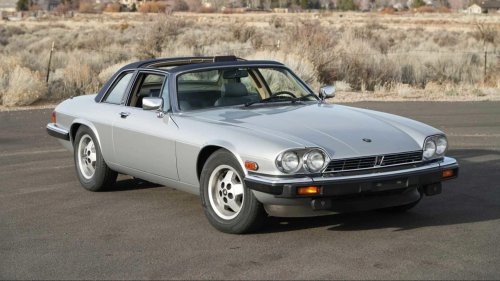
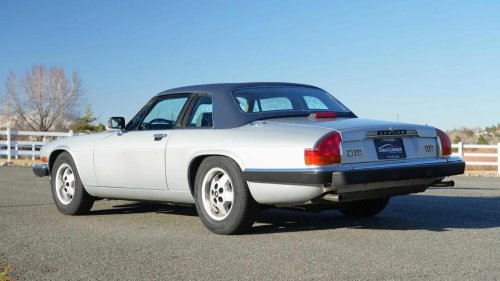
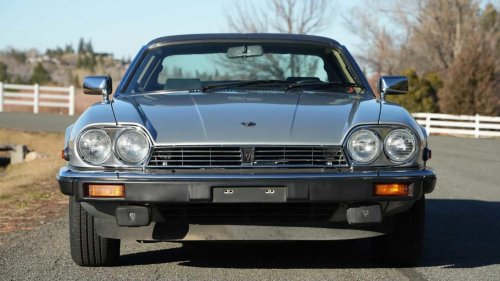
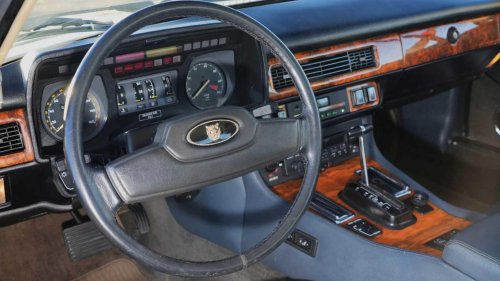
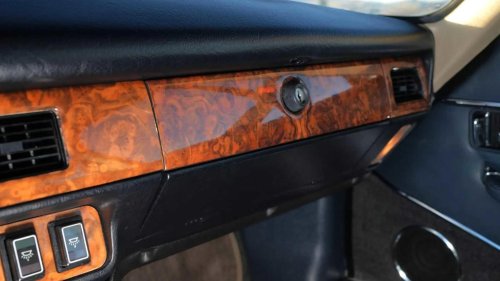
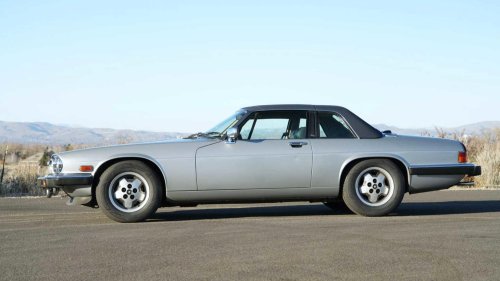
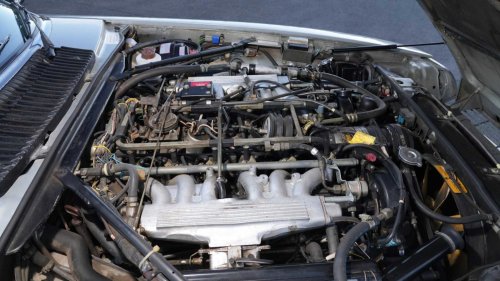
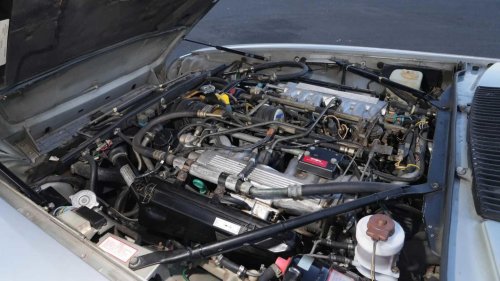
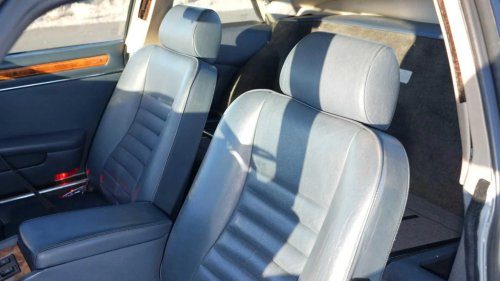
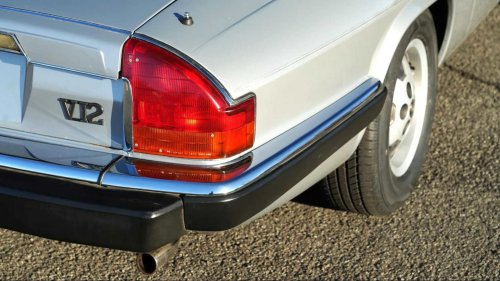
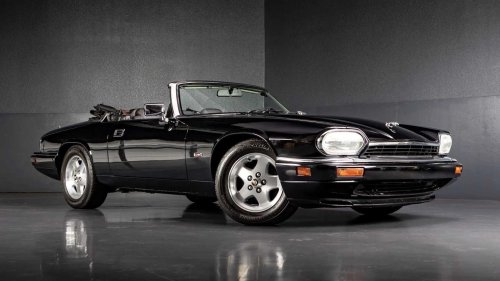
















Virtually every gearhead around has some sort of strong opinion about Jaguar. Some folks love them, some not so much. The fact of the matter is, the famous English marque has a long and storied past that saw loads of innovation, production issues, and a great heaping pile of British pride. Most people who aren't fans of the brand cite awful reliability issues, many of which came to light during the 1970s and 1980s, when the brand was owned by British Leyland.However, reliability issues aside, you'd be hard-pressed to find someone who doesn't think Jags are pretty cars. Take our model of interest in today's write-up: the Jaguar XJ-SC. It's a long-forgotten version of the famous XJS, a model that's known for both its blend of light-fisted luxury and sportiness, along with its tendency to not work properly sometimes. The XJ-SC, in particular, was a rare targa-roofed cabriolet. In other words, it was an almost-convertible. It was produced for just a few years, and only about 5,000 were made in total. Half A Roof With A Whole V12 Bring A Trailer The Jaguar XJ-SC was first introduced in 1982 for the 1983 model year. At the time, Jaguar was interested in broadening the XJS's horizon, as there were no open-topped iterations built up until this time, and many other sporty and/or luxury convertibles were relatively popular. Not to mention, the XJS was also beginning to see a decline in sales, something Jaguar's top brass chalked up to folks not considering the XJS as a worthy successor to the iconic E-Type, which offered both a coupe and convertible body style.Bring A Trailer The change was spearheaded by a man called John Egan, Jag's then-CEO. His idea behind creating the XJ-SC was to capitalize on the aforementioned popularity of convertible grand tourers, bolster the XJS's market share, along with offering an open-topped experience that a wider audience could enjoy. However, once the XJ-SC was launched in 1983, only a single engine was on offer, and it wasn't the V12. Instead, Jag's new 3.6-liter AJ6 inline-six occupied the space under the hood. The new mill was deemed more reliable and economical than the older designs in which it replaced.Bring A Trailer The AJ6 sat as the only engine option for the XJ-SC until 1985. That year, Jaguar's 5.3-liter V12 was finally made available for use within the model. If anecdotal reports are to be believed, the 1985 Jaguar XJ-SC V12 was offered with a starting price of about $36,385. In today's money, that equates to roughly $109,600. A steep price to pay, but when you consider its competitors and their pricing, like the 1985 Mercedes-Benz 560SL's base price of about $48,600, it was actually a bargain. What The XJ-SC V12 Had To Offer Bring A TrailerBeing a Jag, the XJ-SC V12 came with loads of real Burr walnut veneer wood peppered throughout its English sitting room-esque interior. In addition, air conditioning came as standard, along with power windows, locks, and mirrors. A fully-equipped instrument cluster is also present, that features things like a slew of electronic warning lights and a tachometer. All XJ-SC V12s came equipped with seats trimmed in Connolly leather.Bring A Trailer Its roof design was a bit more complicated than the targa top seen on Corvettes or Toyota Supras of the era. Over the front seats were a pair of removable panels with a fixed bar running length-ways down the middle of the car. However, over the rear seats, a foldable soft top was present, allowing for even more open-topped enjoyment. Jag removed the backseats from the XJ-SC due to its targa-convertible hybrid roof being deemed too low for passengers. This means the XJ-SC was, strictly, a two-seater.Bring A Trailer There were a couple of XJ-SC-specific options available, as well. For starters, buyers could opt for a removable hardtop for its rear soft-top section. While the original pricing for the hardtop option isn't exactly easy to nail down, one source states that it cost approximately $3,000 extra. In addition, the XJ-SC features a slightly different rear end, wherein the usual flying buttresses seen on normal XJSs are non-existent. Under The Hood Bring A TrailerArguably, one of Jaguar's most famous engines was its V12. Introduced in 1971, the Jaguar V12 saw use in numerous models, namely the E-Type, XJ12, and the Daimler Double-Six. The version found within the XJ-SC was called the 5.3-Liter HE, or "High Efficiency." The mill swapped out its old cylinder heads for new, improved ones that featured a "swirl" construction. These new heads were designed by Michael May, a Swiss racing driver.Bring A Trailer The basic function of the swirl design was to increase the engine's efficiency via raising its compression ratio. Along with the new heads came new, flat-topped pistons. When the new pistons hit the new cylinder head during the engine's combustion stroke, air was forced around the spark plug. In doing so, something called a stratified charge is created, wherein the air-fuel mixture is richer near the spark plug, and leaner elsewhere prior to the combustion stroke. Because of this, both compression and combustion are much more efficient.Bring A Trailer Working with the 5.3-liter mill is a single, three-speed automatic transmission. However, instead of Jaguar producing its own gearbox, the company instead turned to General Motors for use of its Turbo-Hydramatic TH400. Rear-wheel drive was the sole drivetrain option, as well, with its rear brake disks being mounted inboard, close to the differential. As for suspension, the XJ-SC took advantage of the very same sort that lent the XJS heaps of praise for its ride. The setup consisted of an extremely complex rear independent suspension, along with an independent front that used two shock absorbers per side. XJ-SCs also sported anti-dive and anti-squat metrics in both its front and rear ends. The Fall Of The XJ-SC Bring A TrailerEven with the introduction of the V12 engine in 1985, the XJ-SC was struggling when it came to sales. By 1988, Jaguar had noticed that the XJ-SC was never going to be a strong seller. So, that same year, the model was axed. Reportedly, only 5,013 XJ-SC models were produced, the majority of which were built in a left-hand drive configuration. However, while it was the end of the XJ-SC, it wouldn't be the last open-topped XJS.Bring A Trailer That's because, in 1988, Jaguar introduced a fully-fledged convertible version of the XJS, despite the market seemingly rejecting such a thing. However, contrary to the XJ-SC's dismal sales performance, the convertible XJS proved to be a smash-hit. Once Ford bought Jaguar in 1989 for the tidy sum of $2.38 billion, the American marque went to work refining and improving the XJS, helping to solve numerous issues with reliability. Reportedly, Jaguar sold about 30,896 convertible XJS models between 1988 and the nameplate's axing in 1996, which equates to roughly an average of 3,862 per year. For contrast, the 5,013 total XJ-SCs sold across five years amounted to just about 1,000 per year.It seems that, despite the XJ-SC and its V12 iteration being disappointing sales failures, it did lead to the creation of one of the XJS's most popular iterations: the convertible.