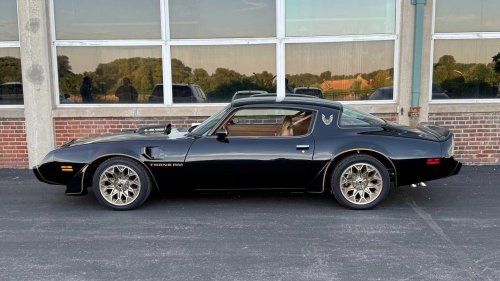





















Picture this: It's 1970, and Pontiac has just rolled out the second-generation Firebird. This sleek muscle car was designed to take on Ford's legendary Mustang, serving as GM's answer alongside the Chevrolet Camaro. But even as customers were getting their first look at this new Firebird, Pontiac's designers were already sketching the next generation.The creative team had big dreams for the future Firebird. They wanted to pack serious power under the hood and build on the car's distinctive, cat-like design that made it a natural for both street cruising and track duty. What they came up with was a bold evolution that pushed boundaries in unexpected ways.Their vision included something almost unthinkable for a pony car: a V12 engine. This powerplant would have completely changed the Firebird's DNA, taking it down a path far from its original mission. The concept was so radical that Pontiac's marketing team didn't know what to do with it. They had no choice but to label it a pure design exercise, hoping it would stay locked away in the studio where only designers could dream about what might have been. The Pontiac Firebird Took Flight With Ferrari V12 Power In 1971 Via Pinterest The idea for what would become the Pegasus concept was conceived by Chevrolet designer Jerry Palmer. It reportedly depicted a more European look for the then-new second-gen Camaro – sort of a cross between the second-gen Camaro (which was destined to become one of the best-loved Camaros ever) and the then-new Ferrari 365 GTB/4.The idea was presented to William Mitchell, the head of GM Design at the time, who loved it but not for Camaro. Pontiac took over and developed a maybe-future Firebird with the general lines of the current Firebird, and the ability to include an engine to make serious horsepower. Pontiac Pegasus 4.4-Liter V12 Specs (Source: Ferrari.com)On paper, the Ferrari's 4.4-liter V12 looked perfect for muscle car duty. It delivered impressive horsepower and torque numbers that could definitely compete. But there was a catch – this engine was built to scream. It didn't hit peak horsepower until 7,500 rpm, and peak torque came at 5,500 rpm. For muscle car fans in 1970, those numbers were way too high.Muscle cars were all about low-end grunt and instant power when you stepped on the gas. The 6.6-liter Pontiac V8 in that year's Trans Am proved this point perfectly. It churned out nearly the same horsepower as the Ferrari, but delivered it much lower in the rev range. Even better, the Pontiac engine produced 112 more pound-feet of torque, with peak power hitting at just 3,400 rpm – exactly what muscle car drivers wanted. Pontiac Vs Ferrari It may not have made as compelling a film as Ford V Ferrari, mainly because the accounts of the day are that Mitchell had the blessing of Enzo Ferrari, who supplied the engine for the new Firebird. Other accounts are that Mitchell acquired a V12 from a 365 GTB4 donor car to drop into the concept.Delivering power to the rear wheels became another challenge because the three-speed automatic Turbo 350 couldn’t handle the power output of the high-revving V12. Reportedly, that’s how Ferrari gave his blessing, by shipping over a five-speed manual to finish the connection to the Positraction rear axle (limited-slip diff).Similarly, other components were specific to the Ferrari V12 – the intake was via six Weber carburetors (the front intakes shaved down to fit under the hood), and the exhaust had to handle the output of the engine properly, so Pontiac ended up just using the system out of the Ferrari. The Pontiac Pegasus Concept Was A Ferrari-Powered Grand Tourer There were other items that slowly eroded the Firebird out of Pegasus and turned the concept more like a Ferrari vision of what a Pontiac Firebird might be, rather than the other way around. By the time it was ready to be displayed, it had the dimensions more of a grand touring coupe, rather than a pony car.Theoretically, the space needed to house the compact 4.4-liter Ferrari V12 should have been about a third smaller than what was being used for the monstrous 6.6-liter Pontiac V8 at the time. And the elongated snout seemed to be simply a display piece to show this wasn’t the same old Firebird. The Pontiac Pegasus Wasn’t All Ferrari In contrast, the wraparound rear window was a carryover from that generation of Firebird, and the front fender vents imparted a Continental sleekness not realized with the then-current bulky Firebird louvers. But the one thing that likely most signaled the separation from Pontiac, was the absence of the split grille.As it turned out, the wraparound rear window was probably the closest tie that the Pegasus concept has to the Firebird. The cabin was roughly the same size (no dimensions exist for the concept, so we’re assuming the two are identical, based on sight alone), though it might not have been as comfortable. The Pegasus' Cabin Was Too Elegant For Pontiac The expansion of the engine bay moved the firewall towards the rear of the car, which meant the Pegasus concept sacrificed its air-conditioning system. That’s not uncommon for a concept car, though, because concepts are often made to gauge public opinion or showcase new technologies. Engineers sort out the public-consumption nuances once the car is green-lit for production.The interior presentation, though, was again straight out of Maranello. Ferrari supplied the instrument display, and the steering wheel displayed a badge that conceptually melded the Firebird and Prancing Horse mascots – bird + horse = Pegasus. It wasn’t a stretch at all. The Ferrari-fied Firebird Was Doomed To Fail GM HeritageThe Pegasus Concept was doomed to fail from the start, because GM at the time probably would not have green-lit a car that seemingly stripped all the essence of Pontiac, and even America, out of a model with a bright future ahead of it.The muscle-car era was at its peak, and Americans wanted that rumble of Pontiac thunder echoing through the concrete canyons of late-night stop light drag races. There was very little chance that a whiny Ferrari V12 with thimbles for pistons would make any inroads into the power-mad culture.And even if Mitchell had temporarily shelved the project and reintroduced it a decade later, the automotive world by then was focused on smaller and simpler cars consuming less fuel, so an ostentatious Firebird would have been too far removed from the basic pony car formula.Even the deep burgundy exterior overly accented in gold was a bit too much for Pontiac. Pegasus could honestly have been a Buick. Perhaps it should have been. Ironically, it looked more Pontiac-ish after it was returned to GM. It was repainted bright red (not quite a Ferrari red!) which better showcased Pontiac sportiness and simplicity. The Pontiac Pegasus Was A One-Owner Car Link Image The Pegasus was primarily meant to separate the GM F-Body Siamese twins, by allowing the Chevrolet Camaro to hold on to the brutish rolling American thunder persona, while the Pontiac Firebird would follow a more European high-revving dynamic sportiness.Pegasus became Mitchell’s personal car, which he reportedly drove sporadically, even after he retired from GM. It was then returned to the company and placed in the GM Heritage Center to sit with other concepts, some of which also bear little resemblance to their respective street cars, such as the original GM Firebird concepts.