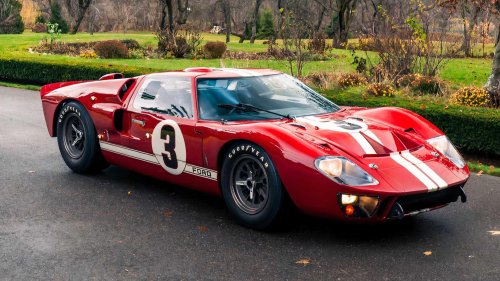
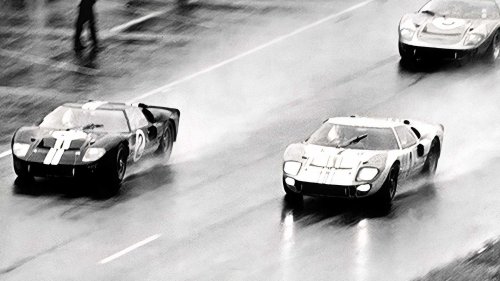
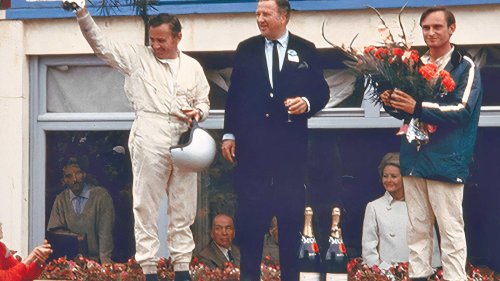
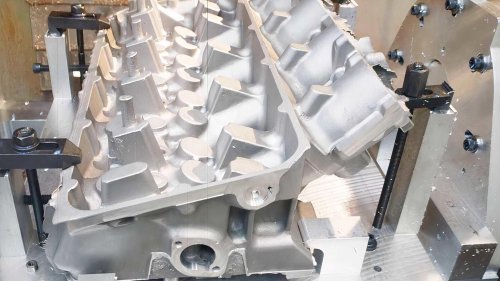
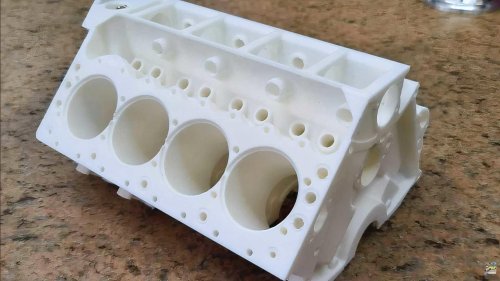
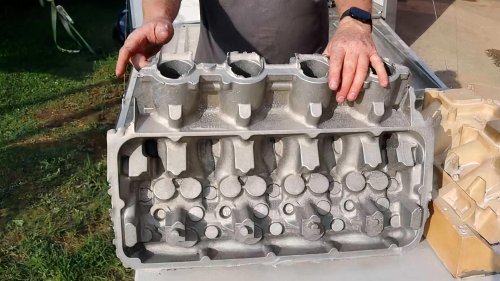
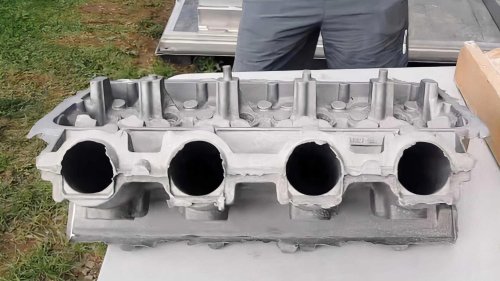
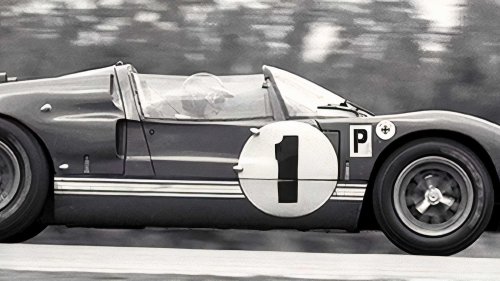
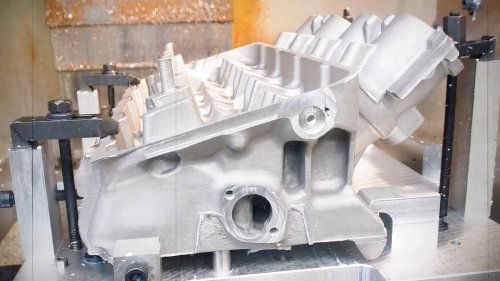
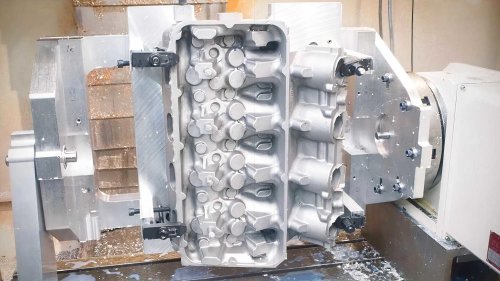
By the late 1960s, Ford was one of the dominant forces in racing. This was the peak of the Blue Oval's "Total Performance" era, when the brand focused on winning at the highest levels of motorsport to attract the emerging baby boomer market. However, while the legendary 427 FE had propelled Ford to victory at the highest levels of motorsports at the time, the view at the top was terrifying, as the engine was reaching its limits. As such, Henry Ford II gathered a small team of skunkworks engineers, gave them a blank check, and asked them to create something even better than the 427 FE.What came out of Dearborn was a wild, experimental, all-aluminum monster that featured a valvetrain so complex and an intake setup so bizarre it earned a nickname inspired by a musical instrument. This engine represented the absolute limit of Ford's engineering ambition and promised to redefine endurance racing, but a sudden stroke of a pen rendered it obsolete before its first green flag. Ford's Total Performance Era Was An All-Out War MecumIn the early '60s, Pontiac quietly went against the 1957 AMA anti-racing agreement and built the legendary 421 Super Duty V8 that powered some of the most dominant race cars of the era, and it was quickly rewarded with boosted street cred and improved sales. Angered by GM's defiance of the agreement, Henry Ford II pulled out of the anti-racing pact in 1962 and launched the "Total Performance" era, a massive global campaign designed to overhaul the company's image from a maker of safe, sensible cars to an utter force in high-speed racing and performance.The goal was to prove Ford's engineering through dominance in every major arena, including NASCAR, NHRA drag racing, the Indianapolis 500, and international road racing. Ford also wanted the performance parts from the race cars to trickle down to road cars, and those would be marketed as having the same DNA as the winners on the track. The Total Performance era was a massive success, with Ford not only scoring major victories in the domestic racing scene but also in iconic international competitions against Ferrari. Ford's War Against Ferrari Changed Everything FordIn 1963, just after launching the Total Performance marketing campaign, Ford attempted to buy Ferrari in a move that started as a strategic business acquisition, reportedly spending millions in the auditing process. The story goes that just as the deal was in the final stages, Enzo Ferrari backed out after noticing a clause that would give Ford control of Scuderia Ferrari (Maranello's racing division). Ferrari reportedly "exploded" and went as far as insulting Henry Ford II personally and calling Ford cars ugly.Furious at the costly rejection and the personal attacks, Henry Ford II returned to Dearborn and ordered his team to build a car that would crush Ferrari at Le Mans, resulting in the fabled GT40. It paired a European mid-engined sports car body with a Carroll-Shelby-tuned Ford FE "side-oiler" V8, creating a monster that humiliated Ferrari at the 1966 24 Hours of Le Mans with a historic 1-2-3 victory. Ford Won, But It Wasn't EnoughFordBefore the Total Performance era, Ford was basically playing catch-up to GM in the domestic racing scene and the likes of Ferrari on the global stage. The 427 FE completely transformed Ford's position in motorsports. After the GT40's victory in 1966, Ford was considered the top dog, having achieved what many thought impossible by winning in nearly every major motorsport.The 427 FE offered the power Ford needed to win, and in "side oiler" form, it added the durability needed for endurance racing. However, as great as the 427 FE was, Ford engineers saw it as reaching its ceiling in the late '60s and feared Ferrari and others catching up, which sparked the internal push for a next-generation clean-sheet successor. Behind The Scenes, Ford Was Building Something Wild YouTube/Jay BrownWhile the marketing department was busy polishing Le Mans trophies after the 1966 season, Ford granted a small skunkworks team total technical freedom to build a successor that didn't share a single bolt with the FE or the upcoming 385-series. The mandate was ruthless: more power, bulletproof reliability, and tighter packaging than anything on the grid.What emerged from the lab was an experimental monster that ignored every traditional American V8 design cue. This wasn't just another V8. It was an exotic, high-revving freak of nature that was borderline illegal by the standards of the day and was designed to make Ferrari's best look like a high school science project. Meet the 427 "Calliope" V8. Ford 427 "Calliope" V8: The Experimental Racing Engine That Time Left BehindFinally, the secret broke: the 427 Calliope V8. This rev-happy, all-aluminum, 427-cubic-inch titan was a largely clean-sheet masterpiece that shared minimal DNA with the FE or the 385-series and was designed for sustained, high-RPM domination at Le Mans. It was Ford's attempt to out-Ferrari Ferrari with pure American engineering.The name wasn't a marketing gimmick; the Calliope (pronounced Call-eye-o-pee) earned its nickname from the fuel injector stacks above each cylinder, which looked more like the whistles on a musical calliope than a racing heart. Beneath the "pipes," it featured a proprietary bore and stroke configuration that was optimized for high-velocity airflow and reduced piston speeds compared to the standard 427.Fun Fact: The name “Calliope” was never an official Ford designation. It emerged informally from engineers and journalists who thought the engine’s intake and exhaust setup resembled a steam organ. Advanced Engineering Decades Ahead Of Its Time YouTube/REVanThe Calliope was a no-compromise endurance weapon. For starters, Ford engineers ditched the heavy iron of the 427 FE for an all-aluminum alloy block, trimming the engine to a relatively lightweight 577 pounds. The design featured a radical over-square 4.34-inch bore and 3.60-inch stroke, optimized for the high-velocity airflow required to maintain a massive power band.The Calliope's main party piece, however, was the twin-camshaft setup hidden in the block, which Ford engineers came up with to solve the valvetrain flex that plagued traditional big-blocks. By stacking two separate camshafts vertically within the block, Ford achieved nearly horizontal exhaust pushrods, opening up massive, straight ports for unparalleled breathing. This also gave the engine its signature "pipe organ" look. The Calliope was a technical flex decades ahead of its time, combining a dry-sump oiling system and twin cams to ensure that it would dominate even at 200 mph on the Mulsanne Straight. The Calliope V8 Was Ready To Dominate, But The Opportunity Disappeared YouTube/REVanEarly dyno testing reportedly showed the Calliope's exotic three-valve configuration generated about 630 horsepower at 6,300 rpm, with Ford engineers eyeing a screaming 8,000 rpm redline to humiliate Ferrari's high-strung V12s. Paired with its featherweight construction and durability, this outrageous racing mill was ready to flex its muscles on the biggest stage. Unfortunately, while Ford engineers had built the perfect endurance engine, they built it for a world that was about to vanish.About a decade after the 1955 Le Mans disaster, speeds had skyrocketed with GT40s flying past the 210-mph mark, and the FIA was feeling the heat to slow things down before the body count rose again. The Rule Change That Killed It Overnight YouTube/REVanJust as Ford was ready to unleash its new 7.0-liter weapon, the FIA introduced a mandate that capped prototype displacement at a meager 3.0 liters, citing safety concerns over the sheer physics of big-block prototypes. The 1968 rule change didn't just tweak the specs; it decapitated the big-block era and effectively neutered the American heavy-hitters, rendering Ford's massive investment in the Calliope obsolete.For Ford, the timing was catastrophic. Their entire endurance strategy had been banked on 427-cubic-inch supremacy, and this stroke of a pen essentially regulated the most advanced V8 in Dearborn's history into extinction before it could even draw a breath in competition.Fun Fact: Even after this engine was sidelined, Ford’s dominance at the 24 Hours of Le Mans continued in 1968 and 1969 with the Gulf-liveried GT40 Mk I cars. The Can-Am Gamble That Failed To Deliver FordAfter spending a fortune on the development of the Calliope, Ford executives couldn't just sit and let a multi-million dollar project rot in a warehouse. They pivoted to the brutal, unrestricted world of Can-Am, dropping the Calliope into a radical, wedge-shaped evolution of the GT40 known as the G7A.The Calliope and G7A looked like a match made in heaven on paper, but the transition was a disaster. With only three engines ever built and minimal real-world testing, the project was buried by constant reliability gremlins. Plagued by oiling and cooling issues in the high-heat environment of American road racing, the all-aluminum monster struggled to deliver on its 800-hp potential against simpler, more reliable big-blocks. Ford quietly shelved the program, leaving the Calliope to vanish into the archives. Why The Calliope Still Matters Today YouTube/Jay BrownWhile the Calliope never got the chance to prove its mettle on the racetrack, it was far from a failure. The sophisticated racing mill solved problems the rest of the industry wouldn't face for decades and showed that Ford was willing to risk everything on a radical idea. In fact, many consider it to be the blueprint that paved the way for some of the high-tech V8s we take for granted today.By moving away from "displacement is king" and toward specialized combustion chamber design, the Calliope served as the spiritual ancestor to the high-revving, airflow-focused engines that define modern performance.Fun Fact: The engine’s dry-deck cooling system, which routed water externally rather than through the block-to-head interface, was far closer to modern race engine practice than typical 1960s designs. The Modern Effort To Bring It Back YouTube/Jay BrownThe FIA may have put the kibosh on the Calliope before competing, but its story didn't end in a junkyard. For decades, the Calliope was a ghost in the Ford archives, but a modern coalition of horsepower junkies led by manufacturing entrepreneur Dan Schoneck is finally waking the beast after getting permission to examine and photograph the only known surviving engine at the Henry Ford Museum.By recovering original blueprints and scanning the lone survivor, the team is using CAD and 3D modeling to reproduce the engine from scratch. Modern casting techniques and precision CNC machining can now fix the flaws that originally crippled the project, and if they're successful, the Calliope might finally get the competition-grade life it was denied fifty years ago.Sources: Hot Rod, Mac's Motor City Garage, Henry Ford Museum



















 +59 others