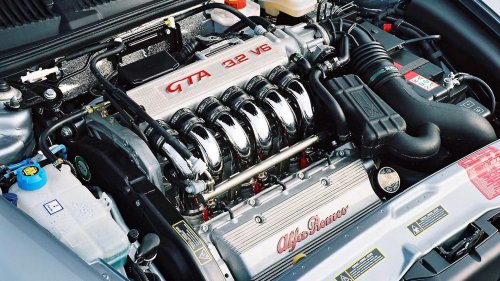
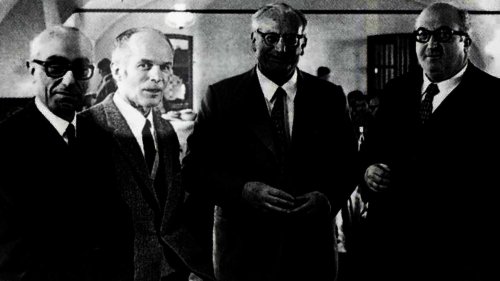
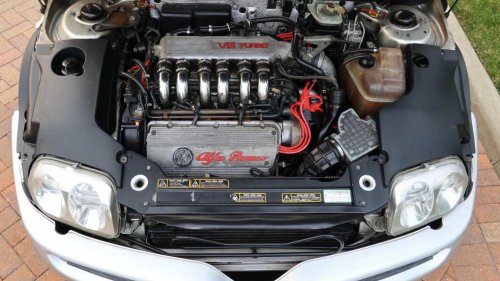
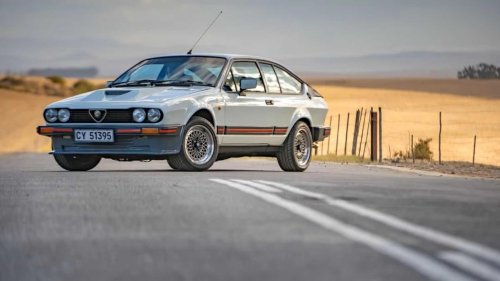
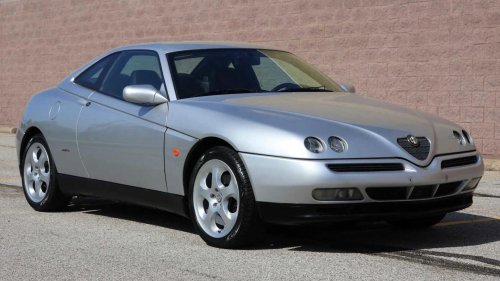
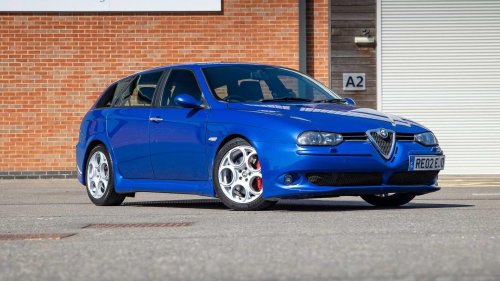
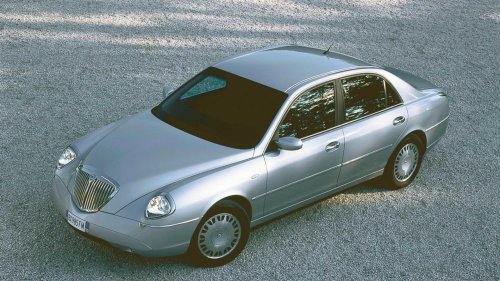
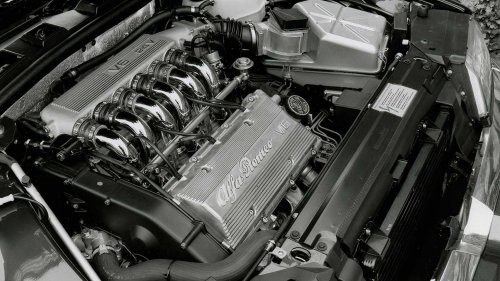



















Jump LinksA Few Facts About The Alfa Romeo Busso V6Famous After The Fact1980s1990s–2000sFor as long as the automobile has been around, it has needed some sort of engine or motor to power it. Much like the vehicles they inhabit, some of these engines throughout the years have been as famous — and even more famous, in some cases — than some of the actual models using them. Take the original Chevrolet small-block V8, for example. Virtually everyone knows of the famous mill, but some models that have used it in the past are quite obscure by comparison.One of the most glaring examples of this unequal engine-to-model popularity ratio, especially in the US, was the Alfa Romeo Busso V6. Here in the States, it's an extremely rare sight, as just a couple of Alfa models sold new in the US actually offered the Busso as an option. However, over in Europe, the Busso V6 is much more popular, not to mention iconic. Of course, being an Alfa Romeo engine, it wasn't very reliable by any stretch. It was, though, one of the best-sounding engines ever produced, and packed quite a punch when outfitted properly. Alfa's Most Famous V6 Is Born Alfa Romeo A Few Facts About The Alfa Romeo Busso V6 Introduced in 1979 Originally offered as a 2.5-liter Widely considered to be the best-sounding V6 ever made Saw a wide range of applications, including racing Axed following the 2005 model year Born in 1913, Giuseppe Busso started his career in mechanical engineering following his 1937 graduation from the Polytechnic University of Turin in Turin, Italy. Two years later, Busso landed a job with Alfa Romeo, just as World War II broke out in Europe. However, even with the war on, Busso was hard at work rising through the ranks at Alfa Romeo. Under the tutelage of engineer Orazio Satta Puliga, Busso learned the ins and outs of engine design. His specific assignment was to help develop racing engines.Wikimedia Commons: Tubolare Zagato Following a brief tenure at Ferrari, lasting from 1946 to 1948, he returned to Alfa in 1948 and continued to work there until 1977. One of his final projects was designing the Busso engine, which was instrumental in cementing his iconic status within Alfa Romeo, and throughout the motoring world. Despite the completion of the engine in 1977, the Busso V6 wouldn't be featured in a vehicle until 1979, when it was installed within the Alfa 6. Famous After The Fact Bring A TrailerWith Giuseppe Busso effectively retired, the Busso V6 engine finally got off the ground. Along with its first assignment being the Alfa 6, it was also featured within the Alfa Romeo GTV6 for the first time in 1980, boasting a power output of 156 horsepower. It was thanks to the GTV6 that the engine began to gain some notoriety. Because the GTV6 was marketed as a sporty coupe, the engine's penchant for performance, as well as its sonorous exhaust note, enthusiasts began to take notice. The Busso V6's Intense Popularity Cars.co.za 1980s Once the Busso V6's sporting prowess was widely known, nearly the entire motoring world began pining for one of their own. The Alfa Romeo GTV6 began appearing in numerous racing series', including the European Touring Car Championship. Beginning in the early 1980s, various tuning companies began to revamp Busso V6s and tune them to their exact specifications, as the motor's bones were considered fantastic for this endeavor. A 2.0-liter entry-level version of the Busso V6 was introduced in 1983, but was only produced for four years.The first company to produce a tuned, mass-market version of the mill was a German Alfa Romeo dealer and tuner called Gleich. They took the powerplant, bored it over to 2.8 liters, added in some lightweight pistons and other go-faster bits, and installed it within the 1982 Alfa Romeo Alfetta GTV6 2.8 Gleich. It produced 188 horsepower and was, reportedly, a well-done upgrade, both in its sound and performance. Another tuner based in South Africa called Autodelta produced a 3.0-liter version of the original 2.5 Busso V6 to be used in the 1984 and 1985 Alfa Romeo Alfetta GTV6 3.0 SA producing 174 horsepower.Busso variations introduced between 1980 and 1989: 2.0L 2.5L 2.8L (Gleich) 3.0L 3.0L (Autodelta SA) 1990s–2000s Bring A TrailerThe Busso V6's popularity continued to expand into the 1990s. In addition, many new variations were introduced during the decade, most important of which were the 2.0-liter turbocharged version and a 24-valve iteration. As for the turbocharged Busso V6, it was first introduced in 1991 as an optional upgrade for the Alfa Romeo 164. At the time, the turbocharged iteration was only meant for use within the Italian market as a way to get around a domestic tax. The tax placed a higher percentage on engines boasting over 2.0 liters, so instead of making the mill larger to produce more power, Alfa simply fitted a turbocharger.Collecting Cars Come 1997, Alfa introduced the 24-valve version of the Busso V6. The first model to employ the use of the new iteration was the 1993 Alfa Romeo 164, with the engine itself measuring in at 3.0 liters. Thanks to the new valvetrain, the 3.0-liter Busso V6 could now produce 208 horsepower. A 2.5-liter version of the 24-valve Busso was introduced in 1996, but was only used by the Alfa 156 and 166. However, the most famous, and most powerful, version of the Busso was introduced in 2002: the 3.2-liter 24-valve iteration.Lancia This 3.2-liter version became the most powerful Busso V6 ever mass-produced for the civilian market. Immediately upon its introduction in 2002, the Alfa Romeo 147 and 156 GTA models began to utilize it, both of which could produce nearly 250 horsepower without the help of any sort of forced induction. In addition to those two sporting models, the 3.2-liter iteration was also featured in the Alfa Romeo GTV, Alfa Romeo Spider, Alfa Romeo 166, Alfa Romeo GT, and even the Lancia Thesis for a time.We'll outline the 3.2-liter, 24-valve Busso V6's detailed specs when installed within the 2002 Alfa Romeo 156 GTA in the table below:*Specs courtesy of AutoEvolution.comBusso variations introduced between 1990 and 2005: 2.5L 24V 3.0L 24V 3.2L 24V The Busso's Achilles Heel Alfa RomeoWhile the Busso V6 is universally loved for its performance, well-balanced nature, and lovely exhaust note, it also housed a not-so-savory secret underneath its chromed intake runners. It was, in some cases, woefully unreliable. However, it wasn't due to poor design entirely, although there were aspects of its mechanical make-up that were partly to blame, like a relatively weak block, and leaky heater matrices. Instead, most of the finger-pointing can be directed to the Busso V6's strict maintenance schedule. The same pretty much applies to the modern Alfa Romeo Guilia Quadrifoglio. If you maintain it properly, it won't leave you stranded.For example, most Busso V6 engines require a very rigid maintenance schedule for its timing belt service. It was recommended that the engine's timing belt be replaced every five years or every 60,000 miles, whichever comes first. If this schedule was deviated from even slightly, catastrophic failure was likely to ensue. In addition, the engine was complex and hard to work on, which meant using a specialized mechanic or shop was necessary. However, when it comes to gearheads, many of us like to do things ourselves, and the Busso V6 didn't look kindly on DIYers.Bring A Trailer It has been reported, however, that the Busso engine is a very reliable unit so long as its maintenance schedule is strictly adhered to, and professionals are employed to carry out the engine's necessary maintenance and repairs. So, if you've got the pocketbook to support that, go ahead and find yourself a Busso V6-equipped Alfa for yourself.