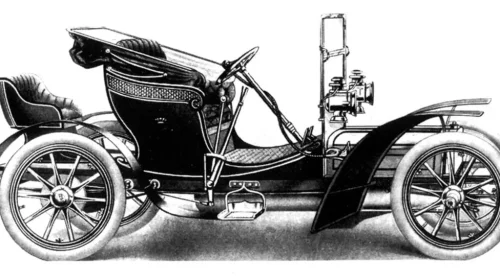
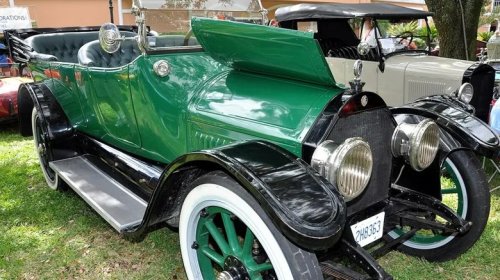
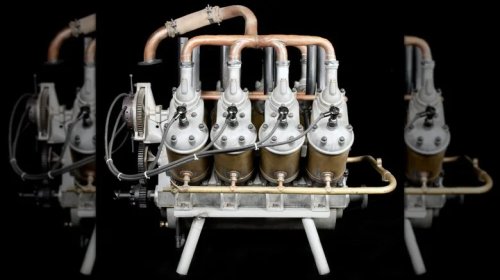
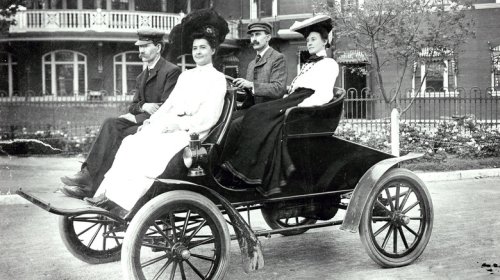
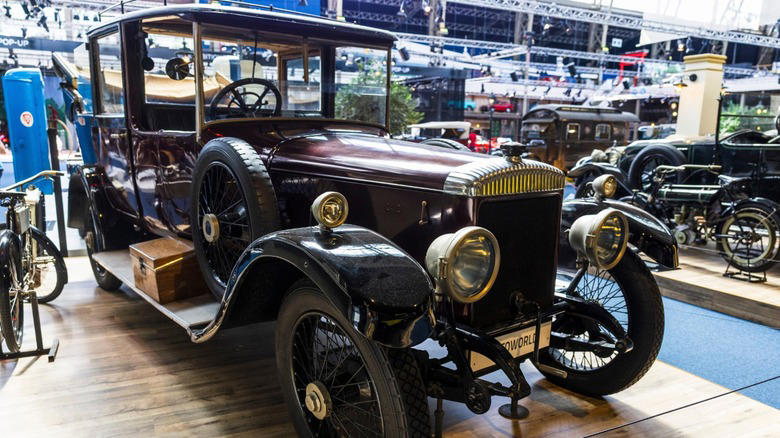
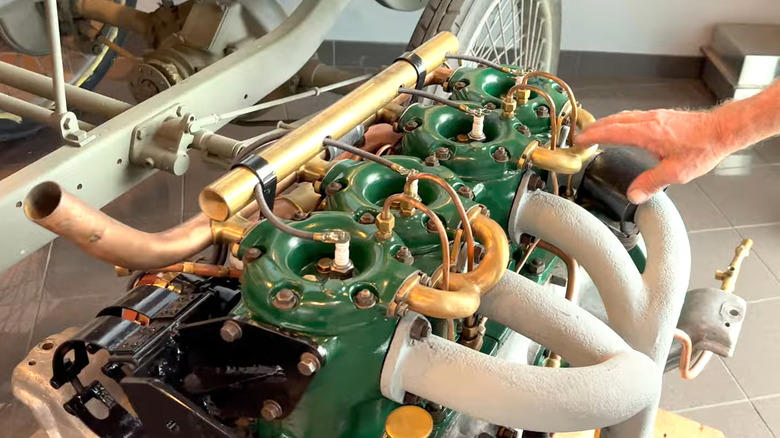
1922 Daimler TS 6-30, featuring a Knight Sleeve valve engineAutomobiles were still in their relative infancy in 1905, but they had been growing more popular for years. There was a problem, though: they were extremely noisy. One cause of the noise were the poppet valve caps and springs that would open and close access to the intake and exhaust valves. Charles Knight, an American inventor, sought to solve that problem by building an engine with no valve springs whatsoever.The Knight Sleeve Valve Engine replaced valve caps and springs with reciprocating sleeves placed around the cylinders. The result was an engine that was so much quieter than conventional engines that it would be dubbed the "Silent Knight." But American automakers weren't impressed, so Knight shopped it around Europe, where it would catch on with companies like Mercedes and Daimler. Knight would license his engine to several automakers on the continent, limiting the licensing to one company per country.Fast forward a few years, and American automakers would start to show interest in Knight's engine, as well. He would license it to multiple U.S. companies, but Willys-Overland would become the most successful with the engine, selling as many as 50,000 Willys-Knight models per year. In the minds of some, it looked like the old poppet valve engines would soon go out of style. After all, this was an era of innovation for the combustion engine — it would be about this time, for example, that the 7-cylinder Gnome rotary engine was invented for airplanes. How did the Knight Sleeve Valve Engine work?You might think the concept behind this engine was simple, but that couldn't be further from the truth. Basically, the engine worked like this: instead of noisy poppet valve caps and springs, each cylinder was surrounded by two sleeves. Each sleeve had slits at the top. The sleeves were timed to move up and down to facilitate each phase of the piston stroke. During the intake phase, the sleeves were positioned so that the slits lined up with the opening to the intake port. And during the compression phase, the sleeves were positioned so that the openings to the ports were blocked. Then, of course, the ignition would happen, pushing the piston back down. This would lead into the exhaust phase, during which the slits were lined up with the opening to the exhaust port. That design might seem weird, but it's not as weird as the Wankel rotary engine. Simple or not, the sleeve valve concept was elegant. It was also fuel-efficient for its time. In 1913, Théodore Pilette entered his Mercedes-Knight 16/45 hp in the 500 Miles of Indianapolis. It had the slowest qualifying time, but it got in. The car ended up in an impressive fifth place, in part because it never had to make a pit stop. Why did they stop making it?Knight Sleeve Valve EngineThe Knight Sleeve Valve Engine solved some problems presented by the poppet valve engines, but there were trade-offs. The engine was very expensive to manufacture, likely because it was heavy and also because the technology was very complex for the time. That's why Willys-Overland sold its Willys-Knight as its premium model, while producing conventional poppet valve models for average consumers. The Knight engines used a lot of oil as well, producing quite a bit of smoke behind it as a result.In the meantime, improvements were being made in the manufacturing of the conventional poppet valve engines. Those problems solved by the Knight Sleeve Valve Engines would eventually no longer exist in conventional engines. There just wasn't a feasible reason anymore to make the investment in a smoky, expensive oil guzzler. Willys-Overland would discontinue the Willys-Knight in 1932, the same year the Knight patents would expire. By that time, motorists and automakers alike had already moved on, and the engine that once powered hundreds of thousands of vehicles on the road would gradually leave the public's consciousness. That doesn't mean combustion innovation is dead, though. To see what we mean, read about the tiny two-stroke INNengine E-REX. Want more like this? Join the Jalopnik newsletter to get the latest auto news sent straight to your inbox, and add us as a preferred search source on Google.



















 +65 others