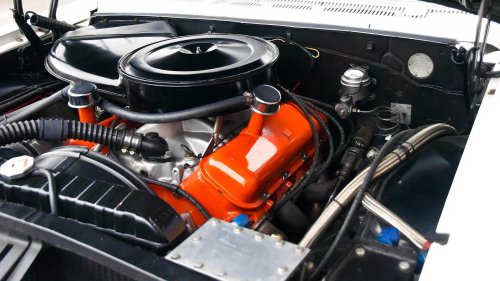



















Chevrolet has had a strong presence in the performance car market for years. This not only includes road cars, but also race cars. Since the early days of American motorsports, Chevrolet has been one of the most competitive names out there. It's tried nearly anything to stay at the front of the pack, too. Its desire to stay competitive got so great at one point that it produced one of the craziest big-block V8 engines the world has ever seen. American Stock Car Racing Gave Us Some Of The Craziest Engines Ever Made MecumWhen America rolled into the 1960s, stock car racing was ruling the roost. The superspeedways of NASCAR were proper proving grounds, tempting America's biggest automakers to produce engines with increasingly crazy levels of power. This ended up creating technological innovations that shaped the way American performance would go for years to come. This era of near-insanity gave us the 426 Hemi engine, the 429 Super Cobra Jet and plenty of others that pushed American muscle cars up to and past the 400 horsepower barrier.The engine we're going to talk about is one of those insane units that truly pushed the boundaries of performance. It was innovative for its time, was so powerful people began making up near-mythical claims about how good it was, and, for a brief period, it was a complete secret. The Chevrolet Mark II 427 'Mystery Motor' Is A One-Year Only Monster Of An Engine In the world of race-spec engines, there aren't many that have had as much of a mythical reputation as Chevrolet's Mark II 427 V8. Known as the Mystery Motor, a term coined by journalists due to how secretive it was, this engine was only ever produced for one year; 1963. Intended to make Chevrolet not only competitive but dominant in NASCAR, the Mystery Motor was an all-new platform with markedly different engineering from previous Chevy V8s.The intake and exhaust valves are staggered, like on the older W Series V8. But in the Mystery Motor, they're also canted relative to their cylinder bores. It also had a completely different casting to the W Series engines, using conventional 90-degree angled cylinder decks. These are features that the later Mark IV big-block Chevrolet V8 would have. The Mystery Motor was a runaway success.The Mystery-powered cars absolutely ran away from the competition at the 1963 Daytona 500, with Johnny Rutherford setting a top speed of 165.183 mph during the qualifying race. This was a closed-course speed record at the time and absolutely wowed anyone who saw it. It's Completely Different From The Z11 427 V8 MecumThanks to the Mystery Motor's size and association with NASCAR versions of regular production cars, it can be easy to accidentally confuse it with the 427 cubic inch engine that was used in the 1963 Impala Z11. This car was a homologation special for NASCAR and Super Stock drag racing, so you might expect that it would have the real Mystery Motor. But, it never did.Aside from displacement, the Z11 engine isn't even slightly like the Mystery Motor. It's actually a stroked version of the 409 cubic inch W series V8. That doesn't mean it isn't a proper performance engine, evidenced by its 430 hp and 575 lb-ft of torque. Its Real Power Has Been Heavily Debated Because the very existence of the Mystery Motor was kept a secret for a long time, certain aspects of what it was capable of have been shrouded. That's led to a lot of debates over the engine. One of those has specifically been about its power output. Some have conservatively estimated that it produced around 400-500 hp. Others have claimed that it could produce as much as 620 horsepower. The fact that there are so few surviving examples of this engine left has only kept the debate alive.We may actually have some concrete modern evidence of how powerful the Mystery Motor really was, though. Just over 10 years ago, Hot Rod magazine managed to get hold of somebody who had an example of the engine and who was willing to have it dyno tested. The engine that was tested recorded a peak output of 446.7 hp and 435 lb-ft of torque. While that's not as impressive as the 600+ hp some have claimed the Mystery Motor was capable of, that's still very potent for a big-block engine built in the early 1960s. Why Was The Mystery Motor Kept A Secret?Bring a TrailerIf NASCAR as a series was based so much on street cars, then why was the Mystery Motor kept so secret? Well, it was to get around those homologation rules. If Chevrolet kept the Mystery Motor a complete secret, then they didn't have to make any street-legal versions. The only parts of the car that Chevrolet had to homologate were everything that could be seen by the general public, and NASCAR's top brass. Perhaps more importantly, it also meant that Chevrolet's secrets weren't being given away to other manufacturers. What Killed Off The Mystery Motor So Quickly?Bring a TrailerThe Mystery Motor absolutely changed the game for Chevrolet and General Motors in racing. So, why did it die off so quickly? Well, it had nothing to do with its performance. In fact, it had everything to do with GM's internal politics at the time.In 1963, GM made a decision to withdraw from factory-sponsored racing programs. The reason it gave for this was safety concerns. The horsepower wars had become ludicrous by this point, and there was definitely a lot of concern over cars becoming too powerful. While it wasn't surprising that GM had concerns about this, what was surprising was how quickly the program was pulled. The engine only lasted a single race in NASCAR, the 1963 Daytona 500, and it ended up failing during the actual race after doing so well in qualifying.As a result of the Mystery Motor program being canceled so abruptly, a lot of the examples that were made were either destroyed or lost. That's directly led to how difficult it is to find examples that still work today. It's estimated that ten are still left at most. And out of those ten, only a few are actually running. Those running examples include the one that Hot Rod magazine did a dyno test on.Sources: Chevrolet, Hot Rod Magazine