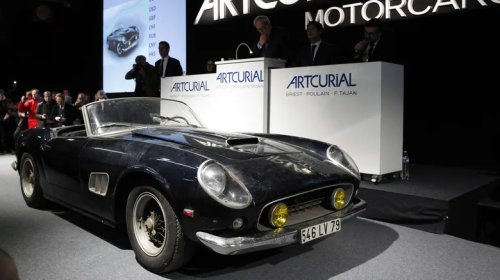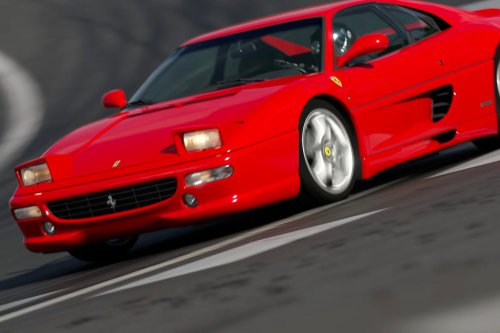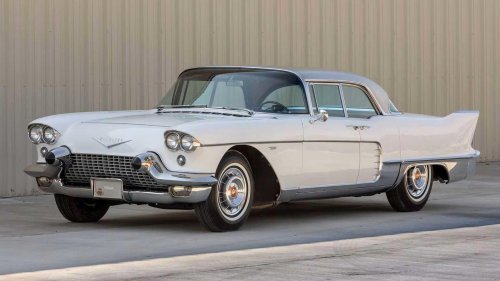
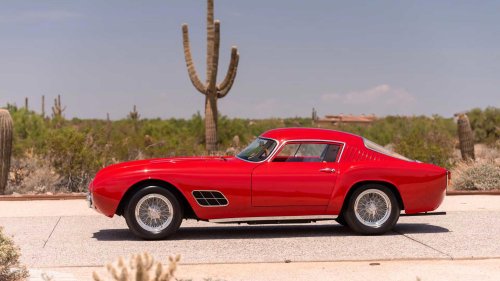
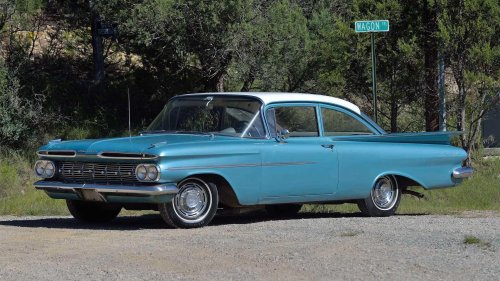
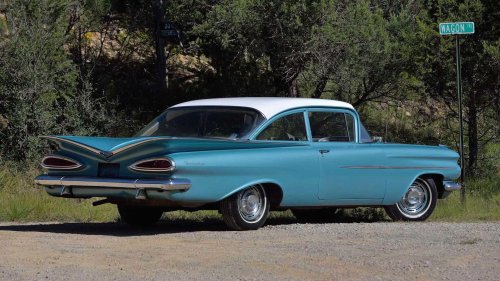
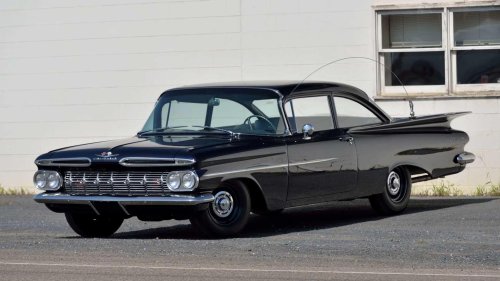
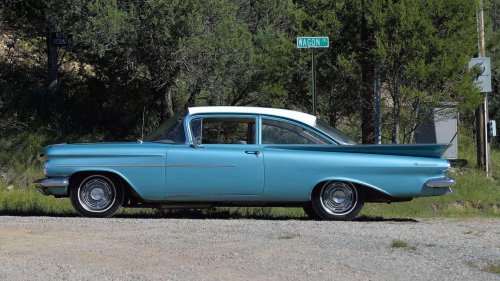



















European Sports Cars of the 1950s were exquisitely-crafted pieces of automotive art, with racing heritage and exotic metal bent in such ways that made them look fast while standing still. At the same time, American cars had a different ethos; the bigger the better was the order of the day, with that extending to both the cars and the engines themselves. These two diametrically-opposed viewpoints seem like there would be a clear winner, but there was a Chevy that could take on Europe’s best and beat it. Some American Sedans Had A Secret Performance Edge MecumThink mid-1950s US sedans, and you’ll probably picture something gigantic, chrome-accented, and sporting fins. A land yacht made for cruising the highways in style, rather than something truly capable of speed. Arguably the quintessential US sedan of the time was the Chevy Bel Air. A crucial piece of Americana, with its bright two-tone paint job, chrome, bench seats, and deep rumble, it was a proponent of that post-war nuclear family image that remains to this day.Like the Bel Air, the Ford Fairlane and the Cadillac Eldorado both followed the same design philosophy of gorgeous, large, and with fins emulating jet planes. They weren’t exactly made for speed, though, favoring style over substance. That’s not to say that there weren’t any performance-oriented US sedans. The Hudson Hornet was winning NASCAR races, and in V8 trim, the Rambler Rebel was hitting 60 mph in 7.5 seconds. But while American cars favored style over speed, across the Atlantic, European manufacturers were taking a different approach. Why European Sports Cars Dominated The Performance Conversation MecumThere were two very different attitudes towards cars in the mid-50s. The US went down a more ostentatious route, buoyed by post-war optimism and a growth in the suburbs. This conspicuous luxury, expressed through sheer size, contrasted with the European approach where cars were optimized more for smaller roads, utility, and fuel efficiency, given the continent was still suffering in the aftermath of the Second World War.Brands born before the war were able to make stunning cars again, like the Alfa Romeo 1900 TI, the Jaguar Mark VII, or the Citroën DS, while brands prioritizing performance were gaining momentum. The European racing scene drove innovation while, on the road market, Mercedes-Benz’s 300 SL “Gullwing” was considered the fastest production car of the time (and only cost $6,820 new, take us back).Possibly the biggest of them all was Ferrari. The Maranello-based marque had risen from selling just three cars in 1947 to 113 in 1957, and its crown jewel was the 250 GT. An effortlessly beautiful car with a 3.0-liter V12 engine to back it up, the 250 GT was everything that European sport and elegance had to offer. But despite all its prowess, there was one American car that managed to leap the Atlantic and challenge, and possibly even beat, Ferrari. The Chevy Biscayne That Could Beat A Ferrari 250 GT MecumLet’s get an important distinction out of the way early; we’re not talking about the generic, base model 1959 Biscayne. The Biscayne itself was Chevrolet’s cheapest full-size car at the time ($2,247 for the two-door version in 1959) and was famous for being light on both weight and features. The 3.9-liter, 235.5 cu-in inline-six engine made 145 hp gross, and would dawdle up to 60 mph… eventually. This had little chance of outrunning anything, let alone one of Italy’s finest. 1959 Chevrolet Biscayne Specs Given that was the base model, you’d be forgiven for thinking that it wouldn’t really get much better from there. You’d also be incorrect because, for some reason, Chevy allowed people to spec this basic, slow, entry-level car with their massive 348 cu-in W-series V8, which made 335 horsepower and 362 lb-ft of torque. This was almost 1.5 times what the base level car came with and, understandably, transformed it from the poverty-spec of all poverty-specs into what could feasibly be called the ultimate sleeper.For comparison, there were a few variations on the 1959 Ferrari 250 GT, with the Pininfarina being the “worst” of the bunch (though “worst” is obviously relative here). That version had a 3.0-liter V12 making 240 hp and around 180 lb-ft of torque, and was capable of clearing 60 mph in around seven seconds. Not exactly slow by any stretch, especially for the late 1950s, but around half a second slower than the 250 GT Berlinetta or California Spyder versions.MecumSo while the Biscayne wouldn’t come out of the factory with more power (not even close), it could be specced to have almost 100 extra horses on Ferrari’s prancing ones. They would have to push a much heavier car, though, with the 250 GT coming in around 2,500 lbs and the Biscayne generously weighed at 3,500 lbs (665 lbs of which was just the engine). Very similar power to weight ratios, then. And while the Ferrari looked every bit as fast as its performance sheet would suggest, the Biscayne had a little more subtlety to it. The Biscayne Was A True Street Sleeper MecumWith that big V8 engine under the hood of a basic, affordable car, it was always destined to be a sleeper. But Zora Arkus-Duntov, the man more commonly known as the “Father of the Corvette”, designed 40 cars specifically for the Oregon State Police and took that one step further, creating the ultimate chase vehicle in the process.These usually slow vehicles had 348 cu-in W-Head V8 engines based on the 250-hp versions that had been modified to reach 305 hp. Duntov also used a camshaft similar to the one he’d pioneered in the 1957 Corvette, which further helped improve performance. Naturally, heavier-duty brakes and suspension more commensurate for police chases were added, while chrome and anything else that could impact weight was removed. What came was a police car capable of 130+ mph, and which was more than comfortable on long chases with whomever dared challenge the law. The Duntov Patrol Cars were the crème de la crème of what started out as the cheapest car in Chevy’s lineup. The Biscayne’s Legend Lives On MecumThe Biscayne would live on for several more generations, ultimately getting axed at the end of 1975 due to prevailing market trends and an increased focus on more fuel efficient cars. But while it was discontinued to help make way for different cars in Chevrolet’s lineup, it challenged a lot of expectations.It showed that you didn’t need a performance car to have performance. It showed you didn’t need to have an expensive car to have style. And, in full V8 engine form, it showed you couldn’t judge an entry-level car by its cover.The V8-equipped Biscayne can be picked up for around $30,000 in good condition, with fully-restored options going for around $60,000. Of course, that’s nowhere near the Ferrari 250 GT, which is of the “if you have to ask, you can’t afford it” variety of cars (though prices easily reach seven figures). But it was never designed to chase Ferrari. It was made to offer the American people a cost-effective way to enjoy the trappings of much more expensive cars. That one model could feasibly have taken the fight to Ferrari was just a happy coincidence.