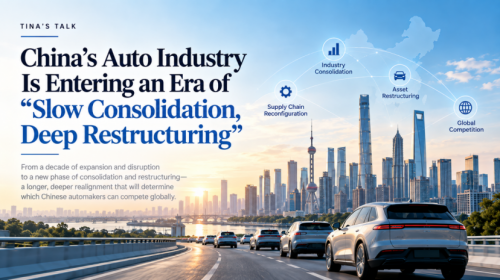
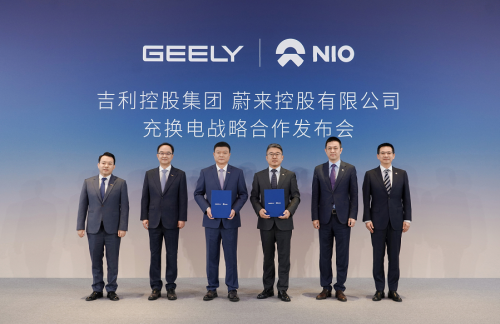
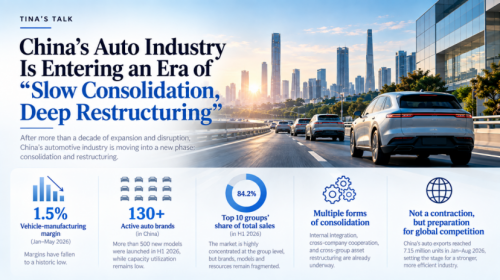
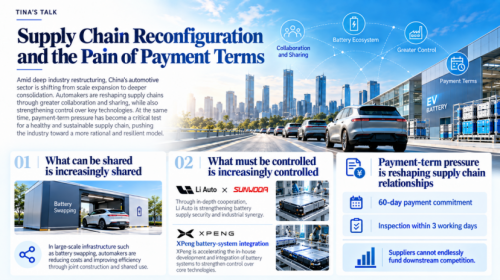
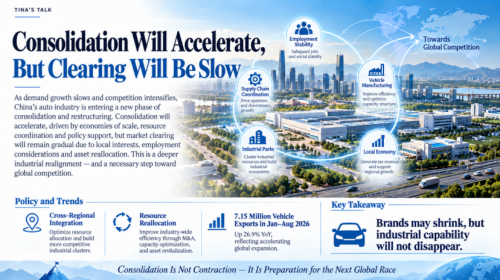
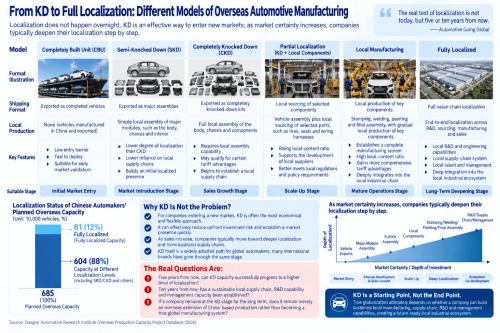
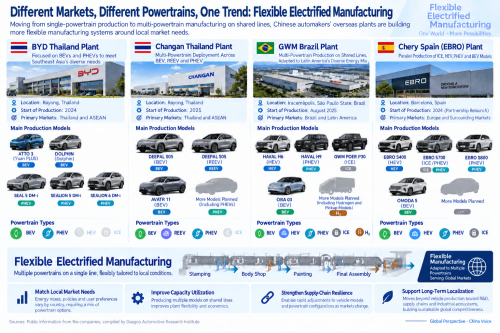
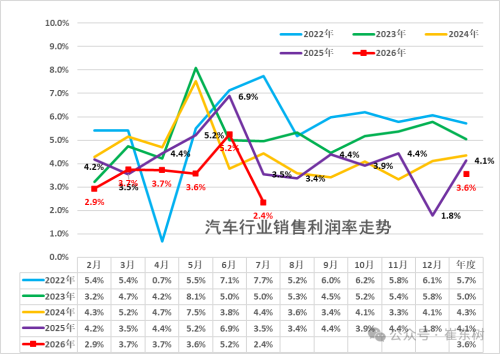
What is coming will come.Over the past month, several developments in China's automotive industry have been particularly revealing.On September 27, Changan Automobile moved the strategic coordination between Avatr and Deepal into a more substantive phase. A new first-tier "AD Synergy Department" was established, with planning, product and marketing, HR, finance and other back-office functions increasingly coordinated, while the two brands remain independent in the market.Around the same time, Geely and NIO took their battery-swapping partnership from operational cooperation into capital and asset integration. Geely injected 100% of YiYi Connect, together with RMB 640 million in cash, into NIO Power and took a 30% stake, while the two sides also established cross-shareholdings around their charging businesses.Soon after, GAC Group announced a major asset restructuring plan to acquire FAW's 50% stake in FAW Toyota through a share issuance. In its announcement, GAC made the rationale clear: better coordination of local R&D, supply chains, manufacturing assets and market resources, while reducing duplicated investment and sharing the cost of technological innovation.These three moves look very different.One is internal brand coordination. One is the integration of infrastructure assets across companies. And one reaches into the ownership and joint-venture structure of two major state-owned automotive groups.But they all point in the same direction:China's automotive industry is moving from more than a decade of expansion and disruption into a new phase of consolidation and restructuring.My view is that China's auto industry is entering an era of slow consolidation and deep restructuring.A 1.5% vehicle-manufacturing margin is a powerful signalWhy now?The answer begins with basic economics.In the first five months of 2026, the sales margin of China's automotive industry fell to 3.4%. At the vehicle-manufacturing level, the figure was only around 1.5%, close to a historic low.Over the same period, industry revenue still grew by 1.4%, but costs rose by 2.3%, while profits fell by 20%.This tells us something important:Scale no longer translates automatically into profit, and growth is becoming increasingly difficult to convert into healthy cash flow.Now look at the supply side.According to Gasgoo Automotive Research Institute, more than 80 automotive companies and over 130 active vehicle brands remain in the market. According to CAAM, more than 500 new models and variants were introduced in the first half of 2026. At the same time, underutilized capacity and product homogenization have become increasingly visible industry concerns.Image source: Gasgoo, enabled by AIMarket concentration creates an even more striking contrast.In the first half of 2026, the top ten automotive groups accounted for 84.2% of total vehicle sales.So at the group level, the market is already highly concentrated.Yet at the level of brands, models, platforms and resource allocation, the industry remains highly fragmented.China's problem is therefore not simply that there are "too many automakers".The deeper issue is that years of rapid growth have left behind layers of duplicated brands, products, R&D systems, manufacturing capacity, distribution networks and infrastructure.In an expanding market, those inefficiencies could be hidden by growth.But when vehicle-manufacturing margins fall to 1.5%, every duplicated system has to be recalculated.No company can afford not to count every yuan.Consolidation has started — but it is not simply about shutdowns and mergersIf we look across what has happened in 2026, this round of industry consolidation looks very different from the traditional idea of "closing, suspending, merging and transferring".There are several distinct models.First: internal consolidation within automotive groupsChangan's approach with Avatr and Deepal is a good example.The brands can remain differentiated in positioning and customer proposition, while planning, technology, procurement, HR and finance do not need to be duplicated in full.The same logic can be seen elsewhere.Geely has been advancing its "One Geely" strategy, while GAC has been reorganising around business-unit structures. Large automotive groups are increasingly focused on reusing R&D, procurement, platforms, manufacturing, channels and organisational resources.This points to an important shift:The first stage of consolidation may not be the disappearance of brands. It may be the disappearance of duplicated systems behind those brands.Second: cross-company resource sharing and capital cooperationThe Geely–NIO battery-swapping deal is particularly symbolic.Battery swapping is a capital-intensive infrastructure business. Its economics improve only when the network becomes sufficiently large, the number of compatible vehicles increases and asset utilisation rises.Geely already had its own battery-swapping capabilities. Yet both companies still chose to integrate more deeply through assets and equity.Image source: NIOThe message is clear.In the past, the logic was often:"If others have it, we need to have it too."The next question may increasingly become:"Does this capability really need to be owned and built independently by us?"Third: cross-group asset restructuringGAC's proposed acquisition of FAW's 50% stake in FAW Toyota is another step altogether.The transaction is not yet completed, but its significance is already clear.During the high-growth era, "North–South joint ventures" and twin-model strategies helped international automakers expand market coverage rapidly.But in a mature market, maintaining two separate products, R&D, manufacturing and marketing systems creates a different question:How much duplication still makes economic sense?The real significance of the GAC–FAW Toyota transaction is therefore not simply who acquires whom.Image source: Gasgoo, enabled by AIIt is that China's auto industry is beginning to cross long-established corporate boundaries and reallocate assets that were built up over decades.That is far more difficult than internal restructuring.The supply chain is also entering a new phase of reconfigurationBehind every automaker sits a much larger industrial ecosystem.And another side of this consolidation is the changing relationship between OEMs and suppliers.For years, people in the industry have joked that "automakers are working for battery companies".That is obviously too simplistic. Falling OEM profitability cannot be blamed on any single supplier.But the phrase reflects a real issue.The battery remains one of the largest single cost items in a battery-electric vehicle. Once vehicle makers enter a low-margin era, they inevitably start reassessing cost, supply security and control over critical technologies.That is why we are now seeing more automakers introduce second and third suppliers, while also using in-house development, joint ventures and capital investment to strengthen supply-chain resilience and control.In September, Li Auto announced plans to invest RMB 2.65 billion in Sunwoda EVB. Following the transaction, Li Auto-related entities would hold around 11.17% and become the company's second-largest shareholder.At the same time, Li Auto has brought CALB into the manufacturing system for its self-developed battery programme.The logic is no longer simply "find another supplier".It is moving towards a model of: in-house battery development + diversified manufacturing partners + capital alignment.XPeng is taking a similar but slightly different route.He Xiaopeng stated in September that XPeng intends to bring more battery-system capability in-house, while not manufacturing battery cells itself.Cells will continue to come from external suppliers, while battery packs, BMS, thermal management, structural design and system integration are increasingly controlled by XPeng itself. At the same time, the company continues to diversify its cell-supplier base.So the industry discussion around "de-CATL-isation" should not be understood as automakers simply walking away from CATL.A more accurate interpretation is this: Automakers are redrawing the capability boundary between themselves and battery suppliers.They may not need to manufacture cells themselves.But they increasingly want control over battery-system definition, supplier choice and critical cost levers.The underlying objectives are clear: cost, supply security, product differentiation and stronger bargaining power.At first glance, this looks opposite to Geely and NIO sharing battery-swapping infrastructure.In fact, the logic is the same.Common capabilities that depend on scale are moving towards sharing and concentration.Capabilities that determine cost, technology and supply security are moving towards diversification and controllability.What can be shared will increasingly be shared.What must be controlled will increasingly be brought under tighter control.This may become one of the defining characteristics of the next phase of China's automotive ecosystem.Image source: Gasgoo, enabled by AIPayment terms: the hidden pain of supply-chain "involution"The debate around competition in China's automotive industry cannot stop at retail price wars.Behind every new vehicle launch are suppliers investing upfront in R&D, tooling, engineering validation and production capacity.At the same time, model cycles are becoming shorter and the duration for which a new model can maintain strong sales is becoming less predictable.If payment terms are also extended, suppliers are forced to carry even more working-capital pressure.When a supplier is handling multiple programmes at the same time, with rising upfront engineering investment and longer cash-conversion cycles, the financial risk rises quickly.Once cash flow becomes strained, the problem is no longer just profitability.It can start to affect R&D investment, payroll and even the ability to maintain normal supply.That is why supplier payment terms have moved from a private commercial issue into an industry-governance issue over the past two years.In 2025, 17 major automakers publicly committed to paying suppliers within 60 days.In 2026, MIIT and the State Administration for Market Regulation went further, specifying that general production materials such as automotive components should in principle be inspected and accepted within three working days after delivery. For SME suppliers, payments are encouraged within 30 days and should not exceed 60 days, while the use of cash payments is also being encouraged.Regulators have also acknowledged the existence of practices that effectively extend payment cycles through delayed inspection and reconciliation.I have always believed that: A healthy automotive industry cannot rely on continuously drawing on suppliers' cash flow to sustain ever more intensive product competition downstream.Payment-term regulation will not directly create industry consolidation.But it will expose companies' true cash-generation capability more quickly.Business models that were previously sustained through financing, extended payment terms and supplier funding will have less room to continue.That, too, will accelerate industry convergence.Consolidation is inevitable. So is its slow paceIf we looked purely at market efficiency, more than 130 brands, roughly 70% manufacturing capacity utilisation and a 1.5% vehicle-manufacturing margin should lead to rapid market exit.But China's automotive industry is more complicated than that.There is a very important — and very Chinese — variable: regional industrial interests.In China, an automaker is often much more than a company.Automotive manufacturing is capital-intensive, highly industrial, employment-heavy and deeply connected to batteries, semiconductors, software, AI and advanced manufacturing.When a vehicle plant lands in a city, suppliers often follow. Industrial parks are built. R&D institutions cluster around it. Jobs are created. And local investment promotion increasingly revolves around that "chain-leading" enterprise. So for many local governments, a major OEM or leading Tier 1 is not simply a market participant. It is an anchor for the local industrial economy.This helps explain why some automakers with weak sales or profitability have not exited as quickly as ordinary consumer businesses.If a chain-leading company disappears too quickly, the question is not simply whether a brand survives. It becomes: What happens to employment? What happens to suppliers? What happens to factories and land?Who takes over the industrial cluster built up over many years? This creates a structural tension in China's auto industry: The market wants inefficient resources to exit. Local governments must also consider employment, investment, supply-chain stability and regional industrial continuity.That tension is one reason why China has been able to sustain so many automotive players for so long.But the balance is beginning to shift.On one side, local governments now have more industrial options. AI, semiconductors, embodied intelligence, robotics and the low-altitude economy are all competing for capital, land, talent and industrial funds.For an automotive company that remains loss-making, lacks scale and has limited technological differentiation, the opportunity cost of continued local support is rising.On the other side, the policy direction is also changing.China's 15th Five-Year Plan for intelligent connected and new-energy vehicles explicitly calls for stronger capacity monitoring, more lawful mergers and acquisitions and cross-regional integration, and the market-oriented and rules-based exit of inefficient capacity.This does not mean China is becoming less committed to the automotive industry.Quite the opposite.Intelligent connected and new-energy vehicles remain a strategically important sector.What is changing is the policy emphasis: from making the industry bigger to making it stronger, more efficient and better allocated.And one phrase in particular matters: cross-regional integration.The hardest restructuring is rarely the merger of two departments inside one group.The real challenge comes when restructuring crosses different cities, shareholders and state-owned capital systems.Where should production capacity remain? Where should taxes be booked? How should employees be reassigned? What happens to existing suppliers? Who becomes the new chain leader?That is why China's deeper automotive restructuring will eventually have to move beyond companies and into the reallocation of industrial resources across regions.And that is why my view is: Consolidation will accelerate, but final market clearing will not be fast.Restructuring will happen, and it will go much deeper.Image source: Gasgoo, enabled by AIDeep restructuring, slow market clearingIn 2026, we are already seeing a much denser flow of internal consolidation, strategic alliances, cross-shareholdings, asset transactions and court-led restructuring.In the proposed restructuring of Hozon New Energy, the parent company of Neta Auto, investors are expected to inject RMB 3 billion in exchange for around 70.62% of the company.Six entities associated with Jiyue have also entered substantive consolidated restructuring, with the objective of preserving asset value, revitalising existing resources and creating conditions for new strategic investors.These cases illustrate something important: A brand can disappear without the underlying industrial capability disappearing.A company may exit, but its factories, equipment, land, engineering teams, supply chain and technologies still have to find a new owner or a new place in the industrial system.So when we look at the automotive industry in the future, we should not only ask: "How many companies failed this year?" Or: "Which brands disappeared?"The more important question is: Where did their assets, people and capabilities go?Because restructuring will not stop at the brand level.It will continue into equity, organisation, R&D, manufacturing, distribution, supply chains, infrastructure and regional industrial ecosystems.The sequence of consolidation in China is therefore likely to be:first internal, then ecosystem-wide;first operational, then capital-driven;first collaboration, then mergers.Consolidation is not contraction — it is preparation for the next round of global competitionNone of this means China's auto industry is simply entering decline. There is still a major source of incremental growth: the global market.In the first eight months of 2026, China exported around 7.15 million vehicles, and full-year exports are moving towards the ten-million-unit scale. Globalisation will create new room for scale for some Chinese automakers. But it will also become a new filtering mechanism. Surviving in China does not automatically mean a company can operate globally.The strongest Chinese automakers of the future will need more than volume. They will need: sustainable profitability, technological innovation, supply-chain organisation and the ability to operate across regions, cultures and markets.So this round of consolidation is not about making China's auto industry smaller.It is about moving resources towards companies that can use them more efficiently and compete more effectively in the next phase of global competition.Over the past decade, one of the defining capabilities of China's auto industry has been its ability to keep adding. More companies. More brands. More models. More technologies. More capacity.That extraordinary intensity of competition helped China make a historic leap in new-energy vehicles, intelligent driving, batteries and supply chains. Without that period of intense competition, China would not have today's speed of innovation or industrial capability.But no industry can remain in a phase of unconstrained expansion forever.When vehicle-manufacturing margins fall to 1.5%; when more than 130 brands continue to launch new products at high frequency; when large amounts of capital are still being invested in highly similar forms of competition; and when suppliers continue to carry enormous financial pressure; the industry has to enter its next phase: reallocating the enormous industrial resources built up over the past decade.In the years ahead, some brands will disappear. Some companies will be restructured. Some capacity will find new owners. Some businesses will be tied together through equity. Others will share platforms, infrastructure or technologies. Still, others will find new positions through supply-chain partnerships and globalisation.So I do not see the next phase of China's automotive industry as a simple elimination round. It will be a long and profound reallocation of industrial resources.Brands may disappear, but industrial capability will not simply vanish.Companies may be restructured, but talent, technology, capacity and supply chains will be recombined.The past decade of China's automotive industry was defined by disruption and reshaping.The next few years will increasingly be defined by:consolidation and restructuring.China's auto industry is entering a new era of slow consolidation and deep restructuring.