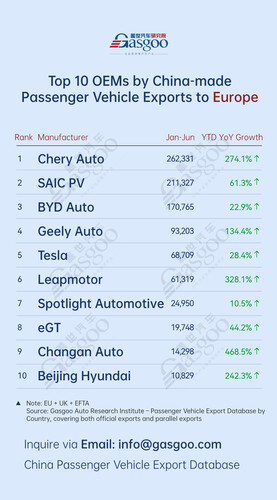
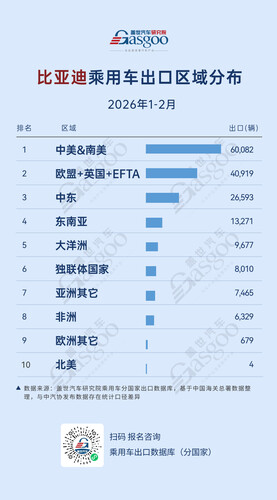
Ava King · 6 months ago@avaking10China's passenger vehicle export overview (Jan.-Feb. 2026): Russia leads overall丨Gasgoo Automotive Research Institute Liked byPost commentRelated PostsTop 10 destinations by BYD passenger vehicle exports (Jan.–Jun. 2026): Brazil leads with 194,686 units | Gasgoo Automotive Research Institute 20 · Oliver Turner · 2 months agoChina's passenger vehicle exporters overview (Jan.-Jun. 2026): Chery Auto surges 274.1% in Europe丨Gasgoo Automotive Research Institute 87 · Lucas Hill · 2 months agoXPENG, Banma unveil automotive-grade AI cockpit solution at 2026 Yunqi Conference 72 · Grace Wilson · 14 days agoChina's September passenger vehicle market: Retail sales slump, exports cushion wholesale declineMia Fortin · 2 days agoRankings of smart cockpit component suppliers in China (Jan. - Jul. 2026): Market concentration continues to rise | Gasgoo Automotive Research Institute 44 · Justin Fortin · 24 days agoJan-Feb 2026, China Passenger Car Exports, Who Is Leading: Chery Leads in Europe, Central and South America See All-Round Growth | Gasgoo Automotive Research Institute 39 · Victoria King · 6 months agoChina's passenger vehicle export overview (Jan.-Jun. 2026): NEVs accelerate global expansion丨Gasgoo Automotive Research Institute 57 · Lauren Rogers · 2 months agoFord China begins exporting its Transit City EV to Europe 63 · Nicole White · 22 days agoRankings of ADAS component suppliers in China (Jan. - Jul. 2026): Market concentration continues to rise | Gasgoo Automotive Research Institute 32 · Ryan Smith · 24 days agoChina passenger vehicle export trends (June 2026): Europe emerges as a key growth market丨Gasgoo Automotive Research Institute 74 · Kayla Mitchell · 2 months agoTop 10 Countries for BYD Passenger Car Exports in Jan-Feb 2026: Brazil Leads with 52,000 Units, Three Middle Eastern Countries Enter Top 10 | Gasgoo Automotive Research Institute 32 · Emma Walker · 6 months agoTop 10 destinations by BYD passenger vehicle exports (Jan.–May 2026): Brazil leads with 186,921 units | Gasgoo Automotive Research Institute 44 · Henry Leblanc · 2 months agoChina’s passenger vehicle exporters overview (Jan.-May 2026): Chery Auto surges 277.5% in Europe丨Gasgoo Automotive Research Institute 16 · Morgan Scott · 2 months agoYao Zhanhui: Building a Path for Integrated Development of Diverse Automotive Energy Replenishment Based on the New Energy System | 2026 Teda Forum 44 · Abigail Walker · 20 days agoGeely Officially Enters the Swiss Market; Nissan Expands China-built Vehicle Exports; SemiDrive Closes RMB 1 Billion Series C Financing 52 · Audrey Roy · 23 days agoNew Dynamics in Chinese Automaker Exports, Jan-Feb 2026: BYD Leads in Latin America, Geely Accelerates Breakthroughs in Europe | Gas Automotive Research Institute 68 · Zoë Lee · 6 months agoTop 10 destinations by BYD's passenger vehicle shipments (Jan.–May 2026): Brazil leads with 186,921 units | Gasgoo Automotive Research Institute 64 · Oliver Lavoie · 2 months agoChina Automotive New Energy Signs Agreement with Leapmotor to Promote Battery Technologies 20 · Grace Wilson · 25 days agoChina's August Auto Exports Reach 1.01M Units, First 8 Months Total 7.153M 29 · Logan Brown · 24 days agoChina's Passenger Vehicle Exports in Jan–Feb 2026: Russia Leads Overall Exports, Brazil Tops NEV List 99 · Hannah Gagnon · 6 months ago