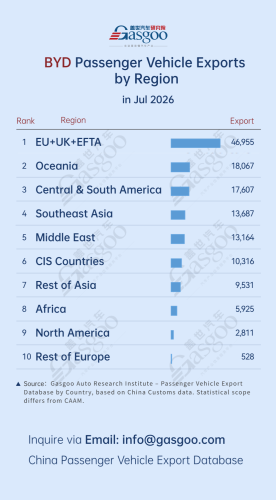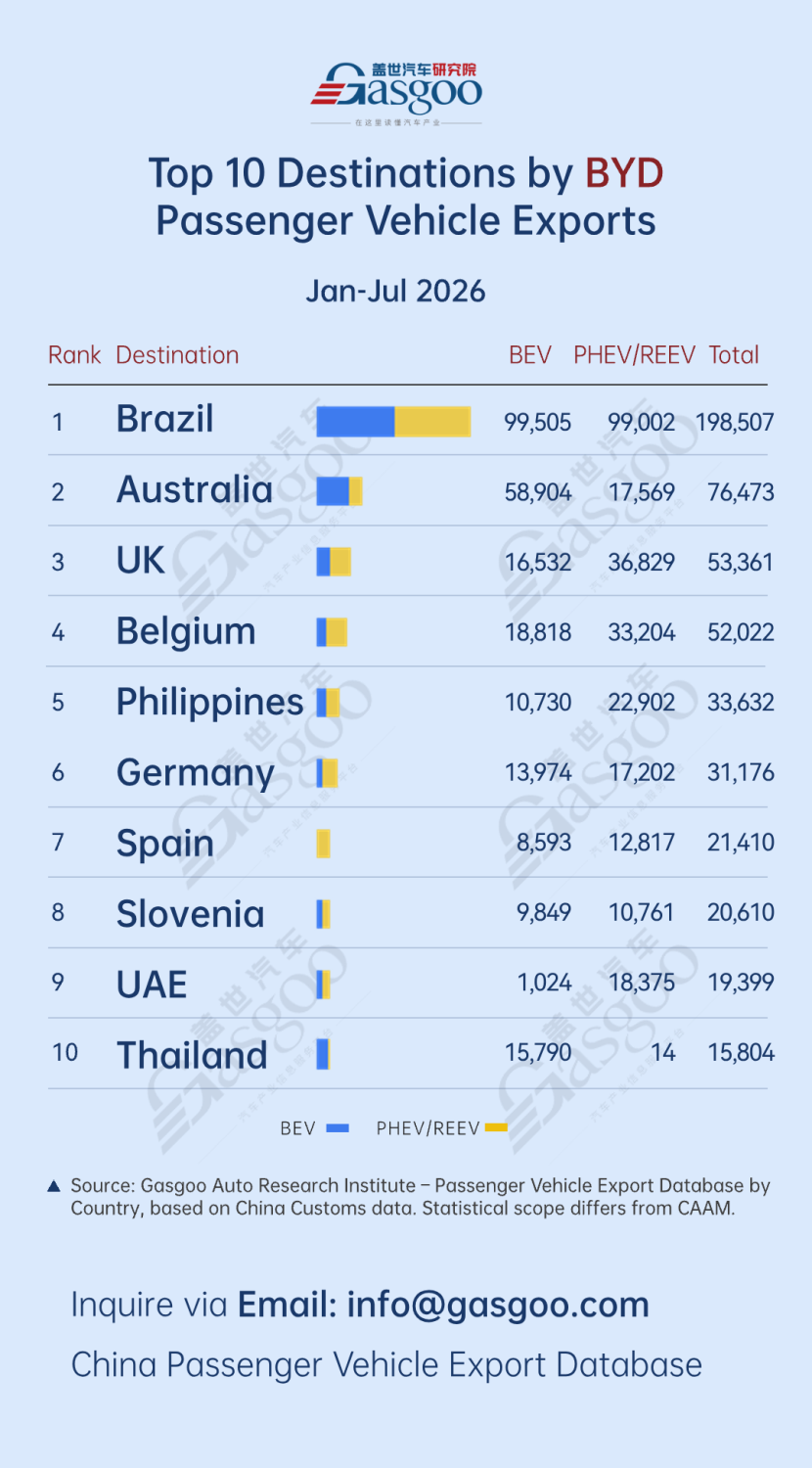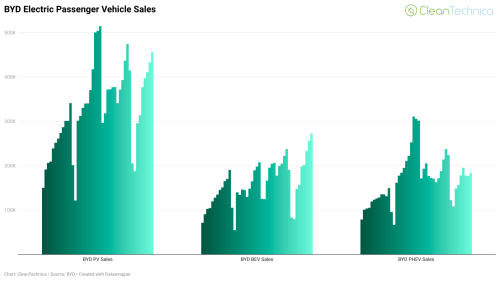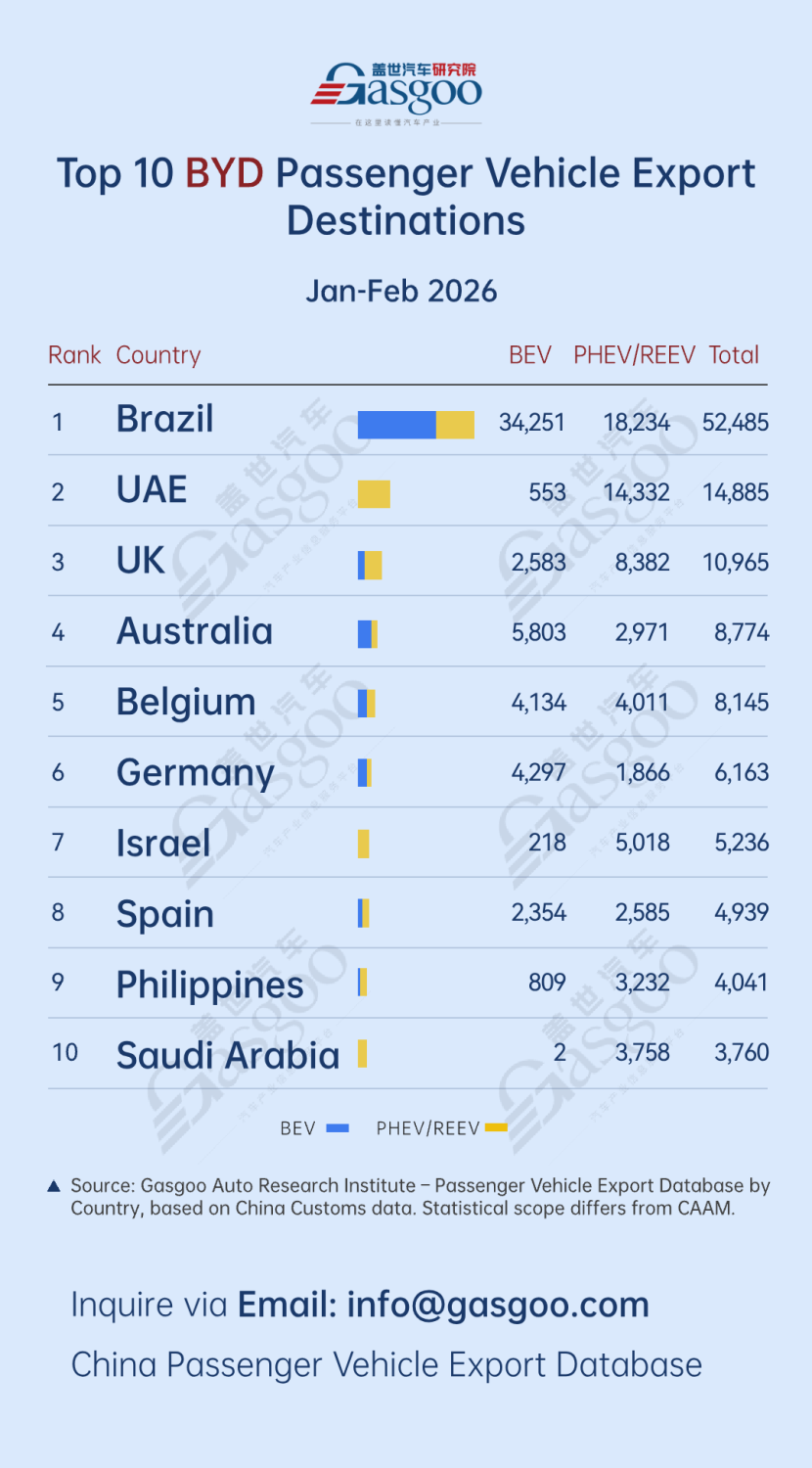



















According to data compiled by the Gasgoo Automotive Research Institute, BYD's passenger vehicle exports further expanded globally for January–February 2026, with clearer leadership in key markets and more distinct regional demand patterns. Brazil took the lead with 52,485 units, followed by the UAE and the UK.Growth was broad-based across Europe, while the Middle East, Oceania, and Southeast Asia continued to gain momentum. Regional preferences for BEVs and PHEVs varied by energy structure and usage scenarios, and BYD's well-aligned product portfolio continued to strengthen its global competitiveness.Brazil: 34,251 battery electric passenger vehicles and 18,234 plug-in hybrid electric passenger vehicles were exported from January to February 2026, totaling 52,485 unitsUAE: 553 battery electric passenger vehicles and 14,332 plug-in hybrid electric passenger vehicles were exported from January to February 2026, totaling 14,885 unitsUK: 2,583 battery electric passenger vehicles and 8,382 plug-in hybrid electric passenger vehicles were exported from January to February 2026, totaling 10,965 unitsAustralia: 5,803 battery electric passenger vehicles and 2,971 plug-in hybrid electric passenger vehicles were exported from January to February 2026, totaling 8,774 unitsBelgium: 4,134 battery electric passenger vehicles and 4,011 plug-in hybrid electric passenger vehicles were exported from January to February 2026, totaling 8,145 unitsGermany: 4,297 battery electric passenger vehicles and 1,866 plug-in hybrid electric passenger vehicles were exported from January to February 2026, totaling 6,163 unitsIsrael: 218 battery electric passenger vehicles and 5,018 plug-in hybrid electric passenger vehicles were exported from January to February 2026, totaling 5,236 unitsSpain: 2,354 battery electric passenger vehicles and 2,585 plug-in hybrid electric passenger vehicles were exported from January to February 2026, totaling 4,939 unitsPhilippines: 809 battery electric passenger vehicles and 3,232 plug-in hybrid electric passenger vehicles were exported from January to February 2026, totaling 4,041 unitsSaudi Arabia: 2 battery electric passenger vehicles and 3,758 plug-in hybrid electric passenger vehicles were exported from January to February 2026, totaling 3,760 unitsFrom a regional perspective, BYD's overseas market shows a pattern of Latin America leading, strong momentum in the Middle East, balanced growth in Europe, and steady penetration in Oceania and Southeast Asia. In Latin America, Brazil topped the list with cumulative passenger vehicle exports of 52,485 units.The Brazilian market shows a dual-track growth pattern for both BEVs and PHEVs. BEV exports reached 34,251 units, while PHEV exports totaled 18,234 units, with BEVs accounting for a higher share.This structure aligns with local policies promoting the transition to new energy mobility, while also fitting high-frequency use scenarios such as urban commuting and ride-hailing. At the same time, PHEVs offer greater flexibility for long-distance travel and charging convenience, creating a complementary dynamic that supports overall growth.The Middle East delivered strong performance, with the UAE, Israel, and Saudi Arabia all ranking in the top ten, becoming key growth drivers for BYD's overseas expansion. Among them, the UAE ranked second with 14,885 units exported, of which PHEVs contributed 14,332 units, accounting for over 96%. Israel showed a similarly high PHEV share of over 95%, while in Saudi Arabia, exports were almost entirely PHEVs (3,758 units) with only 2 BEVs, highlighting a clear preference for plug-in hybrids.Europe continued to see steady penetration, with UK, Belgium, Germany, and Spain all ranking in the top ten, making it the most widely covered mature market region for BYD. The UK ranked third with total exports of 10,965 units, followed by Belgium, Germany, and Spain, with volumes generally ranging between 4,900 and 11,000 units, reflecting a balanced growth pattern.Overall, BYD has established a region-specific product strategy tailored to global markets. BEVs are primarily targeted at regions with supportive policies and higher levels of electrification, while PHEVs play a leading role in markets with less developed charging infrastructure and stronger demand for long-distance travel. With a well-structured product mix and precise market positioning, BYD has continued to strengthen its global competitiveness in early 2026, supported by a clear overseas market hierarchy and solid growth momentum.