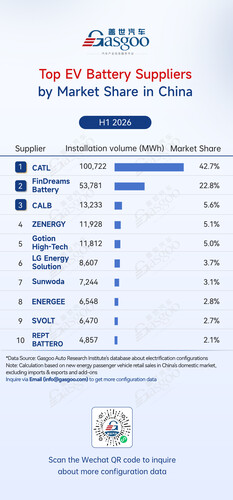
Gasgoo Munich-Data from Gasgoo Institute paints a picture of a solidifying top tier, fiercer competition across the ranks, and deepening vertical integration in China's NEV electrification sector for the first quarter of 2026. Installation figures across six core areas—power batteries, BMS, and drive motors among them—show leading players leveraging technology and scale to corner resources. While local supply chains remain dominant, a clear split is emerging between in-house OEM development and traditional suppliers. Meanwhile, second-tier and specialized firms are carving out niches through differentiation, driving the industry toward greater self-reliance, efficient integration, and faster technological iteration. These shifts offer critical insight into the evolving landscape of the components industry.Power Battery Supplier Installation RankingsCATL, 42,084 MWh installed in Jan–Mar 2026, 44.0% market share.FinDreams Battery, 20,729 MWh installed in Jan–Mar 2026, 21.7% market share.LG Energy Solution, 5,143 MWh installed in Jan–Mar 2026, 5.4% market share.CALB, 5,000 MWh installed in Jan–Mar 2026, 5.2% market share.Gotion High-Tech, 4,049 MWh installed in Jan–Mar 2026, 4.2% market share.Sunwoda, 4,033 MWh installed in Jan–Mar 2026, 4.2% market share.Zhengli New Energy, 3,706 MWh installed in Jan–Mar 2026, 3.9% market share.SVOLT, 2,780 MWh installed in Jan–Mar 2026, 2.9% market share.ENERGEE, 2,505 MWh installed in Jan–Mar 2026, 2.6% market share.REPT, 1,884 MWh installed in Jan–Mar 2026, 2.0% market share.First-quarter installation data for 2026 reveals that China's NEV passenger car battery market remains a "one superpower, many challengers" arena, with the dominance of top players becoming even more pronounced. CATL sits firmly at the top with 42,084 MWh of installations and a 44.0% share. Leveraging its full supply chain layout, rapid tech iteration, and massive production capacity, the company continues to cement its status as the industry backbone. FinDreams Battery follows in second place with 20,729 MWh and a 21.7% share, driven by its deep integration with BYD and vertical integration capabilities that sustain steady growth amid stable demand.LG Energy Solution takes third place with a 5.4% share, standing as the sole foreign firm in the top ten. The battle for fourth through seventh is fierce, with CALB, Gotion High-Tech, Sunwoda, and Zhengli New Energy bunched between 3.9% and 5.2%. Further back, SVOLT, ENERGEE, and REPT rank eighth to tenth, all holding less than 3% and trailing the leaders by a significant margin.Overall, the market is defined by a "duopoly" led by CATL and FinDreams Battery. This dominance underscores the technological prowess and scale advantages of Chinese enterprises on the global stage, while also setting benchmarks for quality and cost. At the same time, the aggressive pursuit by challengers like CALB, Gotion High-Tech, Sunwoda, and Zhengli New Energy continues to inject volatility and vitality into the market.Battery Pack Supplier Installation RankingsFinDreams Battery, 451,132 units installed in Jan–Mar 2026, 25.4% market share.CATL, 429,983 units installed in Jan–Mar 2026, 24.2% market share.ENERGEE, 125,983 units installed in Jan–Mar 2026, 7.1% market share.Tesla, 112,728 units installed in Jan–Mar 2026, 6.3% market share.CALB, 81,364 units installed in Jan–Mar 2026, 4.6% market share.Leapmotor, 74,054 units installed in Jan–Mar 2026, 4.2% market share.REPT, 65,414 units installed in Jan–Mar 2026, 3.7% market share.SVOLT, 60,510 units installed in Jan–Mar 2026, 3.4% market share.Changan Automobile, 56,318 units installed in Jan–Mar 2026, 3.2% market share.Gotion High-Tech, 54,002 units installed in Jan–Mar 2026, 3.0% market share.The battery pack installation market in the first quarter of 2026 is characterized by a two-horse race with clearly defined tiers, as the top two suppliers account for nearly 50% of the total. FinDreams Battery surged past CATL to take the lead with 451,132 installations and a 25.4% share. Riding on BYD's in-house manufacturing system, its pack products are highly compatible with vehicle platforms, driving strong internal demand and lifting overall installation volumes. CATL followed in second with 429,983 installations and a 24.2% share, relying on standardized pack solutions, multi-model adaptability, and broad automaker partnerships to continuously expand its external customer base.ENERGEE, Tesla, and CALB form the industry's second tier, with ENERGEE delivering a standout performance in niche segments with a 7.1% share. Notably, in-house suppliers such as FinDreams Battery, ENERGEE, Tesla, Leapmotor, SVOLT, and Changan Automobile appear frequently on the list. This reflects a clear trend where mainstream automakers are doubling down on in-house pack production to control the cost and technology of core components. Overall, the trend toward vertical integration in the battery pack market is becoming increasingly pronounced. Technological strength and the capacity for large-scale supporting supply have become critical competitive factors, with industry resources accelerating their concentration toward top players with comprehensive full-industry-chain layouts.BMS Supplier Installation RankingsFinDreams Battery, 451,437 units installed in Jan–Mar 2026, 25.2% market share.CATL, 433,716 units installed in Jan–Mar 2026, 24.2% market share.LIGOO, 186,090 units installed in Jan–Mar 2026, 10.4% market share.UAES, 121,285 units installed in Jan–Mar 2026, 6.8% market share.Tesla, 112,728 units installed in Jan–Mar 2026, 6.3% market share.Leapmotor, 75,610 units installed in Jan–Mar 2026, 4.2% market share.ENERGEE, 63,953 units installed in Jan–Mar 2026, 3.6% market share.SAIC Jieneng, 61,561 units installed in Jan–Mar 2026, 3.4% market share.Dr. Octopus, 47,888 units installed in Jan–Mar 2026, 2.7% market share.G-Pulse, 43,032 units installed in Jan–Mar 2026, 2.4% market share.The BMS installation market in the first quarter of 2026 is characterized by a duopoly at the top and accelerating in-house development by automakers. FinDreams Battery leads the industry with a 25.2% share and 451,437 installations. Supported by BYD's in-house R&D and production system, its BMS offers deep compatibility and stability across its vehicle lineup, serving as a key pillar for its market position. CATL follows closely with a 24.2% share, underpinned by years of accumulated battery management expertise and a broad supply footprint covering the majority of mainstream automakers.LIGOO, UAES, Tesla, and Leapmotor rank third through sixth with shares of 10.4%, 6.8%, 6.3%, and 4.2%, respectively. Notably, automakers like Tesla and Leapmotor are sticking to in-house BMS development, continuously expanding their internal supply ratios. Additionally, suppliers with automaker backgrounds, such as ENERGEE and SAIC Jieneng, have cracked the top ten, further highlighting how mainstream OEMs are accelerating the integration of BMS into their core in-house development systems. Meanwhile, G-Pulse holds the tenth spot with a 2.4% share, maintaining stable supporting capabilities in niche segments.Overall, the BMS market in the first quarter not only continued the broader trend of vertical integration but also highlighted the core value of technological R&D and economies of scale. Companies possessing independent R&D capabilities and full-industry-chain service advantages are poised to continue reaping the dividends of industry growth.Drive Motor Supplier Installation RankingsFinDreams Power, 442,633 units installed in Jan–Mar 2026, 19.4% market share.InfiMotion, 197,670 units installed in Jan–Mar 2026, 8.7% market share.Huawei Digital Energy, 167,248 units installed in Jan–Mar 2026, 7.3% market share.Inovance Automotive, 159,690 units installed in Jan–Mar 2026, 7.0% market share.NIO Power Technology, 148,529 units installed in Jan–Mar 2026, 6.5% market share.Tesla, 137,083 units installed in Jan–Mar 2026, 6.0% market share.SVOLT E-Create, 76,898 units installed in Jan–Mar 2026, 3.4% market share.Sunlux Energy Corporation, 69,435 units installed in Jan–Mar 2026, 3.0% market share.CRRC Times Electric, 64,719 units installed in Jan–Mar 2026, 2.8% market share.Li Auto Drive, 61,360 units installed in Jan–Mar 2026, 2.7% market share.First-quarter installation data for drive motors reveals a market defined by the rising prominence of in-house OEM systems and a stratified competitive landscape. Leveraging the scale advantages of the BYD ecosystem, the leader has built formidable barriers in cost control, vehicle adaptability, and mass delivery capabilities, securing a dominant position that remains difficult to challenge. InfiMotion follows closely with 197,670 installations and an 8.7% share, anchored by stable support from the Chery Group to maintain its place in the top tier.Huawei Digital Energy, Inovance Automotive, NIO Power Technology, and Tesla rank third through sixth, with shares of 7.3%, 7.0%, 6.5%, and 6.0%, respectively. The margins between them are razor-thin, signaling intense competition. Additionally, SVOLT E-Create, Sunlux Energy Corporation, CRRC Times Electric, and Li Auto Drive have entered the top ten, engaging in differentiated competition with the leading pack and jointly driving technological iteration and capability upgrades in the drive motor sector.Notably, the top ten list features numerous in-house OEM systems, including FinDreams Power, InfiMotion, NIO Power Technology, and Tesla. Together, they command nearly 50% of the market share, underscoring that the shift toward self-reliance and in-house production of core electric drive components has become a mainstream trend for NEV automakers. Overall, leading enterprises firmly occupy the mainstream market through technological barriers, supply chain binding, and economies of scale. Professional suppliers and in-house OEM systems have formed a complementary competitive dynamic, with future industry battles set to focus on technological upgrades, customer expansion, and cost optimization.Multi-in-One Main Drive System (BEV) Supplier Installation RankingsFinDreams Power, 181,750 units installed in Jan–Mar 2026, 16.7% market share.Tesla, 112,728 units installed in Jan–Mar 2026, 10.4% market share.Inovance Automotive, 88,230 units installed in Jan–Mar 2026, 8.1% market share.NIO Power Technology, 85,250 units installed in Jan–Mar 2026, 7.8% market share.Li Auto Drive, 61,360 units installed in Jan–Mar 2026, 5.6% market share.GLB Intelligence & Power, 58,953 units installed in Jan–Mar 2026, 5.4% market share.CRRC Times Electric, 58,776 units installed in Jan–Mar 2026, 5.4% market share.Sunlux Energy Corporation, 57,549 units installed in Jan–Mar 2026, 5.3% market share.InfiMotion, 53,999 units installed in Jan–Mar 2026, 5.0% market share.Huawei Digital Energy, 41,986 units installed in Jan–Mar 2026, 3.9% market share.The market for multi-in-one main drive systems in the first quarter of 2026 is relatively fragmented, with narrow gaps between tiers and exceptionally fierce industry competition. FinDreams Power took the top spot with a 16.7% share and 181,750 installations. Leveraging BYD's vertical integration in electric drive systems, its multi-in-one solutions maintain core advantages in system integration, cost efficiency, and large-scale application, continuously supporting the electric drive needs of its vehicle lineup. Tesla followed closely in second place with 112,728 installations and a 10.4% share, while Inovance Automotive ranked third with 88,230 installations and an 8.1% share. Together, the top three account for over 35% of the market, setting the pace.NIO Power Technology, Li Auto Drive, and GLB Intelligence & Power ranked fourth through sixth, with shares ranging from 5.4% to 7.8%, forming the second tier. CRRC Times Electric, Sunlux Energy Corporation, InfiMotion, and Huawei Digital Energy are bunched between 3.9% and 5.4%, with minimal differences between them in a white-hot battle. The standout performance of in-house OEM players like FinDreams Power, Tesla, NIO Power Technology, and Li Auto Drive highlights the strategic focus and technical strength automakers are dedicating to core electric drive systems.Overall, the market for multi-in-one main drive systems in domestic battery-electric passenger vehicles from January to March 2026 presents a more fragmented competitive landscape. Players are engaged in fierce rivalry across dimensions of integration, efficiency, and cost, jointly driving the iteration of electric drive systems toward greater integration and higher efficiency.Motor Controller Supplier Installation RankingsFinDreams Power, 442,684 units installed in Jan–Mar 2026, 19.4% market share.Inovance Automotive, 208,843 units installed in Jan–Mar 2026, 9.2% market share.Huawei Digital Energy, 172,362 units installed in Jan–Mar 2026, 7.6% market share.InfiMotion, 151,092 units installed in Jan–Mar 2026, 6.6% market share.NIO Power Technology, 148,529 units installed in Jan–Mar 2026, 6.5% market share.Tesla, 137,083 units installed in Jan–Mar 2026, 6.0% market share.Li Auto Drive, 122,720 units installed in Jan–Mar 2026, 5.4% market share.CRRC Times Electric, 71,456 units installed in Jan–Mar 2026, 3.1% market share.Leapmotor New Energy, 70,897 units installed in Jan–Mar 2026, 3.1% market share.UAES, 67,095 units installed in Jan–Mar 2026, 2.9% market share.Installation data for motor controllers in the first quarter of 2026 reveals a landscape of diverse competition. FinDreams Power sits securely at the top with a 19.4% share and 442,684 installations. Continuing its advantage of deep integration with BYD's vehicle platforms, the company maintains core competitiveness in large-scale supply and cost control through full-industry-chain vertical integration, further cementing its leadership position in in-house OEM motor controllers.Inovance Automotive and Huawei Digital Energy rank second and third with shares of 9.2% and 7.6%, respectively. Their deep accumulation of expertise in control technology, power devices, and system integration allows them to meet the diverse needs of various automakers, keeping their industry rankings relatively stable. Notably, the top ten list includes numerous in-house OEM manufacturers such as FinDreams Power, InfiMotion, and NIO Power Technology. Together, they hold more than half of the market share, highlighting the strategic focus and technical strength automakers are pouring into in-house development of core electric drive components.InfiMotion, NIO Power Technology, and Tesla rank fourth through sixth, with shares between 6.0% and 6.6%. The gaps within this tier are minimal, resulting in a tight race. CRRC Times Electric, Leapmotor New Energy, and UAES are clustered between 2.9% and 3.1%, where competition among trailing players is intense. Overall, leading enterprises continue to dominate through technological barriers, supply chain binding, and economies of scale. Professional suppliers and in-house OEM systems have formed a complementary competitive dynamic, and future market battles will intensify around technological upgrades, customer expansion, and cost control.Data Source: Gasgoo Institute Electrification Configuration DatabaseScan the QR code below to register and get free access to configuration data samples— Recommended Content —