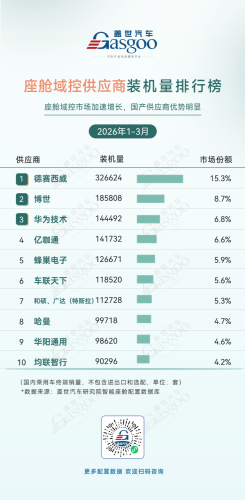
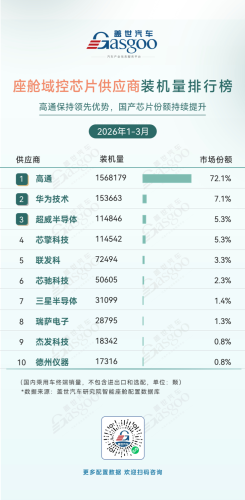
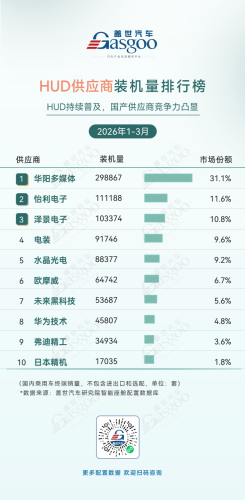
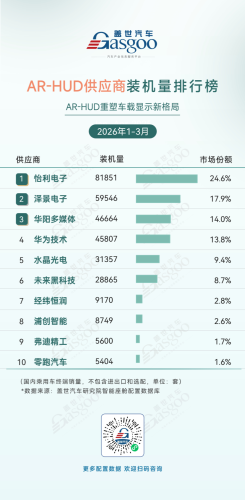
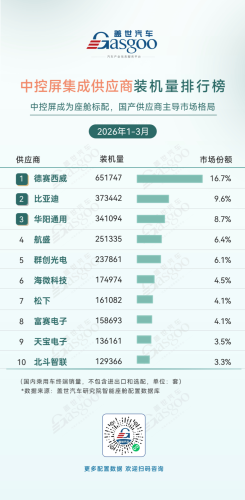
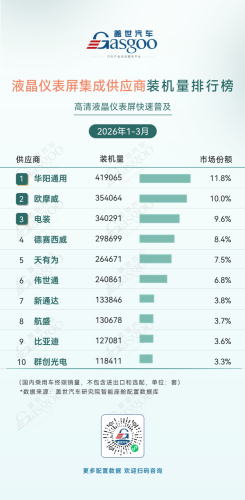
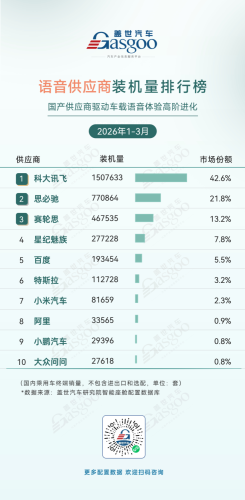
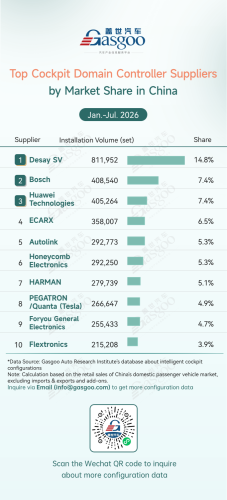
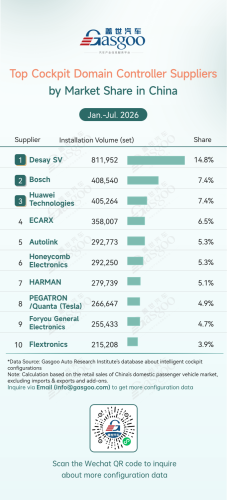
Gasgoo Munich-As the industry's push toward intelligence and electrification deepens, the smart cockpit has become a critical battleground for automakers building differentiated experiences and competing for users. Key segments—including cockpit domain controllers, domain chips, HUD, AR-HUD, center screens, LCD instrument clusters, and in-car voice systems—are undergoing simultaneous technological upgrades and a reshaping of the competitive landscape. Q1 2026 installation rankings reveal a domestic supply chain leading across the board, widening gaps among top players, and persistent variables in high-growth tracks, pushing the smart cockpit supply chain into a new phase of competition and cooperation.Cockpit Domain Controller Supplier Installation Volume RankingsFirst place: Desay SV. From January to March 2026, installation volume in the domestic passenger vehicle market reached 326,624 units, with a market share of 15.3%.Second place: Bosch. From January to March 2026, installation volume in the domestic passenger vehicle market reached 185,808 units, with a market share of 8.7%.Third place: Huawei Technologies. From January to March 2026, installation volume in the domestic passenger vehicle market reached 144,492 units, with a market share of 6.8%.Fourth place: ECARX. From January to March 2026, installation volume in the domestic passenger vehicle market reached 141,732 units, with a market share of 6.6%.Fifth place: SVolt Electronics. From January to March 2026, installation volume in the domestic passenger vehicle market reached 126,671 units, with a market share of 5.9%.Sixth place: CheLianTianXia. From January to March 2026, installation volume in the domestic passenger vehicle market reached 118,520 units, with a market share of 5.6%.Seventh place: Pegatron, Quanta (Tesla). From January to March 2026, installation volume in the domestic passenger vehicle market reached 112,728 units, with a market share of 5.3%.Eighth place: HARMAN. From January to March 2026, installation volume in the domestic passenger vehicle market reached 99,718 units, with a market share of 4.7%.Ninth place: Foryou General. From January to March 2026, installation volume in the domestic passenger vehicle market reached 98,620 units, with a market share of 4.6%.Tenth place: JKN. From January to March 2026, installation volume in the domestic passenger vehicle market reached 90,296 units, with a market share of 4.2%.The Q1 2026 rankings for cockpit domain controllers highlight a market defined by "domestic leadership and tiered differentiation." Desay SV holds the top spot with 326,624 units and a 15.3% share, widening its lead and demonstrating dominance in integrated cockpit solutions and full-vehicle system integration. Bosch (185,808 units, 8.7%) and Huawei Technologies (144,492 units, 6.8%) follow in second and third. Together, these three form the market's first tier, dictating the supply landscape.ECARX, SVolt Electronics, CheLianTianXia, Pegatron/Quanta (Tesla), and HARMAN comprise the second tier, with shares clustered between 4.7% and 6.6%. This tight competition reflects diverse demand for differentiated cockpit solutions. Foryou General and JKN also cracked the top ten, each holding over 4%, showing that while the market is concentrated at the top, local players are growing steadily through vertical integration and ecosystem binding. Overall, the domestic advantage is becoming more pronounced; local suppliers are leveraging hardware-software integration to squeeze traditional foreign firms, driving the industry toward platformization and integration.Cockpit Domain Controller Chip Supplier Installation Volume RankingsFirst place: Qualcomm. From January to March 2026, installation volume of cockpit domain controller chips in the domestic passenger vehicle market reached 1,568,179 units, with a market share of 72.1%.Second place: Huawei Technologies. From January to March 2026, installation volume of cockpit domain controller chips in the domestic passenger vehicle market reached 153,663 units, with a market share of 7.1%.Third place: AMD. From January to March 2026, installation volume of cockpit domain controller chips in the domestic passenger vehicle market reached 114,846 units, with a market share of 5.3%.Fourth place: SiEngine. From January to March 2026, installation volume of cockpit domain controller chips in the domestic passenger vehicle market reached 114,542 units, with a market share of 5.3%.Fifth place: MediaTek. From January to March 2026, installation volume of cockpit domain controller chips in the domestic passenger vehicle market reached 72,494 units, with a market share of 3.3%.Sixth place: Semicrive. From January to March 2026, installation volume of cockpit domain controller chips in the domestic passenger vehicle market reached 50,605 units, with a market share of 2.3%.Seventh place: Samsung Semiconductor. From January to March 2026, installation volume of cockpit domain controller chips in the domestic passenger vehicle market reached 31,099 units, with a market share of 1.4%.Eighth place: Renesas Electronics. From January to March 2026, installation volume of cockpit domain controller chips in the domestic passenger vehicle market reached 28,795 units, with a market share of 1.3%.Ninth place: AutoChips. From January to March 2026, installation volume of cockpit domain controller chips in the domestic passenger vehicle market reached 18,342 units, with a market share of 0.8%.Tenth place: Texas Instruments. From January to March 2026, installation volume of cockpit domain controller chips in the domestic passenger vehicle market reached 17,316 units, with a market share of 0.8%.In Q1 2026, the cockpit chip sector showed a pattern of monopolistic dominance and rapid local breakout. Qualcomm stands alone with a massive 72.1% share, firmly controlling mainstream mid-to-high-end supply—a position unlikely to be shaken soon. Huawei Technologies holds second place, accelerating the volume production of its self-developed chips. AMD and SiEngine took third and fourth with 114,846 and 114,542 units respectively, neck-and-neck in share, as local and emerging chip designers gradually pry open the market.MediaTek and Semicrive hold the middle tier, steadily penetrating mid-range models. Samsung Semiconductor, Renesas Electronics, AutoChips, and Texas Instruments round out the top ten, mostly focusing on niche markets and specific clients. While Qualcomm's edge remains unassailable in the short term, domestic forces led by Huawei and SiEngine are leveraging localized service and customization to gain ground in the mid-to-high-end market, accelerating the push for supply chain autonomy.HUD Supplier Installation Volume RankingsFirst place: Foryou Multimedia. From January to March 2026, installation volume of HUDs in the domestic passenger vehicle market reached 298,867 units, with a market share of 31.1%.Second place: E-Lead Electronic. From January to March 2026, installation volume of HUDs in the domestic passenger vehicle market reached 111,188 units, with a market share of 11.6%.Third place: New Vision. From January to March 2026, installation volume of HUDs in the domestic passenger vehicle market reached 103,374 units, with a market share of 10.8%.Fourth place: Denso. From January to March 2026, installation volume of HUDs in the domestic passenger vehicle market reached 91,746 units, with a market share of 9.6%.Fifth place: Crystal Optoelectronics. From January to March 2026, installation volume of HUDs in the domestic passenger vehicle market reached 88,377 units, with a market share of 9.2%.Sixth place: AUMOVIO. From January to March 2026, installation volume of HUDs in the domestic passenger vehicle market reached 64,742 units, with a market share of 6.7%.Seventh place: FUTURUS. From January to March 2026, installation volume of HUDs in the domestic passenger vehicle market reached 53,687 units, with a market share of 5.6%.Eighth place: Huawei Technologies. From January to March 2026, installation volume of HUDs in the domestic passenger vehicle market reached 45,807 units, with a market share of 4.8%.Ninth place: Findreams Precision. From January to March 2026, installation volume of HUDs in the domestic passenger vehicle market reached 34,934 units, with a market share of 3.6%.Tenth place: Nippon Seiki. From January to March 2026, installation volume of HUDs in the domestic passenger vehicle market reached 17,035 units, with a market share of 1.8%.In Q1 2026, autAUMOVIOtive HUDs entered a volume expansion phase, with local suppliers showing strong competitiveness. Foryou Multimedia leads decisively with a 31.1% share, thanks to mature mass production and cost-effective solutions. E-Lead Electronic, New Vision, and Denso form the second tier, with shares hovering around 10% in a tight race. Crystal Optoelectronics ranks fifth with a 9.2% share and 88,377 units installed.AUMOVIO, FUTURUS, Huawei Technologies, Findreams Precision, and Nippon Seiki follow in sixth through tenth, with shares ranging from 6.7% down to 1.8%. Notably, local firms occupy eight of the top ten spots, accounting for over 83% combined. Overall, the quarter saw significant volume in entry-level HUDs, while high-end AR-HUDs are poised for takeoff. Local players now control the mainstream market, leaving foreign brands with residual space mostly in joint-venture models.AR-HUD Supplier Installation Volume RankingsFirst place: E-Lead Electronic. From January to March 2026, installation volume of AR-HUDs in the domestic passenger vehicle market reached 81,851 units, with a market share of 24.6%.Second place: New Vision. From January to March 2026, installation volume of AR-HUDs in the domestic passenger vehicle market reached 59,546 units, with a market share of 17.9%.Third place: Foryou Multimedia. From January to March 2026, installation volume of AR-HUDs in the domestic passenger vehicle market reached 46,664 units, with a market share of 14.0%.Fourth place: Huawei Technologies. From January to March 2026, installation volume of AR-HUDs in the domestic passenger vehicle market reached 45,807 units, with a market share of 13.8%.Fifth place: Crystal Optoelectronics. From January to March 2026, installation volume of AR-HUDs in the domestic passenger vehicle market reached 31,357 units, with a market share of 9.4%.Sixth place: FUTURUS. From January to March 2026, installation volume of AR-HUDs in the domestic passenger vehicle market reached 28,865 units, with a market share of 8.7%.Seventh place: Hirain Technologies. From January to March 2026, installation volume of AR-HUDs in the domestic passenger vehicle market reached 9,170 units, with a market share of 2.8%.Eighth place: Puchuang Intelligence. From January to March 2026, installation volume of AR-HUDs in the domestic passenger vehicle market reached 8,749 units, with a market share of 2.6%.Ninth place: Findreams Precision. From January to March 2026, installation volume of AR-HUDs in the domestic passenger vehicle market reached 5,600 units, with a market share of 1.7%.Tenth place: Leapmotor. From January to March 2026, installation volume of AR-HUDs in the domestic passenger vehicle market reached 5,404 units, with a market share of 1.6%.The Q1 2026 AR-HUD rankings show a relatively balanced market distribution. E-Lead Electronic leads with 24.6%, followed closely by New Vision, Foryou Multimedia, and Huawei Technologies. The gap among these top four is minimal, signaling intense competition.Crystal Optoelectronics and FUTURUS form a second tier with 9.4% and 8.7% respectively, combining for over 18% and demonstrating steady capability in this niche. Hirain Technologies, Puchuang Intelligence, Findreams Precision, and Leapmotor also made the top ten, relying mostly on specific projects or in-house supply, with shares under 3%. Overall, the AR-HUD market lacks an absolute leader. As automakers demand more immersive interaction and better visualization for ADAS, and suppliers break through in optics and mass production, the landscape remains volatile.Center Screen Integration Supplier Installation Volume RankingsFirst place: Desay SV. From January to March 2026, installation volume of integrated center screens in the domestic passenger vehicle market reached 651,747 units, with a market share of 16.7%.Second place: BYD. From January to March 2026, installation volume of integrated center screens in the domestic passenger vehicle market reached 373,442 units, with a market share of 9.6%.Third place: Foryou General. From January to March 2026, installation volume of integrated center screens in the domestic passenger vehicle market reached 341,094 units, with a market share of 8.7%.Fourth place: Hangsheng Electronics. From January to March 2026, installation volume of integrated center screens in the domestic passenger vehicle market reached 251,335 units, with a market share of 6.4%.Fifth place: Innolux. From January to March 2026, installation volume of integrated center screens in the domestic passenger vehicle market reached 237,861 units, with a market share of 6.1%.Sixth place: Hiway Technology. From January to March 2026, installation volume of integrated center screens in the domestic passenger vehicle market reached 174,974 units, with a market share of 4.5%.Seventh place: Panasonic. From January to March 2026, installation volume of integrated center screens in the domestic passenger vehicle market reached 161,082 units, with a market share of 4.1%.Eighth place: Fusai Electronics. From January to March 2026, installation volume of integrated center screens in the domestic passenger vehicle market reached 158,693 units, with a market share of 4.1%.Ninth place: Ten Pao. From January to March 2026, installation volume of integrated center screens in the domestic passenger vehicle market reached 136,161 units, with a market share of 3.5%.Tenth place: BICV. From January to March 2026, installation volume of integrated center screens in the domestic passenger vehicle market reached 129,366 units, with a market share of 3.3%.The Q1 2026 center screen rankings feature a leading pack with multiple challengers. Desay SV holds the top spot with 16.7%, leveraging large-screen and multi-screen integration solutions for mainstream automakers to scale its advantage. BYD, relying on its self-supply system, takes second, while Foryou General is third. Local firms have firmly secured the top ranks.Hangsheng Electronics and Innolux hold the middle tier, balancing supplies between traditional OEMs and startups. Hiway Technology, Panasonic, and Fusai Electronics have similar shares, showing fierce competition between local and foreign firms. Ten Pao and BICV entered the top ten through stable volume and deep client relationships. Overall, the competition has shifted from simple hardware supply to customization, high-definition display, and cockpit integration capabilities, with local suppliers growing stronger.LCD Instrument Cluster Integration Supplier Installation Volume RankingsFirst place: Foryou General. From January to March 2026, installation volume of integrated LCD instrument clusters in the domestic passenger vehicle market reached 419,065 units, with a market share of 11.8%.Second place: AUMOVIO. From January to March 2026, installation volume of integrated LCD instrument clusters in the domestic passenger vehicle market reached 354,064 units, with a market share of 10.0%.Third place: Denso. From January to March 2026, installation volume of integrated LCD instrument clusters in the domestic passenger vehicle market reached 340,291 units, with a market share of 9.6%.Fourth place: Desay SV. From January to March 2026, installation volume of integrated LCD instrument clusters in the domestic passenger vehicle market reached 298,699 units, with a market share of 8.4%.Fifth place: Tianyouwei Electronics. From January to March 2026, installation volume of integrated LCD instrument clusters in the domestic passenger vehicle market reached 264,671 units, with a market share of 7.5%.Sixth place: Visteon. From January to March 2026, installation volume of integrated LCD instrument clusters in the domestic passenger vehicle market reached 240,861 units, with a market share of 6.8%.Seventh place: Xintongda. From January to March 2026, installation volume of integrated LCD instrument clusters in the domestic passenger vehicle market reached 133,846 units, with a market share of 3.8%.Eighth place: Hangsheng Electronics. From January to March 2026, installation volume of integrated LCD instrument clusters in the domestic passenger vehicle market reached 130,678 units, with a market share of 3.7%.Ninth place: BYD. From January to March 2026, installation volume of integrated LCD instrument clusters in the domestic passenger vehicle market reached 127,081 units, with a market share of 3.6%.Tenth place: Innolux. From January to March 2026, installation volume of integrated LCD instrument clusters in the domestic passenger vehicle market reached 118,411 units, with a market share of 3.3%.The Q1 2026 LCD cluster rankings reveal a fragmented market with a tight race at the top. Foryou General leads with 419,065 units and an 11.8% share. AUMOVIO and Denso follow closely with 354,064 and 340,291 units respectively (10.0% and 9.6%). The gap between the top three is narrow, indicating a fierce standoff.Desay SV, Tianyouwei Electronics, and Visteon form the second tier with 8.4%, 7.5%, and 6.8% shares respectively, collectively holding over 22%. The tail group—including Xintongda, Hangsheng Electronics, BYD, and Innolux—holds under 4% each, suggesting moderate market concentration. As fully digital clusters penetrate deeper and cockpit domain fusion advances, scale and technical synergy will be key factors shaping the landscape.Voice Supplier Installation Volume RankingsFirst place: iFLYTEK. From January to March 2026, installation volume of voice systems in the domestic passenger vehicle market reached 1,507,633 units, with a market share of 42.6%.Second place: AISpeech. From January to March 2026, installation volume of voice systems in the domestic passenger vehicle market reached 770,864 units, with a market share of 21.8%.Third place: Cerence. From January to March 2026, installation volume of voice systems in the domestic passenger vehicle market reached 467,535 units, with a market share of 13.2%.Fourth place: DreamSmart Group. From January to March 2026, installation volume of voice systems in the domestic passenger vehicle market reached 277,228 units, with a market share of 7.8%.Fifth place: Baidu. From January to March 2026, installation volume of voice systems in the domestic passenger vehicle market reached 193,454 units, with a market share of 5.5%.Sixth place: Tesla. From January to March 2026, installation volume of voice systems in the domestic passenger vehicle market reached 112,728 units, with a market share of 3.2%.Seventh place: Xiaomi EV. From January to March 2026, installation volume of voice systems in the domestic passenger vehicle market reached 81,659 units, with a market share of 2.3%.Eighth place: Alibaba. From January to March 2026, installation volume of voice systems in the domestic passenger vehicle market reached 33,565 units, with a market share of 0.9%.Ninth place: XPENG. From January to March 2026, installation volume of voice systems in the domestic passenger vehicle market reached 29,396 units, with a market share of 0.8%.Tenth place: Volkswagen Ask. From January to March 2026, installation volume of voice systems in the domestic passenger vehicle market reached 27,618 units, with a market share of 0.8%.The Q1 2026 voice rankings show high concentration at the top and total dominance by local players. iFLYTEK leads with a commanding 42.6% share and 1.51 million units, leveraging deep expertise in recognition, NLP, and ecosystems. AISpeech and Cerence follow in second and third. The top three control over 77% of the market, cementing a solid first tier.DreamSmart Group and Baidu take fourth and fifth with 7.8% and 5.5% shares respectively. Tesla, Xiaomi EV, Alibaba, XPENG, and Volkswagen Ask follow in sixth through tenth. Notably, Xiaomi represents a wave of OEMs developing in-house voice solutions. Overall, the market has entered a phase of stock competition and experience upgrades. The focus is shifting from basic recognition to multimodal interaction, full-scenario continuous dialogue, and custom ecosystems—a space where top local players remain unshakable.Data Source: Gasgoo AutAUMOVIOtive Research Institute Smart Cockpit Configuration Database—Recommended Content—