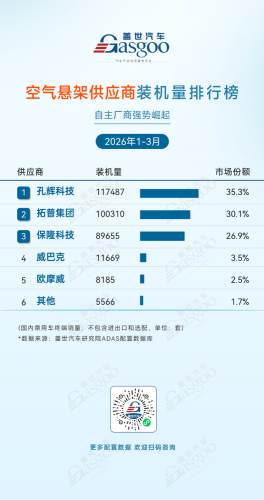
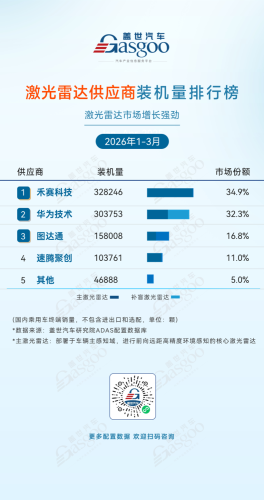
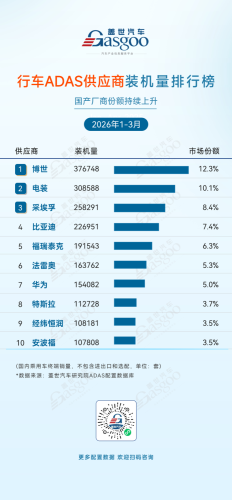
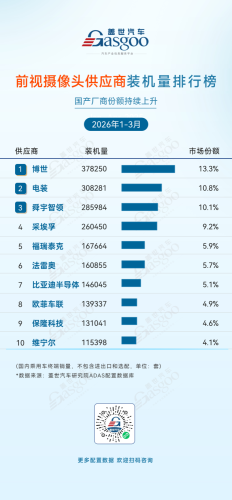
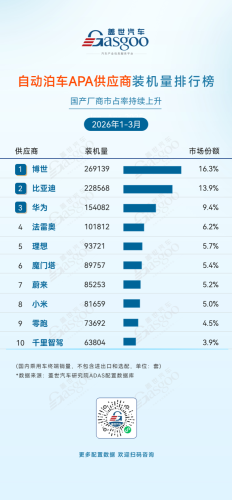
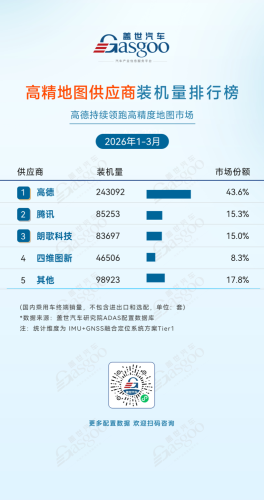
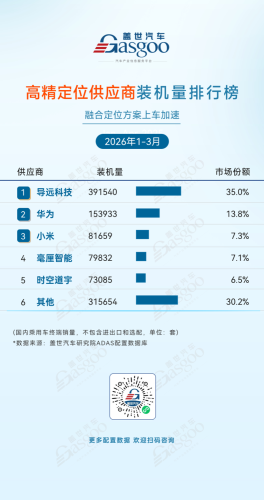
Gasgoo Munich-Data from Gasgoo Automotive Research Institute shows that in the first quarter of 2026, China's passenger vehicle core components market maintained steady growth, with installation volumes expanding across specialized segments and the competitive landscape shifting. Local players further solidified their dominance in sectors like air suspension, LiDAR, high-definition maps, and high-precision positioning, driving industry concentration higher and establishing a firm local hierarchy. Although international giants still hold the first-mover advantage in driving ADAS, front-view cameras, and automated parking, domestic suppliers are rising aggressively—leveraging proprietary R&D, vertical integration, and strong automaker partnerships to reshuffle market rankings and grab share at a rapid pace.Beneath the surface, the supply chain for core components is undergoing a structural reshaping as electrification and intelligent features penetrate the market. Domestic firms have leveled up across R&D, mass production, and scenario adaptation, creating a new dynamic of multi-point competition and differentiated development against global giants. This not only bolsters the domestic smart vehicle ecosystem but also provides critical data and industry insights for the future adoption of high-level autonomous driving and the evolution of the components landscape.Air Suspension Supplier Installation Volume RankingsKH Automotive Technologies: 117,487 sets installed in the domestic passenger vehicle market from January to March 2026, with a 35.3% market share.Tuopu Group: 100,310 sets installed in the domestic passenger vehicle market from January to March 2026, with a 30.1% market share.Baolong Technology: 89,655 sets installed in the domestic passenger vehicle market from January to March 2026, with a 26.9% market share.Vibracoustic: 11,669 sets installed in the domestic passenger vehicle market from January to March 2026, with a 3.5% market share.AUMOVIO: 8,185 sets installed in the domestic passenger vehicle market from January to March 2026, with a 2.5% market share.Others: 5,566 sets installed in the domestic passenger vehicle market from January to March 2026, with a 1.7% market share.In the first quarter of 2026, the domestic air suspension market continued to be defined by the rise of local firms and extreme concentration at the top. KH Automotive Technologies surged to the industry lead with 117,487 installations and a 35.3% market share, leveraging its edge in air spring control technology and broad customer coverage. Tuopu Group and Baolong Technology followed with 100,310 and 89,655 installations respectively, capturing 30.1% and 26.9% of the market. Together, these three leaders command over 92% of the market, establishing a clear and stable hierarchy that dominates the domestic supply system.In contrast, suppliers like Vibracoustic and AUMOVIO hold smaller slices of the domestic market, recording 11,669 and 8,185 installations respectively—together accounting for just 6%. The remaining players managed only 5,566 installations, representing a mere 1.7% share, making a breakout difficult. Overall, the shift toward domestic substitution in Q1 deepened: local manufacturers, armed with cost controls, rapid response times, and fast tech iteration, are squeezing the space for foreign and smaller rivals, pushing the industry toward high concentration.LiDAR Supplier Installation Volume RankingsHesai Technology: 328,246 units installed in the domestic passenger vehicle market from January to March 2026, with a 34.9% market share.Huawei Technologies: 303,753 units installed in the domestic passenger vehicle market from January to March 2026, with a 32.3% market share.Seyond: 158,008 units installed in the domestic passenger vehicle market from January to March 2026, with a 16.8% market share.RoboSense: 103,761 units installed in the domestic passenger vehicle market from January to March 2026, with an 11.0% market share.Others: 46,888 units installed in the domestic passenger vehicle market from January to March 2026, with a 5.0% market share.The domestic LiDAR market posted strong growth in Q1 2026, settling into a 'dual-leader' pattern with a second tier steadily following. Hesai Technology jumped to the top spot with a 34.9% share and 328,246 installations, favored by automakers for its high-end smart driving solutions thanks to precision, cost control, and automotive-grade reliability. Huawei Technologies followed closely with 32.3%. Together, these two local giants control 67.2% of the market, dictating the competitive landscape.Seyond and RoboSense hold firm in third and fourth place, forming the second tier with differentiated strategies in high-end driving and blind-spot detection that complement the market leaders. Tail-end players collectively hold just 5%, as resources continue to flow toward the top. Domestic LiDAR firms have already built out complete technology and capacity capabilities; as penetration rates for high-level autonomous driving rise, leading vendors will benefit from increasing vehicle volumes, driving industry concentration even higher.Driving ADAS Supplier Installation Volume RankingsBosch: 376,748 sets installed in the domestic passenger vehicle market from January to March 2026, with a 12.3% market share.Denso: 308,588 sets installed in the domestic passenger vehicle market from January to March 2026, with a 10.1% market share.ZF: 258,291 sets installed in the domestic passenger vehicle market from January to March 2026, with an 8.4% market share.BYD: 226,951 sets installed in the domestic passenger vehicle market from January to March 2026, with a 7.4% market share.Freetech: 191,543 sets installed in the domestic passenger vehicle market from January to March 2026, with a 6.3% market share.Valeo: 163,762 sets installed in the domestic passenger vehicle market from January to March 2026, with a 5.3% market share.Huawei: 154,082 sets installed in the domestic passenger vehicle market from January to March 2026, with a 5.0% market share.Tesla: 112,728 sets installed in the domestic passenger vehicle market from January to March 2026, with a 3.7% market share.Hirain Technologies: 108,181 sets installed in the domestic passenger vehicle market from January to March 2026, with a 3.5% market share.Aptiv: 107,808 sets installed in the domestic passenger vehicle market from January to March 2026, with a 3.5% market share.In Q1 2026, the domestic driving ADAS market displayed a pattern of 'foreign dominance with local pursuit.' Bosch held the top spot with 376,748 installations and a 12.3% share, sustained by solution maturity and a broad customer base. Denso and ZF followed with 308,588 (10.1%) and 258,291 (8.4%) installations respectively. These three international Tier 1 suppliers combine for over 30% of the market, forming a first tier that retains clear advantages in scale and delivery capability.Notably, domestic brands and solution providers delivered standout growth. BYD surged into fourth place, powered by its self-supply system, while Freetech, Huawei, and Hirain Technologies secured their positions in the top ten, rapidly penetrating the mid-to-low-end segments and automakers with in-house R&D. Foreign players like Tesla, Valeo, and Aptiv held relatively steady, but their growth lagged behind local rivals. Overall, the quarter painted a picture of foreign incumbents defending ground while domestic challengers break through—leveraging algorithm iteration, vertical integration, and cost-performance advantages to rewrite the supply chain and accelerate the push for autonomous control.Front-view Camera Supplier Installation Volume RankingsBosch: 378,250 sets installed in the domestic passenger vehicle market from January to March 2026, with a 13.3% market share.Denso: 308,281 sets installed in the domestic passenger vehicle market from January to March 2026, with a 10.8% market share.Sunny Smartlead: 285,984 sets installed in the domestic passenger vehicle market from January to March 2026, with a 10.1% market share.ZF: 260,450 sets installed in the domestic passenger vehicle market from January to March 2026, with a 9.2% market share.Freetech: 167,664 sets installed in the domestic passenger vehicle market from January to March 2026, with a 5.9% market share.Valeo: 160,855 sets installed in the domestic passenger vehicle market from January to March 2026, with a 5.7% market share.BYD Semiconductor: 146,045 sets installed in the domestic passenger vehicle market from January to March 2026, with a 5.1% market share.O-film: 139,337 sets installed in the domestic passenger vehicle market from January to March 2026, with a 4.9% market share.Baolong Technology: 131,041 sets installed in the domestic passenger vehicle market from January to March 2026, with a 4.6% market share.Veoneer: 115,398 sets installed in the domestic passenger vehicle market from January to March 2026, with a 4.1% market share.The front-view camera market in Q1 2026 featured a parallel competition between international giants and domestic manufacturers. Bosch held the lead with a 13.3% share and 378,250 installations, remaining the industry benchmark thanks to deep technical expertise and global integration capabilities. Denso ranked second with 10.8% and 308,281 installations. Sunny Smartlead jumped to third with 10.1%, emerging as the leader among domestic firms by demonstrating breakthroughs in optical sensing and production capacity. ZF took fourth with 260,450 installations and a 9.2% share. Together, the top four control over 43% of the market, signaling high concentration.Local players like Freetech, BYD Semiconductor, O-film, and Baolong Technology collectively entered the top ten, covering the full chain from optical lenses to algorithm integration. Their penetration is rising rapidly among domestic automakers and cost-effective models. Industry competition has evolved beyond simple hardware manufacturing into a comprehensive contest of optical technology, algorithm adaptation, and automotive-grade mass production—giving domestic suppliers a louder voice in the front-view camera sector.Automated Parking APA Supplier Installation Volume RankingsBosch: 269,139 sets installed in the domestic passenger vehicle market from January to March 2026, with a 16.3% market share.BYD: 228,568 sets installed in the domestic passenger vehicle market from January to March 2026, with a 13.9% market share.Huawei: 154,082 sets installed in the domestic passenger vehicle market from January to March 2026, with a 9.4% market share.Valeo: 101,812 sets installed in the domestic passenger vehicle market from January to March 2026, with a 6.2% market share.Li Auto: 93,721 sets installed in the domestic passenger vehicle market from January to March 2026, with a 5.7% market share.Momenta: 89,757 sets installed in the domestic passenger vehicle market from January to March 2026, with a 5.4% market share.NIO: 85,253 sets installed in the domestic passenger vehicle market from January to March 2026, with a 5.2% market share.Xiaomi: 81,659 sets installed in the domestic passenger vehicle market from January to March 2026, with a 5.0% market share.Leapmotor: 73,692 sets installed in the domestic passenger vehicle market from January to March 2026, with a 4.5% market share.AFARI: 63,804 sets installed in the domestic passenger vehicle market from January to March 2026, with a 3.9% market share.In Q1 2026, the domestic automated parking (APA) market was characterized by foreign leadership and the collective rise of self-developing automakers and local solution providers. Bosch retained the top spot, benefiting from broad model compatibility. BYD claimed second place, powered by its proprietary self-supply system, while Huawei held firm in third. Domestic firms have now broken into the first tier, directly challenging traditional foreign giants.New EV players like Li Auto, NIO, Xiaomi, and Leapmotor are rapidly rolling out in-house parking solutions, while third-party providers like Momenta and AFARI are steadily scaling up, creating a multi-layered, differentiated market. The competitive focus has shifted from basic parking functions to high-level scenarios like complex urban environments and unmanned autonomous parking. Local companies excel at scenario localization, rapid algorithm iteration, and ecosystem integration, steadily eroding the market share of traditional foreign players and accelerating the pace of domestic substitution.High-Definition Map Supplier Installation Volume RankingsAmap: 243,092 sets installed in the domestic passenger vehicle market from January to March 2026, with a 43.6% market share.Tencent: 85,253 sets installed in the domestic passenger vehicle market from January to March 2026, with a 15.3% market share.Langge Technology: 83,697 sets installed in the domestic passenger vehicle market from January to March 2026, with a 15.0% market share.NavInfo: 46,506 sets installed in the domestic passenger vehicle market from January to March 2026, with an 8.3% market share.Others: 98,923 sets installed in the domestic passenger vehicle market from January to March 2026, with a 17.8% market share.The high-definition map market in Q1 2026 was dominated by local suppliers with high concentration at the top. Amap maintained its position as the undisputed leader with a share approaching half the market, leveraging its data update capabilities, automaker integration ecosystem, and mature track record to monopolize supplies for mainstream premium and smart driving models.Tencent and Langge Technology followed closely in the second tier, with NavInfo in fourth. Together, these four major map providers control over 80% of the market. Other suppliers retain 17.8%, leaving some room for diversity. Short term, the landscape is unlikely to see disruptive change; the strong will stay strong, with competition centering on map freshness, vehicle adaptation, and the ability to scale across multiple cities.High-Precision Positioning Supplier Installation Volume RankingsASENSING: 391,540 sets installed in the domestic passenger vehicle market from January to March 2026, with a 35.0% market share.Huawei: 153,933 sets installed in the domestic passenger vehicle market from January to March 2026, with a 13.8% market share.Xiaomi: 81,659 sets installed in the domestic passenger vehicle market from January to March 2026, with a 7.3% market share.MCT: 79,832 sets installed in the domestic passenger vehicle market from January to March 2026, with a 7.1% market share.Geespace: 73,085 sets installed in the domestic passenger vehicle market from January to March 2026, with a 6.5% market share.Others: 315,654 sets installed in the domestic passenger vehicle market from January to March 2026, with a 30.2% market share.In Q1 2026, the domestic high-precision positioning market saw a significant rise in integrated positioning solutions, with a clear stratification of tiers. ASENSING raced ahead with a 35% share, driven by its full-stack integrated positioning offerings and extensive automaker design wins, further widening its lead in scale and customer coverage.Huawei, Xiaomi, MCT, and Geespace ranked second through fifth, respectively, each carving out niches via ecosystems, chip integration, or satellite positioning to secure stable partnerships across different automaker camps. Notably, other providers still command a combined 30.2% share, indicating diverse technological routes and parallel deployment schemes without extreme monopoly. Looking ahead, competition will focus on multi-source sensor fusion, low-cost mass production, and reliability across all scenarios—sectors where local firms have already established dominance in the domestic supply market.Data Source: Gasgoo Automotive Research Institute ADAS Configuration DatabaseScan the QR code below to sign up and get free data samples——Recommended Content——(Click image for details)




















 +48 others