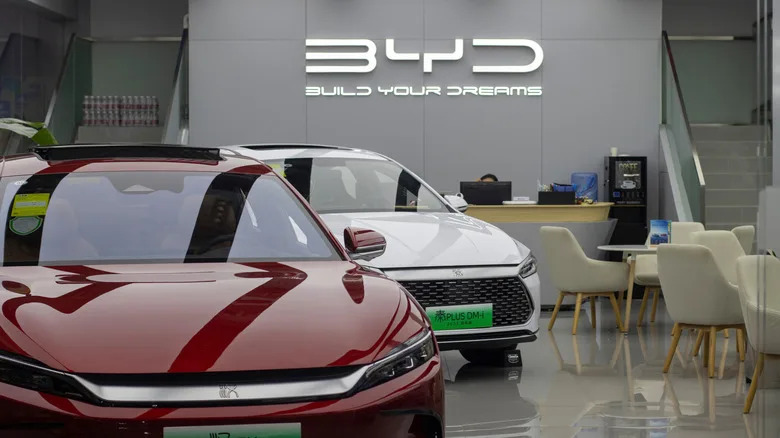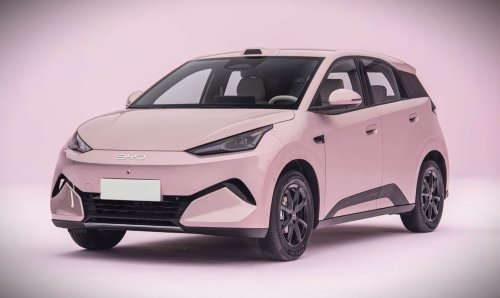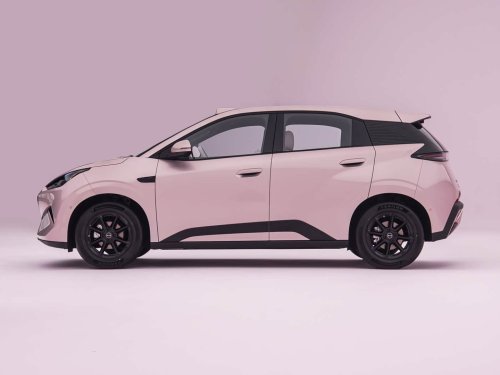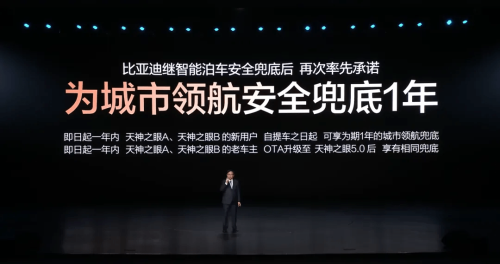
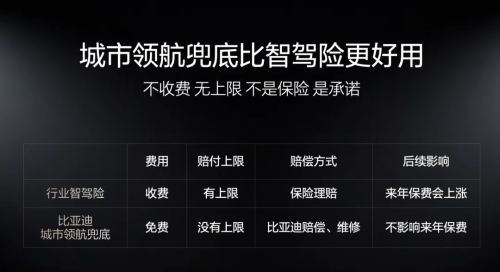
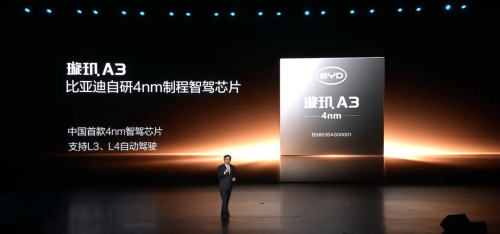
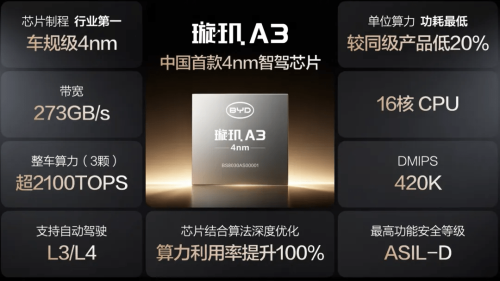
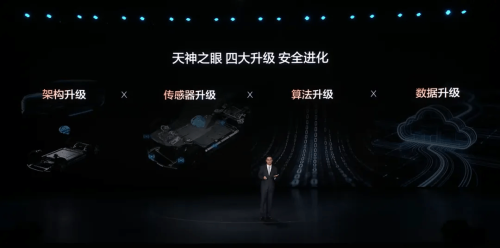
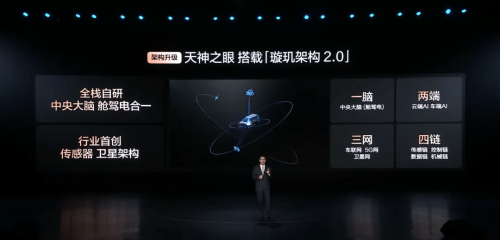
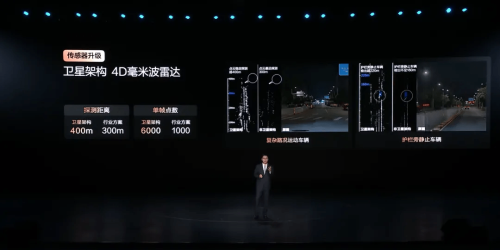
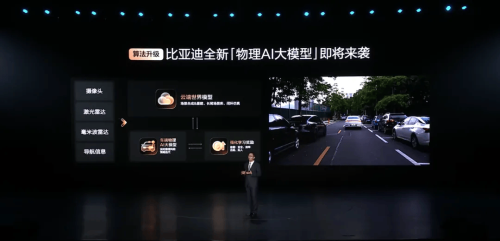
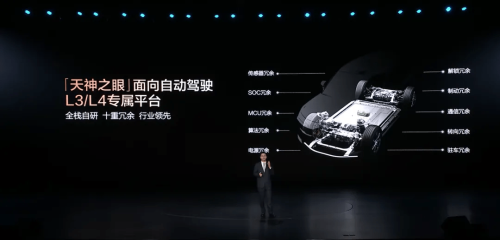
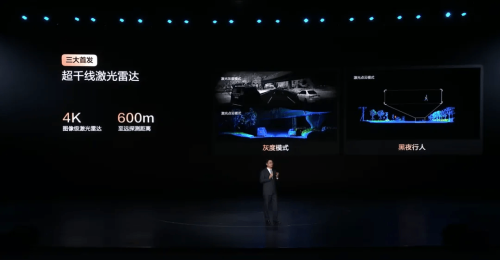
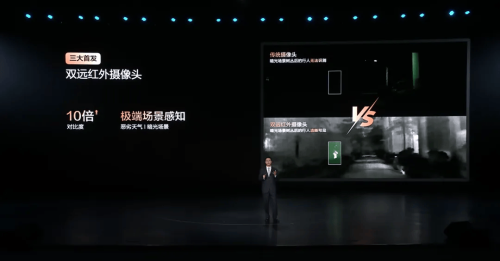
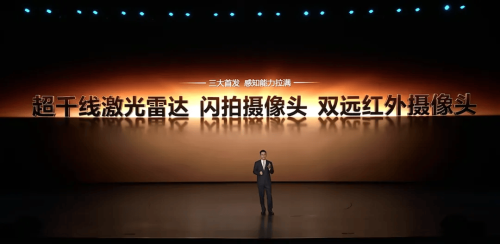



















On the evening of May 28, BYD unveiled two more major technology announcements. The amount of information released at the event rivaled the company’s second-generation Blade Battery and Flash Charging 2.0 launch two months ago. Back then, BYD was attempting to redefine the electrification era; this time, it is clearly moving deeper into the intelligent vehicle era. Before unveiling its core technologies, BYD first announced a more consumer-facing decision. Starting in 2025, BYD had already introduced liability coverage for its intelligent parking assistance system. This time, the automaker expanded that policy to urban navigation-assisted driving scenarios. BYD expands coverage to urban navigation-assisted driving scenarios. The coverage is free of charge, comes with no compensation cap, and does not affect users’ insurance premiums in the following year. The policy applies to users equipped with the God’s Eye B system and versions above God’s Eye 5.0, offering one year of coverage. In addition, BYD announced that all models under its lineup will now support the optional God’s Eye B system, priced at RMB 12,000 ($1,770). BYD’s liability coverage policy BYD Chairman Wang Chuanfu said assisted driving should become as essential for modern EVs as automatic transmissions once became for gasoline cars. After discussing its “smart driving for all” strategy, BYD moved on to the real highlights of the event: its self-developed autonomous driving chip, a new autonomous driving platform, and an entirely new architecture built around the chip. So how capable is BYD’s first in-house smart driving chip? And can its new architecture and L3/L4 platform help the company join the top tier of autonomous driving players? Joining the In-House Smart Driving Chip Race Wang Chuanfu said the first half of the EV era was defined by batteries, electric drivetrains and vehicle manufacturing, while the second half — the intelligence era — will ultimately be determined by chips. Entering the L3/L4 era requires a high-computing chip built on advanced semiconductor processes. This time, BYD introduced what it called “China’s first 4nm smart driving chip” — the Xuanji A3. BYD unveils China’s first 4nm smart driving chip In terms of specifications, the chip features a 16-core CPU architecture, delivers 420K DMIPS, and offers memory bandwidth of 273GB/s. According to BYD’s presentation slides, three Xuanji A3 chips can deliver more than 2100TOPS of computing power, implying each chip exceeds 700TOPS — roughly comparable to Nvidia’s Thor-U. BYD also emphasized its “automotive-grade 4nm” manufacturing process, which it claimed is roughly equivalent to consumer-grade 2nm chips in terms of process standards. BYD’s Xuanji A3 chip parameters For comparison, NIO Inc.’s Shenji NX9031 chip, built on a 5nm process, offers 546GB/s bandwidth and 32 GPU cores, while Li Auto’s newly unveiled Mach M100 Ultra chip delivers 1280TOPS per chip. Xpeng’s Turing AI chip, meanwhile, provides 750TOPS per unit. Compared horizontally, the Xuanji A3 does not stand out purely in terms of raw computing power or memory bandwidth. However, Wang added that BYD had doubled computing utilization efficiency through deep algorithm optimization. Compared with rival products, the chip also consumes 20% less power while still supporting L3/L4 autonomous driving workloads. Before introducing the Xuanji A3, BYD briefly reviewed its semiconductor development history. According to Wang, BYD began developing chips even before entering vehicle manufacturing. During the global chip shortage several years ago, the company established full-stack semiconductor capabilities covering product definition, testing and mass production. Notably, Wang revealed that the Xuanji A3 has already entered large-scale mass production, although specific deployment and launch timelines have not yet been disclosed. While the Xuanji A3 may not have the strongest hardware specs in the industry, the message behind it appears clear: BYD now possesses the capability to independently develop high-computing autonomous driving chips. NIO Inc., Li Auto, Xpeng and suppliers such as Horizon Robotics and Huawei already have their own chip solutions. With the launch of the Xuanji A3 chip, BYD has officially joined that club as well. An Integrated Cockpit-Driving-Powertrain Architecture Of course, autonomous driving is a systems-level engineering challenge, and a high-performance chip requires an equally advanced architecture. BYD therefore introduced the Xuanji Architecture 2.0. Upgrades in BYD’s God’s Eye The core concept behind Xuanji Architecture 2.0 is “cockpit-driving-powertrain integration,” which merges the cockpit domain, intelligent driving domain and electric drive control into a centralized computing brain. Autonomous driving decisions, cockpit interaction and vehicle control are all integrated under the same architecture. Xuanji architecture 2.0 Leapmotor is pursuing a similar technical route. For example, its newly launched D19 uses a cockpit-driving integrated solution based on the LEAP 4.0 centralized domain control architecture, with the vehicle’s assisted driving and smart cockpit functions powered by dual Qualcomm 8797 chips. The advantages of centralized computing architectures are obvious. First, they significantly reduce the number of chips and wiring harness lengths, lowering overall hardware costs. Second, they reduce system latency. BYD said Xuanji Architecture 2.0 achieves latency as low as 8 microseconds — an 80% reduction compared with industry averages. At the same time, the architecture introduces a new “satellite architecture,” which BYD claims boosts data bandwidth by 60 times, computing power by 12 times, and detection distance by 33%. Xuanji 2.0’s satellite architecture On the hardware side, the system combines LiDAR, 4D millimeter-wave radar and ultrasonic radar, enabling longer-range detection and higher point-cloud frame rates. BYD said the system can even achieve emergency braking from 150 km/h in certain scenarios. On the software side, BYD said it has entered the era of “physical AI foundation models.” BYD ushers in “physical AI foundation models.” By combining cloud-based world models, on-vehicle physical AI large models and reinforcement learning, the system is designed to better understand complex physical environments. However, how well the system performs in real-world conditions — and whether it can surpass current industry leaders — will only become clear after commercialization. The “Autonomous” Version of God’s Eye As mentioned earlier, the Xuanji A3 is designed for L3/L4 autonomous driving. But before the chip officially enters vehicles, BYD also unveiled an L3/L4-exclusive platform called the “God’s Eye Autonomous Driving Edition.” Xuanji A3 supports L3/L4 autonomous driving The platform reportedly features 10 layers of system redundancy covering unlocking systems, sensors, algorithms, power supply and steering. The platform will use the Xuanji A3 chip and debut three major sensing components: 1,000-line-plus LiDAR, high-speed snapshot cameras, and dual far-infrared cameras. Breaking them down individually, the first is the “1,000-line-plus LiDAR,” which BYD claims offers 4K image-grade clarity and a maximum detection range of 600 meters. Currently, LiDAR systems exceeding 1,000 lines are mostly used in commercial vehicles. In passenger vehicles, Huawei’s 896-line dual-optical-path LiDAR is among the highest currently available. Xuanji chip’s 1,000-line-plus LiDAR Higher line counts mean denser point clouds and larger raw data volumes, placing greater demands on the computing platform. The high-speed snapshot camera and dual far-infrared cameras each target different scenarios. The snapshot camera supports up to 1000fps — more than 30 times the frame rate of conventional 30fps cameras — theoretically enabling it to capture high-speed moving objects more effectively. The dual far-infrared cameras, meanwhile, are intended for poor weather and low-light conditions, improving pedestrian detection capability. Xuanji chip’s dual far-infrared cameras These are not traditional “high-definition cameras,” but together they address the weaknesses of conventional camera systems in high-frame-rate capture and low-visibility scenarios. While the approach differs from Huawei Qiankun’s six-LiDAR solution, the goal is ultimately the same: expanding the capability boundaries of autonomous driving systems. Looking further ahead to L4 autonomous driving, BYD said its future “God’s Eye L4” platform will support advanced unmanned scenarios such as autonomous moose tests, autonomous track driving, autonomous drifting and unmanned logistics transport. Preparing for the Next Battle BYD’s presentation on smart driving technologies last night was not especially detailed. Still, from a consumer perspective, BYD’s push for “smart driving equality” and its expanded liability coverage for advanced assisted driving systems are clearly positive developments, helping improve public confidence and trust in assisted driving technologies. This was also the most widely discussed part of BYD’s presentation, though arguably not the most important one. Xuanji chip’s components It is increasingly clear that beyond bringing LiDAR and advanced urban NOA systems to entry-level A00-class vehicles like the Seagull, BYD also wants a place in the higher-end intelligent driving race. From an industry trend perspective, Chinese automakers are rapidly moving toward self-developed chips. Leading EV startups such as NIO Inc., Li Auto and Xpeng have already unveiled their own solutions. Beyond securing control over high-computing chips — and delivering higher theoretical performance than “general-purpose solutions” like Nvidia Thor-U — Xpeng Chairman and CEO He Xiaopeng previously said the deeper goal is tighter integration between proprietary chips and self-developed autonomous driving algorithms, enabling higher computing utilization efficiency and establishing long-term software-hardware moats. The intelligent driving race is now entering a new phase. With L3 regulations drawing closer in China and Tesla signaling the arrival of FSD in the Chinese market, an intense battle around autonomous driving on Chinese roads now appears inevitable. Whether BYD can maintain the leadership position it established during the electrification era, however, is a question that will only be answered further down the road.