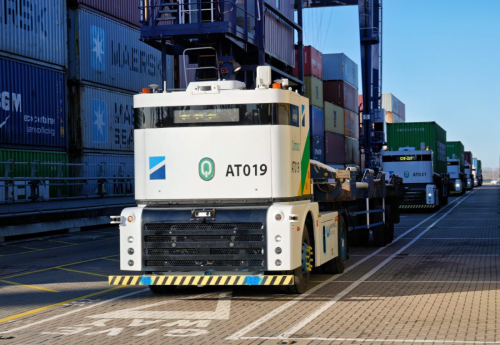
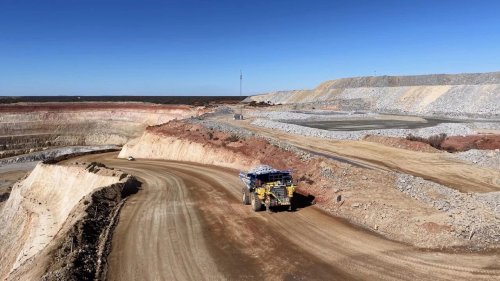
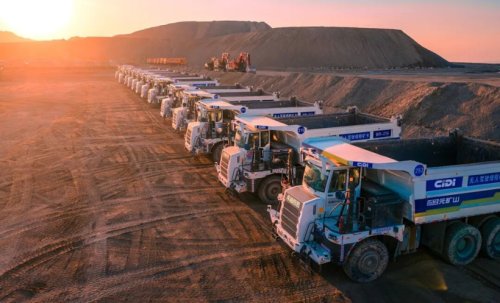
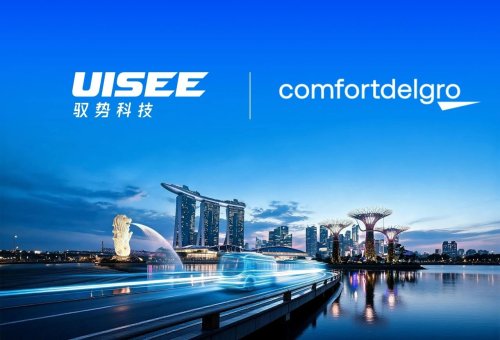
Gasgoo Munich- At Singapore's Changi Airport, a driverless fleet from China is already operating airside.UISEE's autonomous vehicles are now serving overseas aviation hubs, including Hong Kong International Airport and Singapore's Changi Airport.Similar shifts are unfolding at ports. In July, the UK's Port of Felixstowe confirmed its third order for Westwell's Q-Truck. Once delivered, the fleet of autonomous trucks there will reach 100 units.Meanwhile, at the Kalgoorlie goldfields in Western Australia, six Komatsu HD1500 haul trucks have gained "Chinese drivers." E-Ctrl didn't ship a fleet of Chinese autonomous mining trucks to Australia. Instead, it installed its own self-driving system into the site's existing Japanese-brand haulers.Airports, ports, mines. Three distinct production sites are witnessing the same shift: China's L4 solutions, honed on domestic soil, are entering real-world production systems overseas.But "going global" isn't the same as "scaling globally."The three cases vary in maturity and hardly represent the entire Chinese L4 sector. Yet they offer a crucial window into a key question: When Chinese firms move their capabilities—honed in complex domestic production environments—to entirely new regulatory, equipment, and operational frameworks, how much actually carries over?That may be the true test of whether the "China Solution" can genuinely go global.It is also the question that Gasgoo's "China Solution to the World" series aims to answer. As more Chinese technology and industrial solutions enter real-world overseas scenarios, identifying which capabilities hold genuine global competitive edge will be a key focus of the "Golden Gear Awards" hosted by Gasgoo on October 23.Airports: The Real Bottleneck to Replication May Not Be AlgorithmsAirports can easily create an illusion.Enclosed, low-speed, with fixed routes and none of the complex traffic or pedestrians found on open roads, they seem naturally simpler than robotaxis.But in mid-August 2026, during an interview at Urumqi Tianshan International Airport, UISEE co-founder, Chairman, and CEO Wu Gansha pointed out a detail: Airports lack the clear traffic lights and standardized right-of-way signals of city streets. When aircraft push back or park, information is still largely conveyed to transport and shuttle drivers via ground crew waving flags, using hand signals, or relying on the aircraft's own status.Image source: GasgooFor human drivers, this is a familiar language of work.Switch to autonomous driving, and the machine must learn from scratch: when an aircraft is about to move, what the wings, tail, and lights signify, and when to stop and yield. Extreme weather—blizzards, ice, fog, dust storms—only adds to the perception challenge.So even though they are all "airports," Urumqi, Lhasa, Hong Kong, and Singapore present entirely different problems. Climate and layout vary, and once overseas, you layer on differences in regulation, data, and operational systems.That makes UISEE's deployment timelines over the past few years worth watching.Its prospectus reveals that implementing a project at a major international airport in northwest China took roughly 3 years, shrinking to about 1.5 years at Singapore's Changi Airport. At Hong Kong International Airport, project phases fell from roughly 2 years in 2019 to 1 year in 2023, and then to just six months in 2025.Shorter timelines suggest experience is accumulating, but it doesn't yet prove that airport L4 has become a standardized product. Outsiders can hardly tell how much stems from reusable algorithms and engineering, and how much still relies on engineers re-adapting to the site.But push the question a step further, and the real bottleneck to replicating airport L4 may not be the vehicle itself.Since many airport rules were designed for humans, why force machines to endlessly upgrade their ability to interpret them? When an aircraft prepares to enter a zone, rather than having an autonomous vehicle scan lights and judge the plane's status, why can't the airport's operating system digitize that position, status, and right-of-way data and beam it directly to the vehicle?Wu has discussed similar concepts. But the real difficulty may not be technical. Airport operations involve multiple stakeholders—the airport authority, air traffic control, airlines, ground handlers—with fragmented management boundaries. Cross-department coordination is a hurdle in itself.This poses a deeper question for airport L4: Should every autonomous vehicle adapt to different airports, or should airports gradually evolve a common set of operational rules that machines can understand?The former tests a company's engineering prowess; the latter involves standardizing an entire industry.If it remains the former, every new country and airport means new adaptation costs. Only with the latter can the barriers to cross-market replication truly fall.At ports, the problem shifts. Standards are not the issue—the shipping container is itself one of the most successful products of global industrial standardization. The real challenge lies in unifying the production systems behind those containers.Ports: After 100 Trucks, Are You Still Selling Vehicles?In July, the Port of Felixstowe announced its third order for Westwell's Q-Truck. Once delivered, the fleet will total 100 autonomous trucks.Q-Truck operating at the Port of Felixstowe; Image source: Port of FelixstoweCompared to small pilot projects, repeat orders suggest autonomous driving is genuinely integrating into daily port operations.But viewing this merely as "Westwell sold a few dozen more trucks" underestimates the business of port L4.Once a ship docks, quay cranes, container trucks, yards, and yard cranes form a continuous production chain. An autonomous truck driving from point A to point B is just the most basic step.Arrive early, and the truck queues; arrive late, and the crane waits. Reach the yard before the yard crane is ready, and more time is lost. When 100 trucks are working simultaneously, terminal throughput efficiency no longer depends on how smart one truck is, but on who can orchestrate the vehicles and the entire terminal's production rhythm.That is why Westwell's overseas solutions are extending beyond the vehicle.As Felixstowe expands its Q-Truck fleet, it is adding a second automated battery-swapping station and using a private 5G network to link vehicles, control systems, and terminal infrastructure. In other overseas port projects, Westwell has already moved into fleet management, smart gates, and energy management.Autonomous driving is shifting from a vehicle feature to a component of the port production system.But this brings new replication challenges.Global containers may be standard, but ports are not. Different terminals run different Terminal Operating Systems (TOS), quay cranes, yard cranes, road layouts, communication networks, and workflows. Traditional terminals, in particular, cannot scrap their existing systems just to deploy autonomous driving.The Chinese solution must integrate into production systems that have been running for years.This implies two fundamentally different businesses: one involves entering a new port and re-engineering its equipment, communications, and workflows from scratch; the other involves gradually forming standard interfaces, dispatch protocols, and energy systems that allow one solution to slot into different ports with ease.The former resembles system integration; the latter begins to offer the possibility of productized replication.So with Felixstowe's 100 trucks, the real metric to watch isn't "how many more can be sold," but whether Westwell's role within the port's production system shifts as the fleet grows.Globalization in ports ultimately tests system capability.Whether Chinese firms can move from selling autonomous hardware to providing automation systems that plug into different terminals will decide if this business remains equipment export or evolves into solution export.In mining, Chinese companies are attempting to cross not just the boundaries between different production systems, but also product boundaries established by traditional equipment giants over decades.Mines: After Komatsu, Who's Next?In the Kalgoorlie goldfields of Western Australia, E-Ctrl is doing something interesting.Instead of simply shipping "Chinese trucks with Chinese brains" to Australia, it installed its own autonomous driving system into six Komatsu HD1500s. In June, these retrofitted trucks began daytime operations without safety drivers at the Havana Pit; by August, they had completed their first fully autonomous night shift.Six trucks, obviously, do not constitute scale.Image source: E-CtrlBut "Komatsu" matters more than "six."Global mining automation is hardly a virgin market waiting for Chinese firms to cultivate. Equipment giants like Caterpillar and Komatsu established their own autonomous haulage systems long ago, possessing integrated ecosystems spanning haul trucks, autonomy tech, after-sales service, and a global client base.Traditionally, when mining companies buy equipment, they increasingly lock themselves into the automation ecosystem of the equipment OEM.E-Ctrl's Australian project offers another possibility: Can mining "intelligence" be decoupled from the equipment brand?If a miner can choose Komatsu trucks while buying a third-party L4 system—and if that same core capability can then adapt to Caterpillar or XCMG equipment at a different mine—the industrial division of labor in global mining automation, currently built around OEMs, could be upended.The market for Chinese mining L4 is no longer limited to "exporting Chinese trucks."But getting from six Komatsu trucks to that reality is a long road.To enter Australia's real production environment, E-Ctrl still had to validate the drive-by-wire system design, integrate systems, and verify local autonomous functions and safety protocols. Over 100 million kilometers of domestic autonomous driving experience couldn't eliminate that local groundwork.CIDI autonomous mining truck; Image source: CIDISheng Weitian, general manager of CIDI's autonomous heavy truck division, offers another perspective: Closed, heavy-load scenarios are inherently characterized by "high customization needs and fragmented data," and algorithm requirements vary by region.That explains why different companies are attempting different globalization paths.CIDI isn't engaging in heavy asset manufacturing itself. Instead, it chooses to co-develop and go global with OEMs, relying on partners for manufacturing, pre-install customization, and mass production capabilities.One path is "Chinese equipment carrying Chinese intelligence abroad," while the other attempts to "inject Chinese intelligence into existing overseas equipment."It is too early to judge which route will ultimately be more effective. But if the latter path truly works, it impacts more than just product exports—it challenges the existing industrial division of labor in global mining automation.So for E-Ctrl, the real metric to watch isn't how many trucks the Australian project grows to, but: After Komatsu, who else can it retrofit?If switching OEMs means starting from scratch, it remains a project-based solution provider. Only if autonomous driving can decouple from specific truck brands to form a relatively independent technology layer will the role of Chinese L4 in the global mining ecosystem truly shift.Airports must bridge rules, ports must bridge systems, and mines must bridge equipment boundaries. The challenges differ, but they all point to the same globalization question.The Globalization Watershed Isn't the First ProjectAirports face rules and standards, ports face production systems, and mines touch on the industrial division of labor behind equipment.All three scenarios ask the same thing: How much of the L4 capability Chinese companies have built domestically can be separated from its original environment and reused by the next overseas client?Fair to say, it is hard to give an answer yet.Among the three samples, UISEE has provided relatively rich cross-airport data, showing deployment cycles shrinking from years to months. Westwell has reached the 100-truck mark at Felixstowe, but that largely proves scalable operations at a single overseas port; data on replication efficiency across different ports remains scarce. E-Ctrl's Australian project has just entered real production, and six Komatsu trucks are better viewed as a significant validation than proof of established scale.So a more accurate description today is this: China's L4 has opened a channel into the global industrial system, but it is far from standardizing that passage.What is truly worth watching next isn't more "first overseas projects," but the second and third ones.Are deployment cycles continuously shortening? Are on-site engineering teams shrinking? Is the ratio of re-development and verification dropping? Is per-project delivery cost falling? Can a single system interface with an increasing number of third-party equipment and production systems?These are precisely the metrics companies rarely disclose.Yet they may be better indicators than "how many countries entered" or "total autonomous miles driven" for judging whether a company is merely executing overseas engineering projects or building a global product.If entering every new airport, port, or mine requires reinvesting heavily in engineering staff, redevelopment, and re-verification, then regardless of the number of overseas projects, the business remains fundamentally heavy on delivery.Conversely, only if the second project is faster, cheaper, and less dependent on manpower than the first does the nature of the business truly begin to change.The first project proves you can "get out"; the second proves you can "replicate."This also means it is too early to say a mature "China L4 Global Solution" has formed. A more accurate judgment is: The channel is open, but the ability to replicate remains unproven.China's L4 has rolled onto global production sites.But the day the "China Solution" truly arrives may not be when the first autonomous vehicle runs overseas, but when the next project no longer requires starting from scratch.





















 +5 others















![Gasgoo, Xpeng, [Gasgoo News] XPENG GX officially announced; China's NEV insurance premiums up 34.8% YoY in 2025](https://cdn.topcarnews.net/media/id/aHR0cHM6Ly9pbWFnZWNuLmdhc2dvby5j-b20vbW9ibG9nby9OZXdzL1VFZGl0b3Iv-aW1hZ2UvMjAyNTA2MTAvNjM4ODUxNzAw-MTkzODM1OTU2NTQxNDEzNi5qcGc/c06991c2ffe2e05fe81c97062ebd8cf3.jpg?t=20261008&post_id=12479)