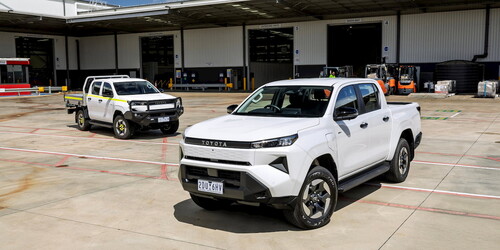
Madeleine Tremblay · 5 months ago@madeleinetremblay37Thailand auto groups lobbying for higher CBU China EV tax to protect local industry, parts supply chain Liked by+21 othersInternational NewsPost commentRelated PostsSeyond Falcon Platform | Declaration for the 2026 8th Golden Gear Award Top 100 China Automotive New Supply Chain 10 · Annabelle Girard · 3 months agoNissan Taps China JV To Power Philippine EV Push 69 · Mason Fortin · 29 days agoFreetech-ADC25 "Smart for All" Urban NOA Solution | Submitted for 2026 8th Gasgoo Awards China Auto New Supply Chain Top 100 32 · Daniel Carter · 3 months agoChina's EV charging war escalates as Geely touts 2.2-MW tech for 4-minute full charges 13 · Chloé Rogers · 1 months agoFreetek-ADC25 "Smart for All" Urban NOA Solution | Submitted for 2026 8th Golden Gear Awards China Auto New Supply Chain Top 100 85 · Charlotte Wilson · 3 months agoChangan Nevo Q06 EV crossover started sales in China ahead of global rollout 98 · Abigail Campbell · 1 months agoMomenta R7 World Model | Application for Gasgoo Awards China's New Automotive Supply Chain Top 100 63 · Nicole Brown · 3 months agoFord China begins exporting its Transit City EV to Europe 63 · Nicole White · 1 months agoGasgoo Zhou Xiaoying: Building Low-Carbon Capabilities Across the Entire Industry Chain, Supporting High-Quality Globalization of China's Automotive Industry 51 · Mia Wilson · 3 months agoResearchers Drove a Chinese EV Into an Underground Mine. It Kept Calling China Anyway. 89 · Aiden Morgan · 1 months agoNorth American auto industry must scale supply chains, production to face China 25 · Hannah Gagnon · 4 months agoAudi Is Fighting to Keep Its Own China-Only EVs Out of Germany 75 · Chloé Morgan · 1 months agoChina Auto Chongqing Summit | Xiaomi EV: Supply Chain Capabilities Set the Ceiling for Brands 13 · Charlotte Roy · 4 months agoThe Unstoppable Rise of Leapmotor — August’s China EV Sales Report (45% BEV Share) 53 · Jacob Bouchard · 1 months agoChain Fusion · Innovation Going Global | 2026 8th Golden Gear Awards China Auto New Supply Chain Top 100 Selection and "China Auto Industry Innovation Case Library" Simultaneously Launched 93 · Alexander Campbell · 4 months agoNIO Recalls 686 firefly EVs in China Over Potential Steering Assist Issue 75 · Nathan Wilson · 1 months agoGlobal EV Market Grows 2% in August as Europe Offsets China, North America 21 · Adam Turner · 1 months agoLi Auto launches i9 EV in China: world’s most aerodynamic mass-production SUV at 0.215 Cd 89 · Madeleine Green · 1 months agoChina, Sweden study ties early EV battery retirement to a small cluster of aging cells 26 · Samuel Girard · 1 months agoJeep’s 202,000-SUV Recall, China’s 70% EV Target, and What Else Moved 16 · Abigail Smith · 1 months ago



 +21 others