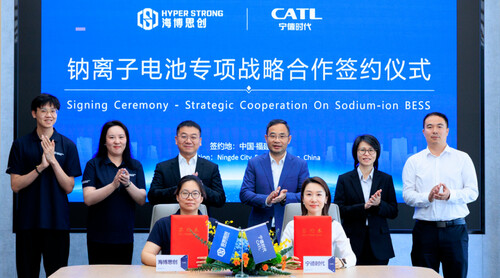
Dr Wu Kai, CATL's chief scientist (Source: CATL) CATL, the world’s largest battery maker, signed a 60 GWh sodium-ion battery deal with energy storage integrator HyperStrong — the largest sodium-ion battery order ever placed. The three-year agreement is equivalent to half of all energy storage batteries CATL delivered in 2025. The deal marks what CATL calls proof that it has “overcome the challenges of the entire sodium-ion battery mass production chain.” Industry observers are already calling it a potential “DeepSeek moment” for the global energy storage industry. The deal CATL and Beijing HyperStrong Technology announced the three-year strategic cooperation agreement on April 27. Under the deal, CATL will deliver 60 GWh of sodium-ion batteries to HyperStrong for energy storage projects. The partnership covers technology research and development, product application, and project implementation. It builds on a broader framework agreement signed in November 2025, when HyperStrong committed to procuring 200 GWh of battery cells from CATL over the period from 2026 to 2035. Advertisement - scroll for more content The 60 GWh figure is significant. For context, that’s roughly equivalent to half of the total energy storage battery volume CATL shipped in all of 2025. CATL said the agreement demonstrates it now possesses “large-scale delivery capabilities” for sodium-ion technology — specifically that it has solved the key manufacturing challenges around energy density, foaming, and moisture control during production. Why sodium-ion matters Sodium-ion batteries use sodium instead of lithium as the charge carrier. Sodium is roughly 1,000 times more abundant in the Earth’s crust than lithium and far cheaper to source, which makes sodium-ion batteries a compelling alternative for applications where cost matters more than maximum energy density — particularly grid-scale energy storage. CATL’s energy storage sodium-ion cell is a 300+ Ah large-format product with an energy density of about 160 Wh/kg, a system energy conversion efficiency of 97%, and a cycle life exceeding 15,000 cycles at 80% capacity retention. It operates across a temperature range of -40°C to 70°C, which is significantly wider than most lithium-ion cells. Critically, CATL designed the sodium-ion cells with the same dimensions as its lithium-ion products, making them compatible with existing supply chains and installation infrastructure. That dramatically reduces adaptation costs and shortens deployment timelines. As we covered last week, CATL is also pushing sodium-ion into electric vehicles, with its chief scientist confirming mass production by the end of 2026 and a target of reaching LFP-level energy density (enabling 600 km / 370+ miles of range) within three years. The first sodium-ion EV, the Changan Nevo A06, debuted in February. Competitive context CATL is not alone in the sodium-ion race. BYD, its biggest rival, has developed a third-generation sodium-ion platform that achieves over 10,000 cycles and has solved high-temperature performance issues. Both companies view sodium-ion as a strategic hedge against lithium price volatility. But CATL’s 60 GWh deal puts it well ahead in terms of commercial-scale commitments. No other sodium-ion manufacturer — including HiNa Battery, Natron Energy, or European players like Altris and Faradion — has secured an order anywhere close to this size. The global sodium-ion battery market is projected to reach $1.08 billion in 2026, with a compound annual growth rate of 15.8%. CATL, which already controls 39.2% of the global EV battery market according to SNE Research, is positioning itself to dominate this adjacent market as well. Davis Zhang, a senior executive at battery supplier Suzhou Hazardtex, told the South China Morning Post that the deal could represent a “DeepSeek moment” for the global energy storage battery industry — the idea being that wide use of sodium in production could dramatically reduce costs and improve manufacturing efficiency across the sector, similar to how DeepSeek disrupted assumptions about AI training costs. Electrek’s Take This is one of the most significant battery deals of the year, and it’s not about EVs — it’s about energy storage. The 60 GWh figure is massive for a technology that was still considered pre-commercial just a couple of years ago. CATL first unveiled its sodium-ion battery back in 2021, and we’ve been tracking its progress toward commercialization since it first confirmed 2026 deployment targets late last year. What makes this deal compelling is the practical engineering behind it. By designing sodium-ion cells with the same form factor as lithium-ion, CATL eliminated the biggest barrier to adoption: the need for entirely new manufacturing and installation infrastructure. Energy storage integrators like HyperStrong can slot these cells into existing systems with minimal retooling. The “DeepSeek moment” comparison is a bit hyperbolic, but the underlying point holds. If sodium-ion can deliver 15,000+ cycles at a fraction of lithium’s raw material cost, it could fundamentally reshape the economics of grid-scale storage. That matters enormously for the energy transition — cheap, long-lasting stationary storage is arguably the single biggest bottleneck to scaling renewable energy. We’ll be watching closely to see if CATL can actually deliver at this scale, but the commitment from HyperStrong suggests the technology is no longer a research project. It’s a product. Stay up to date with the latest content by subscribing to Electrek on Google News. You’re reading Electrek— experts who break news about Tesla, electric vehicles, and green energy, day after day. Be sure to check out our homepage for all the latest news, and follow Electrek on Twitter, Facebook, and LinkedIn to stay in the loop. Don’t know where to start? Check out our YouTube channel for the latest reviews.