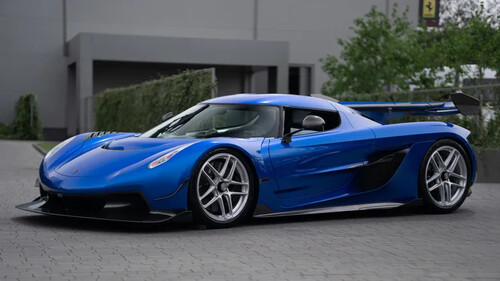
You may have been doing some online vehicle browsing, been looking through your vehicle's owner's manual, or maybe you have just looked at your fuel cap door and noticed that there is something mentioned called flex fuel or "85", but have no idea what it means. Though not strictly limited to SUVs and pickup trucks, even though there are more examples of flex fuel vehicles (FFVs) in these segments compared to the sedan and small crossover markets, flex fuel is an alternative fuel source that offers you some flexibility in what you fill your vehicle up with. But what is flex fuel? And can it be helpful to you?We are taking a look at flex fuel and have made a simple guide about what exactly it is, what vehicles can use it, how flex fuel works, the pros and cons of flex fuel, and whether you should be putting it in your vehicle's gas tank.In order to give you the most up-to-date and accurate information possible, the data used to compile this article was sourced from various manufacturers and other authoritative sources, including the EPA, U.S. Department of Energy, and Fuel Economy.gov. The Science Behind Ethanol Blends 2025 green Chevrolet TahoeThere is a bit of science behind flex fuel, and as you've probably guessed, you can't just fill your tank up with flex fuel if your vehicle isn't designed to take it. At the pump, you've probably seen E10 or E85 grade gas options. E10 is seen as regular gasoline, while E85 is flex fuel, and is composed differently from regular gas. But what does that actually mean? Ethanol vs. Gasoline: What’s The Difference? Ethanol is essentially alcohol made from crops, mainly corn here in the U.S.A., while gasoline is a petroleum product refined from crude oil. Ethanol carries slightly less energy per gallon compared to gasoline, so if you're running on flex fuel (or E85), you could see fewer MPGs compared to using regular gas.But, where ethanol comes alive is when it comes to octane. Its naturally higher octane rating means it's more resistant to engine knock and pre-ignition, while it also burns cleaner than gasoline and, generally, produces less in the way of harmful tailpipe emissions from carbon monoxide and nitrogen oxides. Mix Profiles From E10 To E85 Explained Ford was the first marque to offer flex-fuel vehicles in the late 1990s, but by 2006, Ford, GM, and Chrysler had all started rolling out models that could use it, while brands like Toyota, Nissan, VW, and Audi all offer models today that are classed as FFVs.Choosing to fill up with flex fuel can be beneficial if your vehicle is designed to use it, and if you want to use it (or can), look out for E85 at the pump. Both "E85" and "E10" tell you how much ethanol is mixed with gasoline, with E85 gas composed of approximately 51% to 83% ethanol, with the remainder made up of gasoline, while E10 gas is composed of 90% gasoline and 10% ethanol. Inside The Engine: What Makes Flex Fuel Work William Clavey | TopSpeed It is important to note that not all vehicles are capable of using flex fuel, and if you do use it in a vehicle that isn't designed to drink it, you could risk engine damage and fuel system failure because it is more corrosive than regular gas and can degrade plastic and rubber components. Plus, because of the higher alcohol content, you could also end up with the wrong fuel-air mixture, which can make your engine run lean and potentially cause damage. Luckily, automakers that offer FFVs make it clear how to check if you can use flex fuel.Check Your Vehicle's Fuel Door. A lot of FFVs will have a label on the fuel door saying what fuel you can use. Look out for "E85". Check For Badges On Your Vehicle. Some models literally say FFV, Flex Fuel, or E85 on the side. Look For A Yellow Gas Filler Cap. A lot of brands started using yellow gas caps from 2006 onwards to indicate if you can use flex fuel. If you have a vehicle with a capless gas filler, look for a yellow ring around where you stick the nozzle. Check Your Owner's Manual. Sensors That Sniff Out Your Fuel Mix In modern vehicles, one of the most crucial components that make a flex-fuel vehicle versatile is the fuel composition sensor. It is effectively the brain that lets your vehicle switch between regular gasoline and ethanol-based fuels by constantly analyzing the ethanol content in the gas and sending that data to the ECU. The ECU then adjusts fuel injection timing, ignition timing, and air-fuel ratios.This means you could fill up with regular gas one day and E85 the next without having to do anything or change any settings. Just fill up and go. Some older models, like the Ford Taurus, utilize oxygen sensor levels to estimate the ethanol mix in the gas you are using and how the vehicle is running, but modern FFVs nearly all boast a dedicated ethanol sensor, so you don't need to think about it. Engine Tweaks: Compression And Timing For Ethanol The make-up of FFV's engines differs slightly from models that aren't built to take it, and are equipped with a fair few subtle mods that ensure that the more corrosive nature of E85 is kept in check. FFV's fuel systems utilize corrosion-resistant materials like stainless steel lines, reinforced gaskets, and ethanol-proof rubber seals, while the oil formulation is often tweaked as well to neutralize any acids that can form by burning ethanol.But, it is the vehicles' state of engine tuning that makes the real difference. While most FFVs don't have a different compression ratio to their gas-only siblings, they do boast different spark timing and fuel delivery timing to accommodate the slower and cooler nature of ethanol burning. Thanks to the cooling effect that ethanol-rich gas has on combustion, it can be awesome for engine longevity, and more importantly, if you are looking for some real guts, on performance.Models like the Dodge Challenger SRT Demon 170 have shown the true power of ethanol when taken to the extreme, with this ridiculously powerful Demon capable of shooting over 1,000 horsepower when the engine is tuned specifically for E85-only use. So, if you know your stuff or own something that is truly set up to take high-octane E85 gas, you can see some insane numbers. Flex Fuel's Big Picture: Performance, Cost & Climate Bring A Trailer There are, of course, certainly both some pros and cons to running on E85 over regular gas, but depending on where you sit, it could be well worth it. Especially, as we have mentioned, if you are looking for the true performance or cleaner-burning gas, it could be worth it, but there are also some trade-offs you should consider before switching over to using E85 only or looking for FFVs only. E85 Gas: More Power Or A Cleaner Burn? One of the biggest draws to vehicles that can be filled up with high-ethanol-based gas is what they can do in terms of performance. We have already mentioned the 1,000+-horsepower Demon 170, but we have also seen the supercar world adopt either an E85-only or a flex-fuel stance, with the 1,600-horsepower Koenigsegg Jesko Absolut running solely on E85 and the Hennessey Venom F5 Revolution"Fury V8" capable of spitting out up to 1,817 horsepower when running on E85 but also able to use regular gas, just with a slight sacrifice in power.If you are into tuning and racing, being able to use E85 can make it possible for higher performance, especially in higher-compression models, and thanks to ethanol cooling the combustion chamber of engines more effectively, it reduces the likelihood of detonation and can make your engine run smoother.Hennessey If you aren't looking to scream out over a thousand horses, E85 can offer something a little more "conscious" in the form of cleaner combustion. Thanks to the cleaner combustion that E85 can offer, you can get smoother idling and quicker throttle responses from your vehicle, and while power boosts may not be too noticeable in stock engines, the cleaner-burning aspect is a win for your engine internals and, to some degree, the environment.It is worth keeping in mind, though, that to get the full oomph that is possible when running on E85 gas, you'll need to tune-up and potentially some hardware upgrades, not just the ability to use it. Fuel Economy Trade‑Offs: Distance And Dollars The trade-off with E85 is basically that it has a lower energy content than regular gas, which means lower MPGs. According to the EPA, the average fuel economy drop when switching over to E85 is around 20–30 percent. That translates to, if your vehicle can achieve a combined MPG rating of 30 MPG, only seeing from 21 to 24 combined MPG when using E85.It isn't all bad, though, depending on where you fill up, because E85 is generally cheaper than regular gas (the EPA said in June that the national average for E85 is $4.316 per gallon, while the price of regular gas per gallon is $4.986). Filling up with E85 can balance out fuel economy loss - just not MPG and fuel usage. So, while you could see some wallet savings, you could be using more gas in general, which, depending on where you sit with either saving money or using less gas, makes it a fine line to walk. The Pros And Cons Of Flex Fuel In short, owning a flex-fuel vehicle can make things easier for choice at the pump, and you could see some boost in performance, but you should consider weighing up using both regular and E85 in your vehicle. The pros of using flex fuel are:Lower cost per gallon.Higher octane rating.Cleaner emissions.It can improve engine longevity.Flexibility at the pump.On the other hand, the cons of using flex fuel include:Reduced fuel economy.Availability. Some states have a limited availability of ethanol, so E85 is rarer to find. More frequent fill-ups (on average).Absorbs water. This isn't a problem if you use your vehicle a lot, but for vehicles that sit around a lot, it can result in water in your vehicle's system. Mixed environmental impact. Because ethanol is corn-based, the eco-benefits are debatable because of the use of fertilizer, land usage, and energy-intensive production to grow the corn. If you live in an ethanol-rich region, like the Midwest, with easy access to E85, you are looking to support semi-renewable fuels, or are looking to juice up a performance vehicle. The use of E85 could be ideal for you, but if you prioritize MPG ratings, long-distance travel between filling up, or don't drive frequently, it may be safer to stick with regular gas.