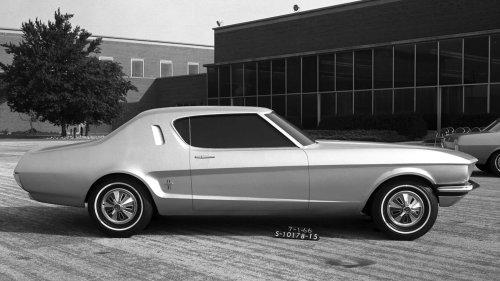
























It may have been around since the '60s, but the Ford Mustang is still America's best-selling sports car. Aside from a few wobbles in the '70s and '80s, the Blue Oval's muscle car hero has stuck to the same basic recipe of chunky V8s, chiseled styling, and affordable performance. But what if Ford had never used these basic ingredients, instead going for a more European concoction of low-power, light weight, and, quite possibly, high-priced limited production for the Mustang?The car would have been America's answer to the slightly brittle-yet-nimble Italian sports cars of the era, with rakish track car looks and a tiny windscreen that meant driving goggles were as essential as a pair of ventilated Nappa driving gloves. It all sounds like a fanciful alternative universe, but the truth is, this could have actually (possibly) happened. Before the Mustang made its production debut, a concept was doing the rounds in America and showing off a very different idea of what Ford's sports car could look like. This is the story of the forgotten Mustang sibling that was different in every way from the Mustang that we have come to know and love. The Mustang "I" Was The 'Stang That Never Was Mustang I Highlights Of The 1962 Mustang I Concept Used the 1.5-liter V4 drivetrain from the Euro Ford Taunus in a novel way The Mustang I concept weighed just 1,500 lbs The one-off car would hit 120 mph during public displays In the early '60s, American carmakers were seeing a new type of customer come to the surface. Whereas in the previous decade, young people were officially labeled old a few months after their 21st birthday, in the swinging sixties, it had started to change. Rather than just go out and buy a pipe and a trilby, young people with a bit of money wanted to buy nice, sporty cars to drive around in. Many firms had noticed this and were scrambling to make their line-ups a bit more exciting.One of these brands was Ford, with Henry Ford II himself calling for a new image and advertising strategy called Total Performance from 1962 onwards. This would appeal to younger, cooler buyers, and also neatly tie in competition endeavors to road cars, showing that race car thinking can be a useful trickle down into road cars and make them nice and exciting. The Team Had Just A Few Months To Come Up With A Daring New Sports Car Spearheading this new approach would be a new project named W-301. Chief stylists Bob Maguire and Damon Woods set to work on this experimental sports car design, which would draw attention to Ford's new way of thinking. The name 'Mustang' was given to the car. It apparently came from one of the employed designers, Phil Clark, who had used horse references at design school and would pen an equine logo for the new car. It all sounded like a lot of fun, until it was revealed that the new concept car would need to be fully working and ready to wow crowds at car shows and big race meetings in around three months' time. It was time to get to work. The Mustang I Used A Lot Of What Ford Had Lying Around THe Henry Ford 1962 Mustang I Concept Specs Source: FordThe team had to make do with what they had lying around, but, interestingly, turned to Europe for inspiration. The car could have utilized a V8, but instead, the decision was made to make it as light as possible and use a zingy 1.5-liter V4 drivetrain from the Euro Ford Taunus. The only issue was that that car was front-wheel-drive and that wouldn't do for a pioneering sports car – we'd need to wait a few years for that. So Ford flipped around the platform and created a rear-engined, rear-wheel-drive car, complete with Mustang logos on the sides. Ford Tuned The Four-Cylinder To Almost Double Its Original Power Ford managed to massage the 60-degree V4 to push the output up from 65 horsepower to a claimed 109 horsepower, which, considering it weighed just 1,500 lbs, was plenty. The car had tubular A-arm front and rear suspension and rolled on 13×5-inch magnesium wheels. The car was fitted with a 4-speed manual gearbox and had dinky proportions. The Mustang I is just 39.5 inches high, 61 inches wide, 154 inches long and has a wheelbase of 90 inches.When the car was rolled out at the US Grand Prix at Watkins Glen, New York, in October 1962, it looked out of this world. The concept was surrounded by Mustang logos, and, even at this point, you could consider it job done. Then racer Dan Gurney wound the car up to 120 mph in front of a stunned crowd, serving as the ultimate hors d'oeuvre to the main event. If Ford could have taken a few orders for the Mustang I there and then, it probably would have gotten plenty of signatures. But the Mustang I wasn't to be. The Mustang I Made Way For The Real Mustang Ford Reviewers at the time said the handling of the Mustang I was a revelation, but the bottom line was, erm, the bottom line. A small-production, lightweight two-seater, with no luggage space, may have seemed rather lovely, but not many people would buy it, and ultimately, there wouldn't be much profit for Ford. With the Mustang I doing its thing to whip up interest in Total Performance, Ford was secretly working on its new sports car that would carry the name into the showrooms. Ford Went All-Out To Promote Its New Sports Car Wraps came off the production Mustang on April 14, 1964, at the largest exhibit at the New York World’s Fair, called the Ford Pavilion. The Mustang was on display in and around the Wonder Rotunda, and almost 15 million visitors even rode in an all-new Mustang convertible on the Walt Disney-designed Magic Skyway ride. Suffice to say, the American public was hooked on the new pony car, which started at $2,368.00. In the past fifty-plus years, more than ten million Mustangs have now been sold. The only link to the Mustang I was the air intakes, the name, and the badges. These days, the Mustang has come a long way from a Disney ride, becoming a track weapon at the Nurburgring. Here's What Happened To The Mustang I The Henry FordThe Mustang I narrowly avoided going to the crusher and was constantly hidden away by the designers and engineers, according to reports. It was pretty much forgotten until 1975, when the decision was made to donate it to The Henry Ford Museum by the Ford Motor Company. It was then restored in 1980 by Ford and remains a popular exhibit at The Henry Ford today, serving as a reminder of what the Mustang could have been. Today, it remains one of the many Mustang concepts that few people know even existed.