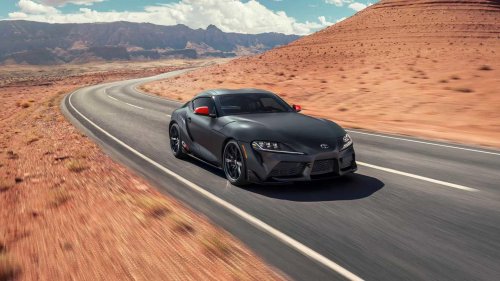
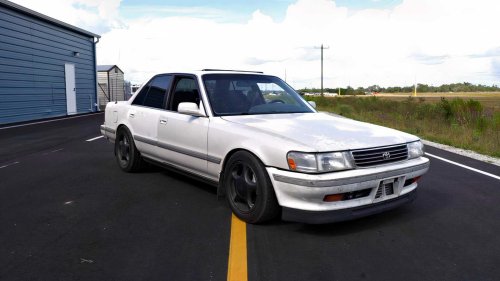
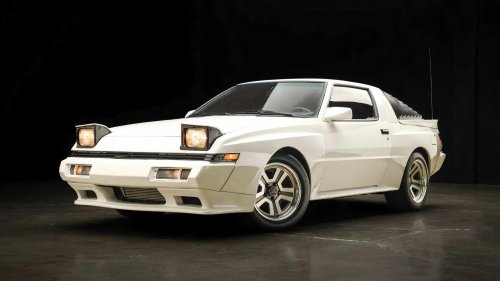
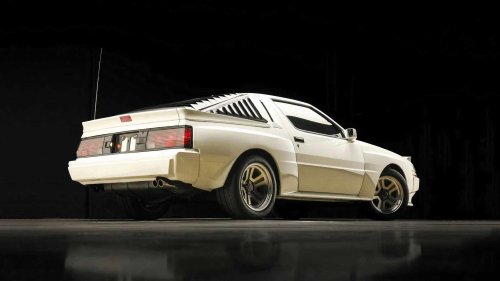
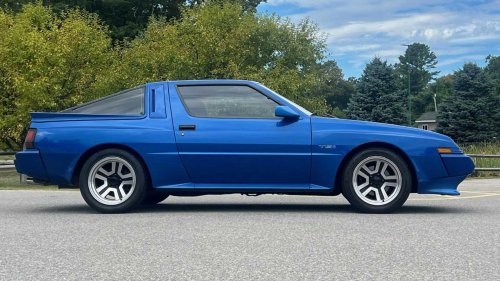
In 1987, walking into a dealership and asking about a turbocharged rear-wheel-drive coupe built in Japan, with a drag coefficient better than the era's benchmark sports cars, rear-wheel anti-lock brakes, and electronically adjustable suspension, would probably not have put the Pentastar badge on your mental shortlist. And yet that car existed, in exactly that showroom, at a price that its European rivals would have found embarrassing. Almost nobody who bought one knew what it signified. The factory being built while it was on sale would go on to produce three of the most significant performance cars of the following decade. This is the car that made that factory possible, and the founding document that nobody remembers reading. In 1987, The Badge On The Hood Was Deceiving Everyone Bring A Trailer The American car market in 1987 had a reasonably clear idea of what performance meant under which badge. Certain manufacturers made sports cars. Others made muscle cars. The Pentastar on a car's hood suggested something else entirely: a competent, comfortable American vehicle built for reliability and value, with the occasional flirtation with turbocharged four-cylinders that critics received with mixed enthusiasm. The brand's public identity had been built on survival. The Kei car had saved it from bankruptcy, and the minivan had given it commercial momentum. Performance was not the conversation at the time.What the badge did not reveal was that one of the cars wearing it had been built in Japan, designed around a turbocharged 2.6-liter inline-four producing 188 hp, and shared its fundamental architecture with a machine that was winning endurance races in Japan, Australia, and the United States simultaneously. The car competing directly with the Porsche 944 in showrooms was not developed by the same engineers who built the Kei car. It was the product of a partnership that had been building toward something far more significant than anyone browsing the dealership lot in 1987 had any reason to suspect. The Partnership That Made It Possible Bring A Trailer The relationship that produced this car began in 1971, when one manufacturer took a 15% stake in a Japanese automaker that was looking for a partner to help it understand how to make money in the car business. The arrangement started with captive imports, rebadged Japanese vehicles sold under American names to fill gaps in the domestic lineup during the fuel crisis years. The Plymouth Colt, the Dodge Arrow, the D-50 pickup: all were Japanese-engineered cars wearing American badges, sold through American dealerships to buyers who largely did not know or care about the distinction.By the early 1980s, that arrangement had matured into something more purposeful. Both manufacturers were facing problems that the other could help solve. Import quotas restricted how many Japanese vehicles could enter the United States market, and the Japanese partner needed American production to continue growing. The American partner needed the engineering credibility and technical capability that years of captive imports had demonstrated. In October 1985, both companies officially incorporated Diamond Star Motors, a 50-50 joint venture that would build a $650 million production facility in Normal, Illinois, capable of producing 240,000 vehicles annually. The plant broke ground in April 1986 and would eventually produce the Eclipse, the Eagle Talon, and the Plymouth Laser. But while it was being built, the most technologically advanced product of the captive import era was already sitting in showrooms, making the case for everything that was to follow. Meet The 1987-1989 Chrysler Conquest TSI Bring A TrailerThe car is a rebadged version of the Japanese-market Mitsubishi Starion ESI-R, built in Japan, and the Chrysler-branded Conquest TSI specifically ran from 1987 to 1989. The 2.6-liter G54B turbocharged engine was chosen over the Japanese 2.0-liter specifically for the North American market, where its low-end torque delivery and emissions compliance made it the more practical choice. Independent period testing confirmed a 0-60 mph time of 8.0 seconds, a quarter mile of 16.3 seconds at 85.5 mph, and a top speed of 127 mph. The 234 lb-ft of torque arrived at just 2,500 rpm, giving the car a usable, accessible performance character rather than the narrow power band associated with many turbocharged engines of the era.What made the car technically extraordinary for its price point was less the headline performance numbers than the specification surrounding them. The drag coefficient was 0.32, confirmed as superior to both the Mazda RX-7 and Nissan 300ZX at the time of its release. The widebody's extended arches covered a wider track on 16-inch alloy wheels. Rear-wheel anti-lock brakes were standard. A limited-slip differential was fitted. The optional Sports Handling Package available on 1988 and 1989 models added electronically adjustable Tokico shock absorbers, wider wheels and tires, and revised suspension tuning that transformed the car's dynamic behavior at the limit. The base price was $14,717. A fully optioned example tested by a period journalist came to $18,682. The 944 started at $22,950. The Technology Nobody Expected From A Chrysler Dealer Bring A Trailer The rear-wheel anti-lock brake system on the Conquest TSI deserves specific attention because it was genuinely advanced for a car at this price in 1987. Most anti-lock brake systems of the era were front-biased or four-wheel systems fitted to significantly more expensive cars. A rear-wheel ABS on a $14,717 sports coupe positioned the car ahead of most of its competition in this specific area. The automatic climate control system, standard across the TSI range, was similarly above the expected equipment level for the segment.The electronically adjustable suspension in the Sports Handling Package used Tokico shock absorbers with selectable damping rates, allowing the driver to choose between a comfort and a sport setting. At the time the Sports Handling Package was offered, electronically adjustable suspension was appearing across a range of vehicles from premium sports coupes to luxury sedans. The Conquest made it available at a price point that most of those cars could not match. The sum of these features, on a car sold by a manufacturer whose public reputation was built on minivans and economy sedans, made the Conquest one of the most technically ambitious mass-market performance cars in its segment. The badge made it invisible to most of the buyers it deserved. The Car That Built The Road To Diamond Star Mecum The Conquest TSI was the highest expression of what the captive import model could produce. It demonstrated that a Japanese performance platform could be sold under an American badge, at an American dealership, to buyers who wanted the performance without the import premium. It demonstrated that the engineering credibility was there. It demonstrated that the market existed. When the Diamond Star Motors plant opened in Normal, Illinois in March 1988 and began producing the Eclipse, the Talon, and the Laser, it was completing a journey that the captive import era had started. The Conquest was the proof of concept. The Eclipse was the product of what that proof made possible.The line from the Conquest to the Eclipse does not end in 1990. The model of cross-brand engineering collaboration that the 1971 partnership established, the captive import era refined, and the Diamond Star Motors joint venture formalized is still the template manufacturers reach for today. The GR Supra produced under a collaboration between a Japanese and a German manufacturer is the most recent prominent example of the same logic: two manufacturers solving separate problems by sharing an engineering platform, wearing different badges, and selling to different buyers. The Conquest was not the first car to emerge from this model, but it was the most technically sophisticated pre-DSM expression of it, and the one that made the strongest case for what the partnership could achieve at its peak. What A Conquest TSI Is Worth Today MecumCurrent market data for the Conquest TSI shows an average recorded sale price of $18,000, with the highest sale reaching $35,000 for a 1988 example sold on February 18, 2026 and the lowest recorded at $6,300. Current valuations for well-preserved 1988 and 1989 examples in excellent condition sit in the $20,000 to $22,000 range. The Sports Handling Package commands a meaningful premium among buyers who understand what it adds. The 1989 model year, the last and rarest with just 1,961 total Conquest and Starion examples produced, commands the strongest premium of the three model years for documented, original examples.The comparison to the 944 in the table is purposelful. A car that originally cost $8,000 less than the 944 and competed with it directly on aerodynamics and technology now trades at roughly a third of the 944's current market value. The 944 has a collector following built on decades of enthusiast attention and the broader Porsche brand halo. The Conquest has neither, which explains the gap entirely. It does not explain whether the gap is deserved. The Founding Document Nobody Read Mecum The cars that came out of the Diamond Star Motors plant got the fame. The Mitsubishi Eclipse became a tuner icon. The Talon developed a devoted enthusiast following. Both became the cars that a generation of performance buyers remembers when they think about early 1990s sport coupes. The Conquest TSI became a footnote, remembered mostly by the specialist community that calls it a Starquest and hunts for unmodified examples with documented histories.That outcome is partly explicable. The Conquest sold in modest numbers, ended production in 1989 before the DSM era had properly begun, and never developed the aftermarket ecosystem that made the Eclipse and Talon household names in the performance community. But it was the car that made the most sophisticated technical argument for the partnership that produced those icons. It had the rear-wheel ABS, the electronically adjustable suspension, the 0.32 drag coefficient, and the turbocharged rear-wheel-drive platform at a price that made all of it accessible. The badge on the hood hid everything. The history that followed confirmed it.Sources: Hemmings, Classic.com, Hagerty.

















 +31 others