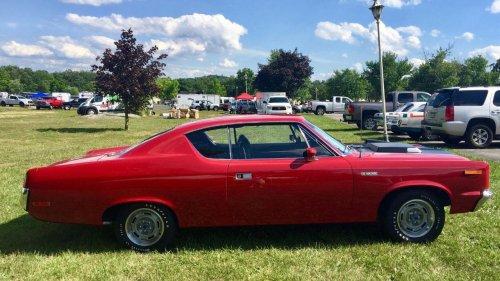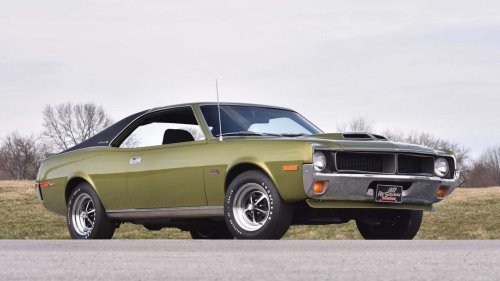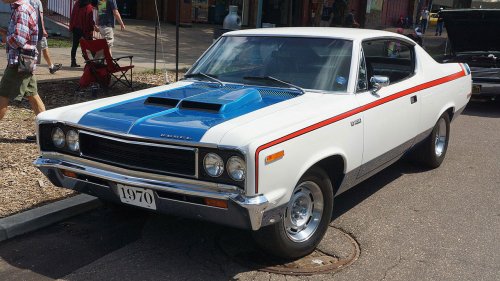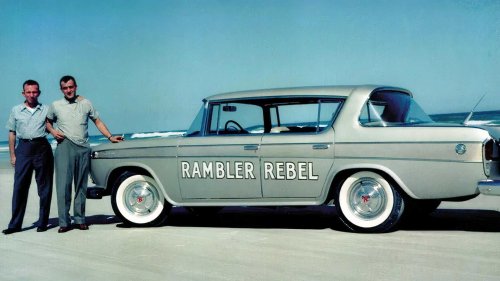
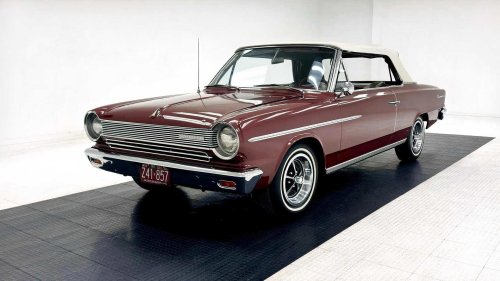
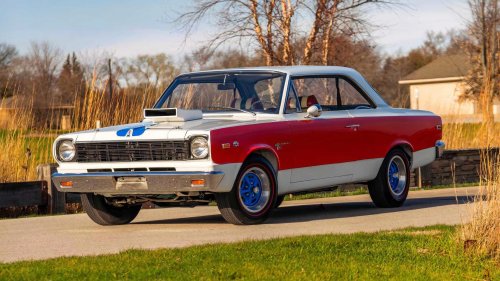
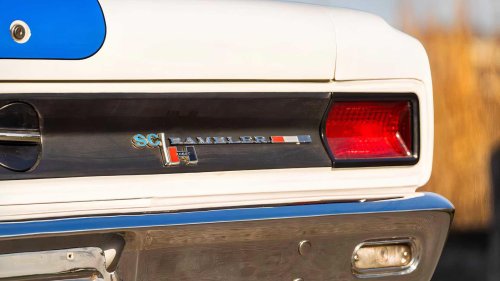


















The exploits of the American Motors Company during the height of the first great muscle car revolution go unappreciated far too often. Given that AMC didn’t make it out of the 20th century while its competition lived on, that’s to be expected. But if you want to contextualize what America’s mysterious fourth big automaker meant to the greater story of the muscle car boom, you don’t necessarily need the full story. Instead, you can look at what AMC’s arguable halo car got up to at the brand’s absolute best. AMC: The Counterbalance to Big 3 Dominance Credit: AMC (Now Owned by Stellantis) When George Mason and his partner George Romney founded AMC in 1954, it was little more than a gathering of two down-on-their-luck American automakers, Nash-Kelvinator and the Hudson Motor Car Company. On their own, the pair produced icons like the Hornet and the Statesman. But their puny footprints compared to Chrysler, Ford, and General Motors meant joining forces was the only reasonable means of staying in business. It was the largest corporate merger of its type in history to that point, and it’d one day give rise to some of the best muscle cars of them all.It’d take some time for the company to mature before it reached those heights. In those early years, AMC carried on the production of the Hudson and Nash lineup – moving the entire production operation to a massive facility in the scrappy, industrial heart of Kenosha, Wisconsin. Flashes of future brilliance came in waves, spurred on by the introduction of the Rambler Rebel platformwith experimental electronic fuel injection. These early Rambler Rebels were nearly as fast as Corvettes in their day, all while carrying four doors and space for five people. It’d take some time for AMC to acquiesce to the typical muscle car formula, while a lineup of affordable, smaller cars than what the Big 3 were building kept profit margins high.AMC’s long-term goal wasn’t to compete with Ford or Buick in the race to slam bigger engines inside bigger and bigger platforms. Doing so would’ve put them out of business in a matter of a few years. Instead, their lineup was sized in a way that filled gaps the Big 3 were too high on their own metaphorical supply to bother filling, adding little performance trinkets where they could. The champion of this philosophy was a plucky little thing called the Rambler American. Rambler American: A Fitting Platform for a Muscle Car Icon Hemmings The Rambler American didn’t start its life as a chisel-jawed muscle car, not by a long shot. When it launched in 1958, it was just a plucky little runabout with a puny 100-inch wheelbase and a diminutive 3.2-liter straight-six under the hood. Over the years, the American’s trademark Airflyte styling, once a trademark feature of the Nash lineup, gave way to boxier, more aggressive, stately form factors as the 60s rolled along. But never once did the Rambler American abandon its roots as a plucky little car.By 1964, the Rambler American was an entirely clean-slate design, the product of AMC’s then Vice President of Design, Dick Teague. In a retrospective by close friend and long-time historian at Hillsdale College Richard M. Langworth, Teague’s old confidant recalled what miraculous job he pulled off with the gen-III Rambler American, all on a shoestring budget. At the time, Teague was still a fresh face at AMC, and the results cemented his place at the company for the rest of his career."Dick’s first task was to restyle the 1961-63 Rambler American: You remember, that dumpy thing with the concave body side molding? An English designer had been hired around the same time,” Langworth said of Teague. “‘My God, Dick,’ he said to me, ‘it looks like a ruddy ordnance vehicle.’ It did, too! Dick’s 1964 replacement was a quantum leap forward—the first Rambler American that could honestly be called good looking.” And look good, it sure did. Good enough for AMC to trust Teague’s creation to morph into its all-time greatest muscle car. AMC Hurst SC/Rambler: A World Class Muscle Car, But a Fraction the Size Via MecumDick Teague’s efforts laid the foundation for AMC to go full-on crazy with the Rambler American platform once the muscle car boom was at the peak of its influence. A special performance-oriented edition was developed alongside the team at Hurst. A Pennsylvania-based performance parts manufacturer that made American muscle cars from every brand faster, Hurst is best known for working with General Motors on the Hurst/Olds program. But the soon-to-be SC/Rambler project was proof that Hurst took no sides in the muscle car wars, they just loved old-fashioned horsepower.Under the hood of each SC/Rambler was a 390-cubic-inch variant of AMC’s in-house developed second-generation short-deck V8, the same found in the larger and more mass-produced AMX. It sported genuine advancements like forged connecting rods and a forged crankshaft, need we remind you this was in 1969? People still lose their minds over modern performance cars sporting forged internals, and AMC was using similar, albeit simpler methods to squeeze as much power out of the 390 V8 as possible. Measured in gross horsepower on a dyno stand with open headers, this engine made 315 horsepower at the crank.Further goodies came in the form of a BorgWarner T-10 close-ratio manual gearbox with a trademark Hurst shifter, plus AMC’s “Twin-Grip” limited-slip differential and power-assisted front disc brakes for better handling characteristics. By no means was the SC/Rambler a Ferrari rival, it was clearly a point-to-point drag racing warrior. But so committed was the SC/Rambler to its primary objective, it was marketed as the only car in the world built to the specs of the NHRA’s F/Stock drag racing class. There, it put up numbers like an advertised quarter mile run of 14.3 seconds, all while wearing vibrant decal sets and a functional nose scoop that blurred the line between a street rod and a real racer. A Legendary Drag Racing Icon, With a Price Mecum In effect, it was built as much for homologation for the NHRA as it was to turn a profit. That meant production figures were bound to be pretty low, as little as 1,512 examples built for the single 1969 model year. After that, the Rambler line was replaced by the bold and ever-controversial AMC Hornet compact. This ensured that the SC/Rambler remains one of the rarest and most sought-after American performance cars of the 1960s. When well-preserved examples go up for sale online or at auction, and they seldom ever do, they can reach six-figures sales figures on reputable sites like Hagerty and Hemmings. Compared to more famous faces like Chargers, Camaros, and Mustangs, that garner huge price tags just on name recognition alone, hardly anyone outside of a close-knit community of enthusiasts have even heard of the SC/Rambler.Ironically, this phenomenon helps keep price projections over the years stay relatively reasonable. Considering the amount of history, prestige, and the story that goes into every nut and bolt of an SC/Rambler, that’s nothing short of a modern-day automotive miracle. Given the sum of its parts, a pristine SC/Rambler might as well be worth ten times what it is. At the minimum, it’s one of the coolest muscle cars most folks are completely unaware of.Sources: Hemmings