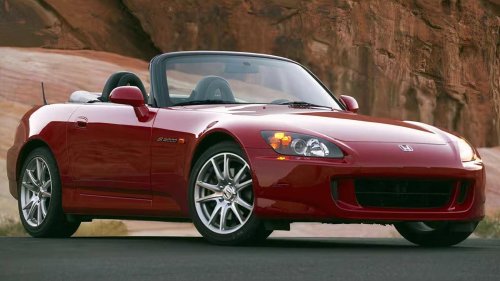
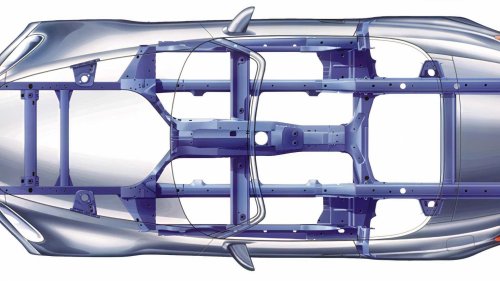
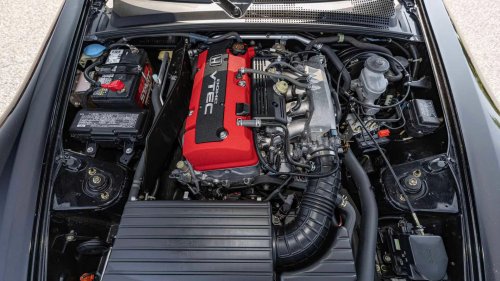
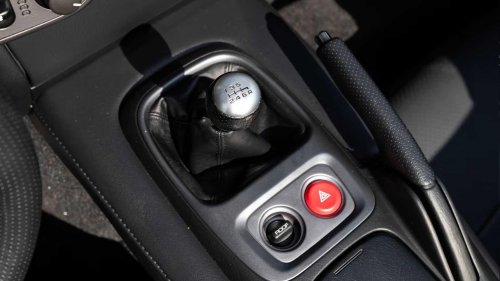
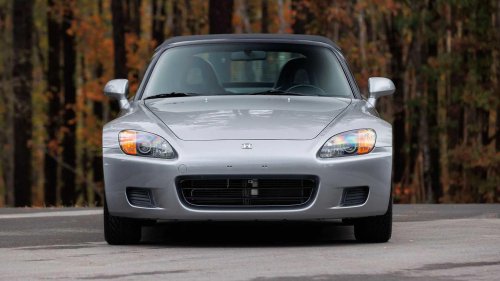
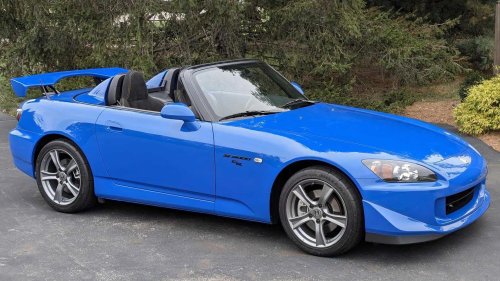


















The '90s were a great time in the Japanese automobile industry. They were engineering some of the best sports cars at the time and introducing some of the latest engineering feats that exceeded their European counterparts. Toyota gave us the Supra and sister company Lexus was giving Mercedes a run for its money. The Nissan GT-R was faster than ever and Mazda gave us the exotic-sounding RX-7.Honda was in the midst of its legendary run, having already stunned the world by benchmarking the Ferrari 348 to create the NSX and redefining front-wheel-drive performance with the Integra Type R. Yet, as the decade began to close, whispers emerged from Tokyo about a new project, something that wouldn't just be another fast car, but a rolling manifesto of everything Honda had learned in five decades of engineering. The industry knew something was coming, but they weren't prepared for a machine that would eventually make supercars twice its price look lazy. The Honda S2000 Was a 50th Anniversary Gift HondaIt all started with the Honda Sport Study Model concept shown at the Tokyo Motor show in 1995. The crowd loved the car and that was the approval Honda needed to build this car. When Honda officially took the wraps off the production S2000 in 1999, it wasn't just launching a new model; it was celebrating its 50th birthday. The name itself was a deliberate nod to the iconic S500, S600, and S800 roadsters of the 1960s, cars that established Honda’s reputation for small-displacement, high-revving sports cars. But while the heritage was vintage, the execution was pure, and featured some of the latest mechanical engine tech Honda had at the time.Developed under the watchful eye of Shigeru Uehara (the same mastermind behind the NSX) the S2000 was designed with a purpose rarely seen in production roadsters. It arrived in a market that was suddenly crowded with "lifestyle" convertibles, but the S2000 felt less like a fashion statement and more like a surgical instrument. Honda revealed a car with a silhouette so timeless it still looks modern today. It Was A Convertible Without Compromise Honda UK Most convertibles of the era suffered from "scuttle shake". This is a vibration and twisting sensation felt in convertibles or open-top cars, caused by a lack of structural rigidity because they have no roof. Honda’s solution was the High X-bone frame. This wasn't just a marketing buzzword; it was a revolutionary monocoque structure where the central tunnel acted as the primary backbone of the car, linking the front and rear bulkheads in a massive "X" shape. The result was a platform with the torsional rigidity of a coupe.This rigidity allowed the suspension to do its job without the chassis flexing under load. To perfect the handling, engineers opted for a front mid-engine layout, tucking the entire engine block behind the centerline of the front axle. This achieved a perfect 50/50 weight distribution. This gave the S2000 incredible balance and gave it handling that would rival even some of the best sports cars today. The F20C Was a Legendary 9,000 RPM Engine Via: Mecum Auctions While the chassis was a masterpiece, the heart of the S2000 is what truly changed everything. In an era where the competition was moving toward larger displacements, bigger engines and smoother power deliveries, Honda did what every hardcore enthusiast wants. They built a 2.0-liter four-cylinder engine that felt like it had been stolen from a Formula 3 car. To drive an S2000 is to participate in a piece of mechanical theater.There is no "push-button" start gimmick here for show; the red "Engine Start" button wakes the engine, a buzzing, high-strung idle that hints at the violence to come. The dashboard features a digital F1-style tachometer that reads up to 9,000 RPM and an orange LED arc that visibly shows the RPM climbing. When you finally hit 5,850 RPM, VTEC kicks in, the cam profile switches, the intake roar changes to a metallic scream, and the car surges forward with a second wind that carries you all the way to a staggering 9,000 RPM redline. This engine was paired with a six-speed manual transmission, which meant you were in total control of how this magnificent engine sounded and made power. It Had The Most Horsepower Per Liter For A Long Time The numbers behind the F20C are the stuff of legend. Upon its release, it produced 123.3 hp per liter (in Japanese spec, roughly 247 hp total) but the US cars made 240 hp. This wasn't just impressive; it was a world record. For over a decade, the Honda S2000 held the title for the highest specific power output of any naturally aspirated production engine in the world. It wasn't until 2010 that the Ferrari 458 Italia finally snatched the crown. They had to make a supercar to beat the record set by Honda's little engine.Consider the landscape in the early 2000s: most sports cars weren't as focused as the S2000. The Porsche Boxster was a heavy-hitter with prestige, but the base 2.7-liter model of the time produced only 217 hp. It felt soft and "safe" compared to the Honda. The BMW Z3 was a cruiser rather than a bruiser, lacking the structural stiffness and high-RPM drama of the S2000. The Audi TT was stylish and had all-wheel drive, but its turbocharged delivery felt disconnected and lacked the razor-sharp throttle response of a high-compression N/A Honda.The S2000 changed the market by proving that a "junior" sports car didn't have to be a compromise. It offered exotic-level engineering with fiber-reinforced metal (FRM) cylinder liners, forged aluminum pistons, and a shift throw so short and clicky it remains the industry benchmark, all at a price point accessible to the working professional and offering more performance than its rivals. If the competition wanted to keep up, they needed to upgrade to higher models which easily meant you could exceed $40,000. The S2000 Was Built To Be A Driver's Car Mecum Auctions Every touchpoint in the S2000 was designed to remove distractions between the driver and the road. The cabin is famously minimalist; the audio controls are hidden behind a flip-down panel, and the HVAC dials are angled toward the driver like a cockpit for easy access. There are no cupholders in the traditional sense, and the storage is laughably small. But you don't buy an S2000 for the storage.You buy it for the engagement, the six-speed manual transmission, widely regarded as one of the best gearboxes ever manufactured. Each gear change feels like clicking a bolt-action rifle. The steering, though electric (a rarity in 1999), was tuned for high-speed precision. Honda’s intention was to create a pure open-top experience where the wind, the 9,000-RPM scream from the engine, and the vibrations of the X-bone chassis converged into a single, addictive sensation. It was a car that demanded your full attention; if you respected it, it rewarded you with a level of engagement that modern, muffled sports cars simply cannot replicate. The AP1 vs. AP2 Debate Broad Arrow Auctions Among enthusiasts, the S2000 is split into two distinct eras: the AP1 (1999–2003) and the AP2 (2004–2009).The AP1 is the "purist" choice, featuring the original 9,000-RPM redline and a more "twitchy" rear suspension geometry that favored experienced drivers who enjoyed taming oversteer. This car rewarded good drivers who could eke out every ounce of performance from this car. The AP2 saw Honda refine the formula. They increased displacement to 2.2-liters (the F22C1), which lowered the redline to 8,200 RPM but added much-needed mid-range torque while essentially maintained the same power. They also softened the suspension and added 17-inch wheels to make the car more stable and "usable" for the average owner. In today's market, the "debate" is largely won by condition rather than code. Both versions are seeing a rise in value. While you could find a decent S2000 for $15,000 a decade ago, clean, low-mileage examples now regularly fetch between $35,000 and $60,000, with the rare Club Racer (CR) editions reaching well into the six-figure territory at auctions. The S2000 Already Has Modern Classic Status Bring A Trailer The Honda S2000 has transcended its status as a mere "used car" to become a definitive modern classic. It appeals to enthusiasts because it represents the golden era of automotive history, it has modern reliability and safety with pure driver engagement and analog feel but lacks the intrusive electronic nannies, turbos, and heavy touchscreens that plague today's performance cars.It is a reminder of a time when Honda’s engineers were allowed to build the best engine they possibly could, simply to see if they could do it. As we move toward an electrified future, engines like this may never exist again, as proven by the recent performance cars from Honda that use turbocharged engines. The screaming 9,000-RPM redline of the S2000 stands as a high-water mark for the internal combustion engine, a 50th-anniversary gift that keeps on giving to anyone lucky enough to sit behind the wheel.Sources: Honda, Classic.com.