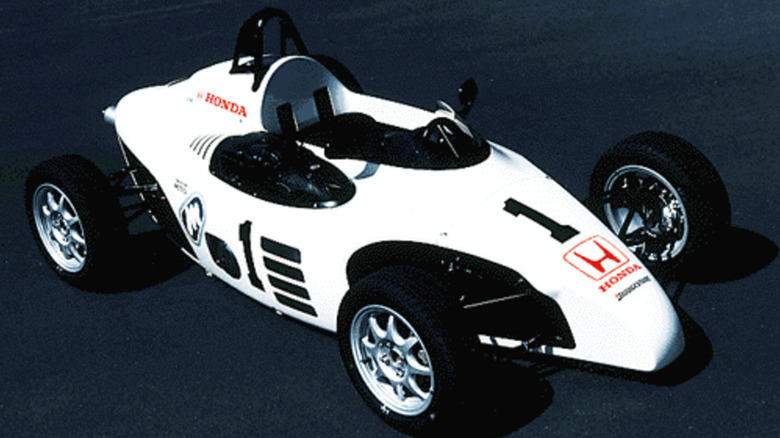





















Darren Heath Photographer/Getty Images Honda has a long and illustrious history with formula cars. Of course, most enthusiasts will recall Honda's Formula 1 efforts, helping greats like Ayrton Senna, Nelson Piquet, and Keke Rosberg achieve great success during the 1980s. However, while Honda still enjoys a crucial and involved role in the current world of Formula 1 as a power unit supplier, it also indulged in a number of smaller formula projects in the past. One such project was the Honda Side-by-Side, which debuted in 1997, and in many ways, it was just like most other formula cars. It was designed exclusively for use on closed tracks, and despite the name, it was a single seater. Superficially, the design was unremarkable, with a pointed nose cone and a wheel in each corner. What wasn't very typical though, was the location of the engine — it sat next to the driver, hence the name, Side-By-Side. The reason for this was really quite simple. It provided the racer with an incredibly low polar moment of inertia (meaning the car is less likely to twist under load), and balanced weight distribution. This was all intended to give the car fantastic handling qualities, in particular very sweet slide-controllability, which made the Side-by-Side the perfect skill-boosting starting point for budding drivers. A closer look at the Honda Side-by-Side Honda Newsroom Power came courtesy of a narrow V-twin motorcycle engine, and as already mentioned, it sat directly next to the driver on the right-hand side of the formula car. Honda claims this gave the Side-by-Side excellent weight distribution, although surely the physical size and weight of the driver would affect this dramatically, especially as the car itself only tips the scales at a feather-light 860 pounds. Regardless, the V-twin provided the miniscule Honda with 56 horsepower, and 44 lb-ft of torque, further driving home the fact that the Side-By-Side was a tool for honing skills, rather than setting track records. The racer employed a tubular spaceframe chassis, it sat upon diminutive 175/60/R14 tires (here's how to understand what's written on your tires), and the power from that 742cc V-twin engine was channeled to the rear wheels via a five-speed sequential transmission. A proper racer, just shrunken down into a more approachable package. Back to that bizarre engine location. By concentrating the Side-by-Side's mass to the center of the car, Honda reduced the car's likeliness to switch between under and oversteer. While the design clearly hasn't taken off over the last three decades in motorsport circles, it's nonetheless an interesting chapter in the history of driver development from within motorsport circles, and no doubt an absolute riot at any of your favorite racetracks.