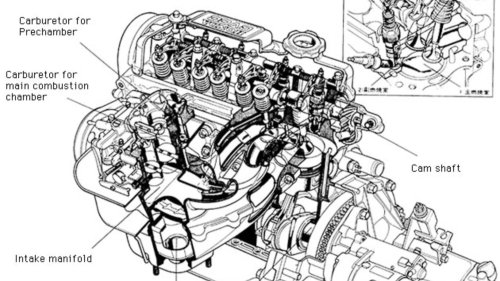
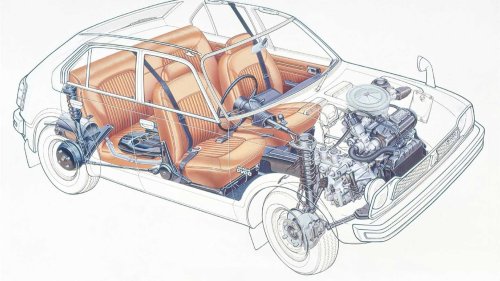
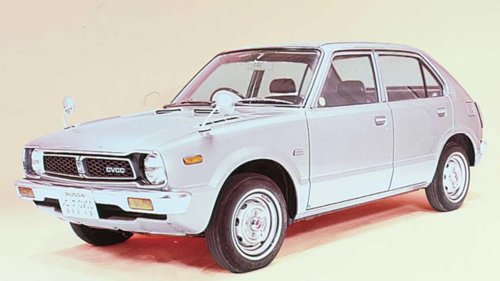
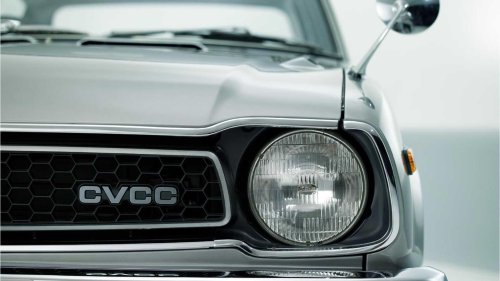



















Jump LinksThe IssueThe SolutionIn the late 1960s, America’s car culture was booming as people took to the roads in record numbers. While most people loved that sense of freedom, it also came at a cost, with sharply elevated levels of air pollution and clouds of smog blanketing cities.Congress had to do something and so, in 1970, it passed the Clean Air Act that set strict new rules for vehicle emissions and sent automotive chiefs into a huddle. Every OEM came to the conclusion that they needed a range of answers—including costly catalytic converters and unleaded gasoline—if they were to comply with the new EPA rules by 1975. Consequently, they all went to work with the aim of tackling pollutants emerging from a vehicle’s engine as one of the most affordable answers to the challenge.However, Honda had some different answers up its corporate sleeve and unveiled a radical new approach in the shape of its Compound Vortex Controlled Combustion (CVCC) engine as fitted to the Civic, which turned out to be one of the greatest automotive breakthroughs ever. Honda Engineers Perform an Emissions Miracle Honda GlobalHonda is perhaps best known for building small and efficient vehicles and its engineering team felt that they could clean up exhaust emissions more effectively by perfecting the combustion process itself. And their targeted hunch eventually proved correct, as Honda’s CVCC motor was the first engine certified by the EPA to meet the toughest 1975 emissions regulations without (like all the others) relying on a catalytic converter. The Issue The biggest problems of that era revolved around three of the most problematic byproducts from conventional gas engines: nitrogen oxides (NOx), carbon monoxide (CO), and unburnt hydrocarbons (HC). At that time, engines would typically rely on simpler carburetors for a fuel mixture, and it would be tricky to find the perfect balance between performance and pollution.Leaner mixtures that favored more air than fuel might reduce CO and HC but lead to NOx. Richer mixtures might produce smoother power but with dirty exhaust as a trade-off. Emissions regulations now called for reductions of more than 90% below 1970 levels, turning the screw significantly on all the manufacturers. The Solution The answer from Honda was both subtle and revolutionary. The Japanese company came up with an engine that featured a novel cylinder-head design with two distinct zones: a pre-chamber and a main combustion chamber. A small but rich mixture of fuel and air would enter the pre-chamber close to the spark plug during each intake stroke, while the main chamber contained an ultra-lean mixture.Upon ignition, a jet of flame would pass through narrow orifices from the pre-chamber into the main chamber, igniting the lean mass rapidly and stably. The result burned so effectively that it produced far fewer pollutants, reducing CO and HC through efficient flame propagation and lowering NOx through reduced combustion temperatures.Honda introduced its CVCC engines in 1.5-liter four-cylinder form initially, conducting marathon and relentless tests to prove that it could meet or exceed the EPA’s 1975 standards for both leaded and unleaded gas. And crucially, the special cylinder head was portable, so Honda could fit it to other engine blocks, significantly cutting down on manufacturing costs. In 1972, the EPA announced that a test vehicle fitted with a CVCC was not only fully emissions compliant but had better fuel economy than rival compacts. And you could still get between 53–60 hp depending on the specification, and between 69–76 lb-ft of torque for everyday usability. The Clean Engine That Saved The Civic And Elevated Honda In The Marketplace Honda Global In the 70s, people wanted small and efficient vehicles and Honda was happy to oblige. While most of its rivals scrambled to comply with federal regulations, Honda had a mass-produced car on the US market that met those new exhaust standards without the need for a catalyst. And the company certainly made the best of its breakthrough and EPA endorsement, selling an enormous number of Civics along the way. In fact, that model often outsold domestic compacts and established imports with its reputation for fuel efficiency and low maintenance costs.The EPA would often use Civic CVCC vehicles as reference cars when checking other manufacturers’ work. And throughout that period, through multiple testing cycles, Honda’s cars registered CO, HC, and NOx levels that were well within federal limits. With such a head start, Honda more than doubled its US market sales as a consequence, and it was no longer a brand known only for its motorcycles. Instead, it became a force in the auto industry, with the Civic winning the prestigious Car of the Year award in Japan many times, among other accolades.Meanwhile, the big American companies looked to Honda to try and license its combustion patents, but they still struggled to scale the technology across some of their larger engine products. At the same time, Honda pushed forward confidently with vehicles like the Accord and the Prelude and absorbed the legacy of its CVCC engineering. How The CVCC Avoided The Catalytic Converter When Others Couldn’t Honda Global In most cases, OEMs saw catalytic converters as a way to fix their dirty engines after the fact. These devices would use precious metals like platinum and rhodium to convert HC, CO, and NOx into far less harmful products within the car, and on the way out. However, this often came at a steep cost involving extra hardware, more complicated maintenance, and unleaded gasOn the other side of the coin, Honda’s CVCC stratified-charge process addressed the issue at the source. The process burned the lean mixture in the main engine chamber so successfully that tailpipe pollution was often much lower than that of rival cars with their catalysts in place. Meanwhile, Honda was also able to keep costs trimmed by using a carburetor rather than costly fuel injection. So, it’s little wonder the likes of Ford, Chrysler, and Toyota wanted to purchase a license for CVCC from Honda, even though they faced hurdles trying to scale the technology up for larger or multi-carburetor engines.Still, as much of a breakthrough as the CVCC engine was, it couldn’t cope with even tighter regulatory standards as time went by. And so, by the tail end of the 70s, Honda started to equip some of its later CVCC models with oxidation catalysts, EGR valves, and even three-way catalytic systems. As it turns out, there was only so much that smart in-engine CVCC tech could achieve as emissions science moved forward. The Legacy Of The CVCC In Modern Emissions Engineering Honda Global Honda’s approach to the original problem may have been revolutionary, but as it turns out, it was always the way to go. By making stratified-charge combustion reliable and affordable, Honda paved the way for the industry’s move toward sophisticated combustion controls, lean-burn tech, and direct injection.Today, engineering schools call the CVCC a landmark in automotive problem-solving, and there have been hundreds of patents over the years that cite Honda’s pioneering work in relation to airflow, thermal management, and combustion dynamics. And all along, it seems that the CVCC engine may have revolutionized the Honda Civic itself, saving Honda in the process and making the company what it is today.When the chips were down in the 1970s, Honda was the first manufacturer able to meet and beat America’s toughest emissions targets without using a catalytic converter. Honda came up with a technically pure, dependable, and highly usable solution that would set a new path for what small cars were able to deliver.The CVCC single-handedly propelled the Civic into bestselling territory and elevated Honda as a global automotive leader. And even though the dirty-air crisis of the 1970s might have threatened the very existence of the automotive business, the CVCC engine proved that smart engine design can always find a way.