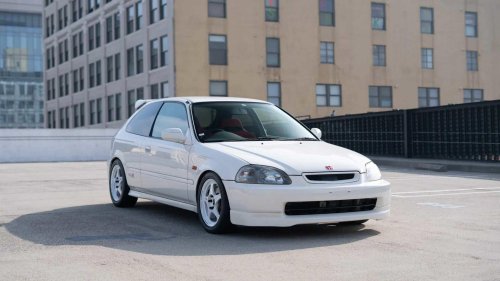
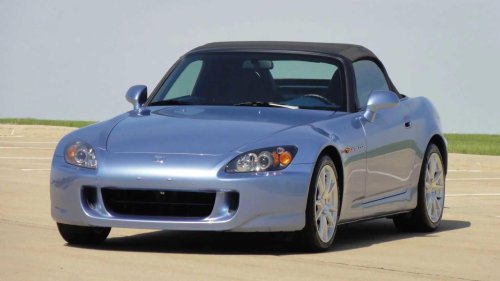
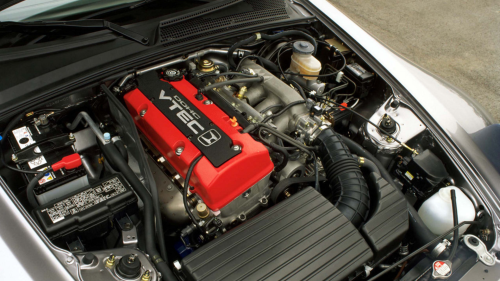
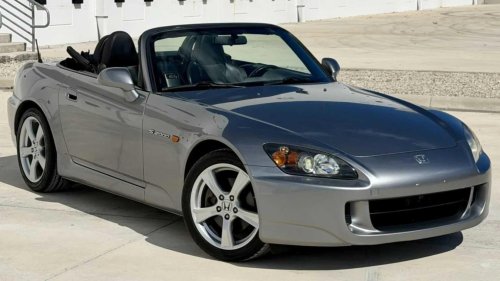
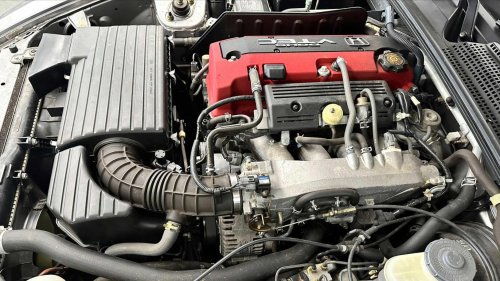
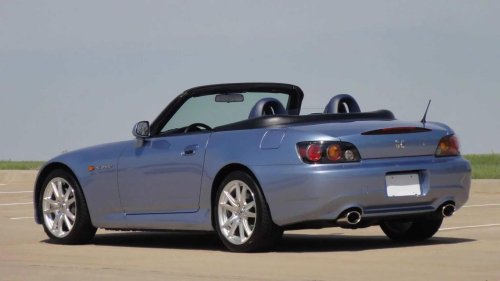
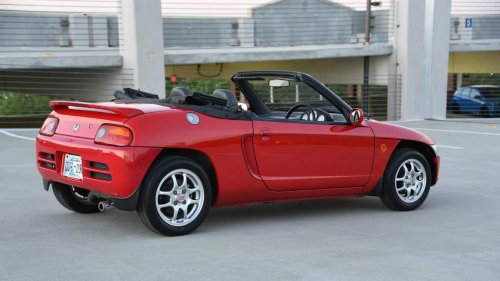



















For auto enthusiasts, there's little more invigorating than experiencing a screamer of a high-revving, naturally-aspirated engine. While forced induction can help deliver huge power outputs and aid low-end torque, the sensations that come with the sound and feel of a powertrain that dances on the edge of a five-figure redline are hard to match. Especially in the more environmentally-conscious age we live in today, where such things are now a rarity.For decades, Honda was one of the best at delivering these engines, with that reputation lifted by one in particular that still holds one of the highest redlines ever put into production. Honda Engines Have Long Been Characterized By High Redlines Bring a TrailerEnthusiasts will tell you that Honda has produced some of the most beloved engines in modern automotive history. The Japanese manufacturer has a worldwide reputation for cranking out compact powertrains that offer performance well above their pay grade.Legends it has produced include the B16B, a 1.6-liter naturally-aspirated four-cylinder at the heart of the Japanese market EK9 Honda Civic Type R, famed for its 8,000-rpm redline and the C30A V6, the 8,000-rpm powertrain that made the Acura NSX one of the finest sports cars of the '90s. We can’t forget the K20 as well, an engine that has a huge amount of respect both in stock and modified form.So, when Honda set about making a front-engined, rear-wheel drive drop-top sports car at the end of the ‘90s, you could bet it would be defined by a screamer of an engine. Why The S2000 Demanded That Continued Bring a Trailer Introduced in 1999, the Honda S2000 would be the first true roadster that the manufacturer had made since the S800 back in 1966. Designed as a modern interpretation of that car, which had a tiny high-revving four-cylinder engine inspired by motorcycle racing, it would be focused on driving thrills first and foremost.The car itself sounded like it would have all the ingredients to deliver on that recipe before anyone had even been behind the wheel to experience it. It weighed just 2,809 pounds, putting it around 300 pounds lighter than the NSX, with that classic front-engine, rear-drive layout.With just two seats, a soft top and what would turn out to be one of the sweetest-feeling manual transmissions ever produced, the powertrain of the S2000 simply had to deliver for the roadster to be a success among enthusiasts. Fortunately, it did. Its Screaming Engine Delivered 2000 Honda S2000 engine The first iteration of the Honda S2000, the AP1 produced from 1999 through to 2003, was powered by a 2.0-liter naturally-aspirated four-cylinder engine, the F20C.It was a technical marvel, with its 240-horsepower output giving it the title of being the highest specific output naturally-aspirated powertrain in production at the time, an impressive 120 hp per liter in US spec. Japanese market cars had even more power owing to less strict emissions demands, with 247 hp on tap. Honda F20C Technical Specs Its oversquare design, with an 87mm x 84mm bore and stroke, meant that its peak power came extremely high in the rev range, a mesmerizing 8,300 rpm and redlining at 9,000 rpm. Given the stresses that would be required on the engine at that point, Honda opted to use a forged crankshaft, connecting rods and pistons to help deal with the heavy demands.Low-end torque was famously the greatest weakness of the F20C as a result of its high-revving nature, though, with 153 lb-ft at 7,500 rpm. Because of that, it relied heavily on Honda’s VTEC system to come to life when driving hard. At around 6,000 rpm, the system would come to life, switching to a more aggressive cam profile and opening up the F20C's screaming personality. Why Its Successor Cut That Short HondaWhile the S2000 was an absolute delight to drive on the limit on a canyon road as a result of its screamer engine, wider criticisms of its poor torque delivery sent Honda back to the drawing board for the roadster’s mid-life refresh.When the updated AP2 Honda S2000AP2 Honda S2000 arrived in the 2004 model year, it dropped the F20C in place of a newly developed 2.2-liter F22C engine. Honda F22C Specs While its bore remained at 87mm, the stroke was increased to 90.7mm to strengthen low-end torque. It meant peak torque now stood at 162 lb-ft, coming in earlier at 6,500 rpm. It still had 240 hp, now delivered at 7,800 rpm and with a reduced redline of 8,000 rpm. Still quite high, but not quite the screamer it once was.That reworked engine, along with revised suspension and wider rear tires, changed the feel of the S2000 from a skittish, wild sports car into a more tame beast, albeit one that was arguably less exciting. The F20C Would Never Be Seen Again Bring a Trailer The F20C and updated F22C engines were bespoke to S2000 and suited the roadster’s character, though neither engine would see action in another car again.Honda has never outlined a reason for the retirement of the engines, but there are likely explanations. Packaging could be the biggest factor, with the powertrain designed to fit under the long hood of the S2000 and pair with the unique-to-the-car gearbox.Even if the engine were shoehorned under the hood of a sedan or hatchback, it’s fair to say that none of Honda’s cars since have suited the application of a high-revving, low-torque engine. As much as we’d love to have seen a Civic Type R utilizing one. Values Reflect Its Legendary Status Bring a TrailerWith the Honda S2000 firmly a cult favorite, values have remained incredibly strong across the board.Hagerty says good-condition early AP1 cars fetch around $26,300, with the very best examples commanding as much as $51,300. You can pick up well-used models in need of some work for around $16,500. Those have remained pretty consistent over the last 12 months at the time of writing, with a rise of 10% at the very top of the market.Although the AP1 tends to be the model that automotive journalists today yearn for, buyers are still paying attention to the AP2 as well. Values are notably higher than early cars according to Hagerty, with good-condition cars averaging around $32,300 and the very best selling for north of $54,000. The Cheaper Alternative You Hadn’t Considered Bring a TrailerAlthough the Honda S2000 is the only traditional roadster the Japanese manufacturer has officially sold in the US, you can get a cheaper, smaller alternative that still has a screamer of an engine in its own right.The Japan-only Honda Beat is a curious little sports car that was designed to fit the country’s tax-friendly Kei car regulations. The two-seater measures just 129.7 inches long, 54.9 inches wide and 46.3 inches tall. Yet, despite its compact stature, it packs a bit of a punch. Its naturally-aspirated 656cc engine could only produce 63 hp owing to those Kei regulations, but it had a mighty 8,500-rpm redline that made it a real riot to drive hard.The Honda Beat has been legal to import into the US since 2016, and plenty have found their way Stateside since. A budget of $10,000 should easily get you a good one already available in the country.