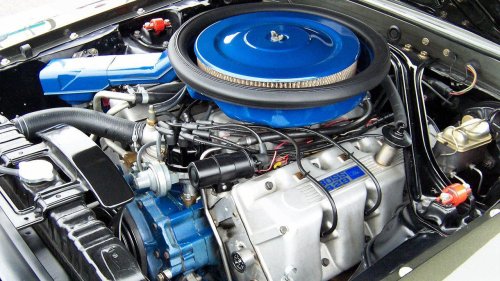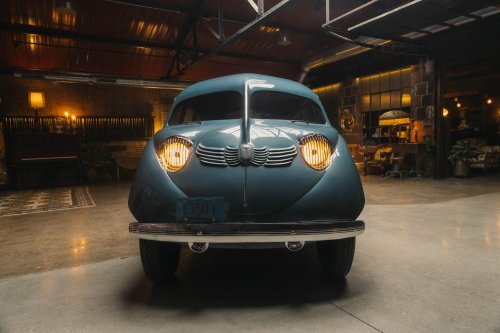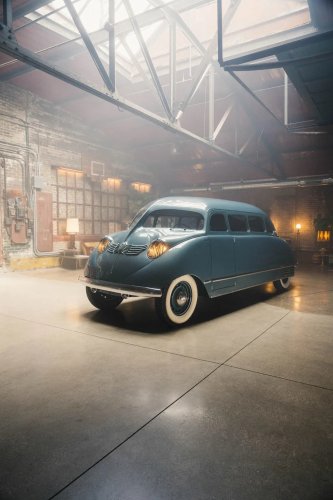
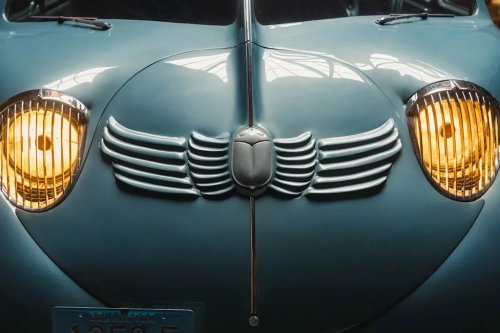
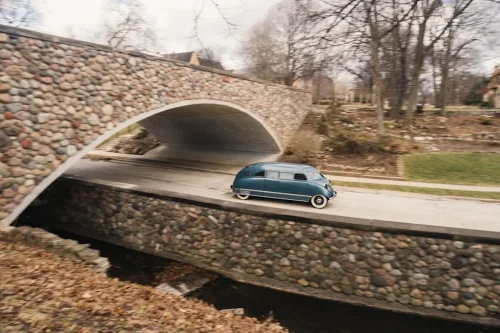
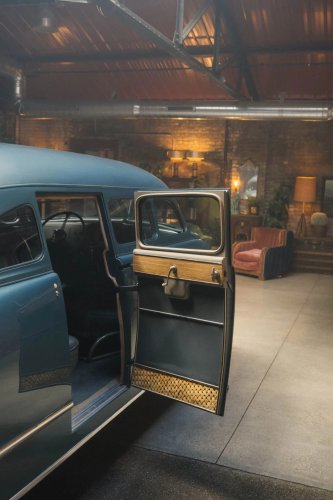
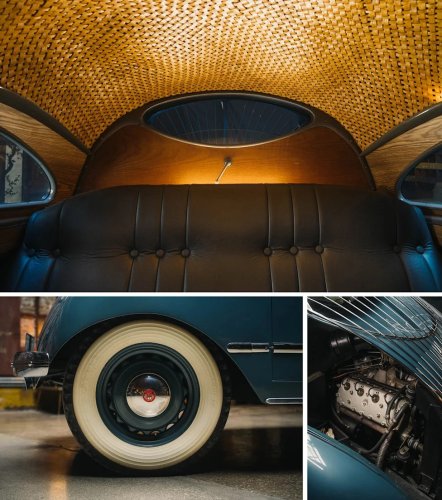
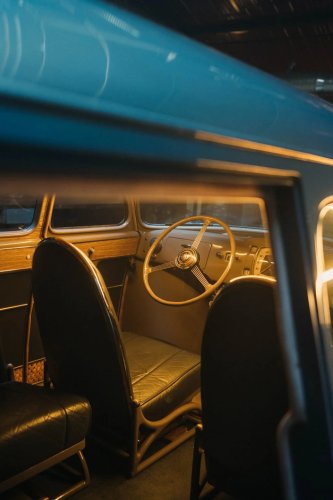
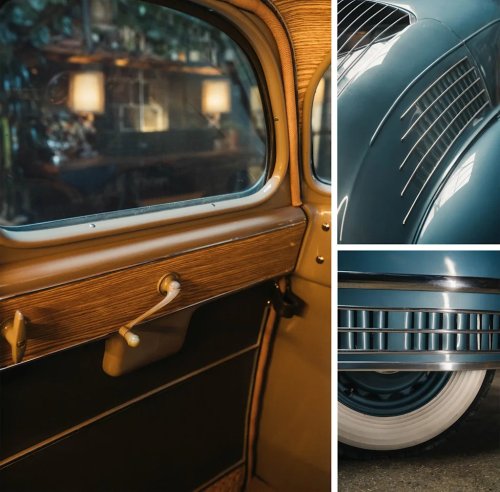
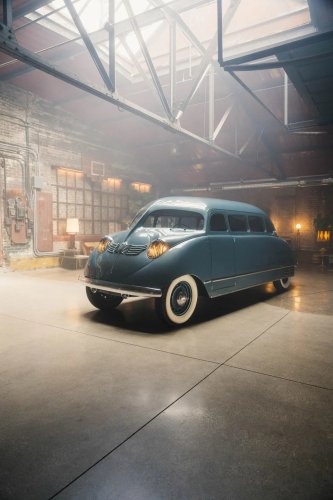
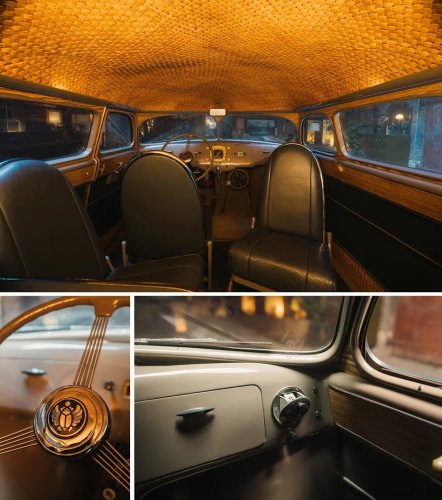
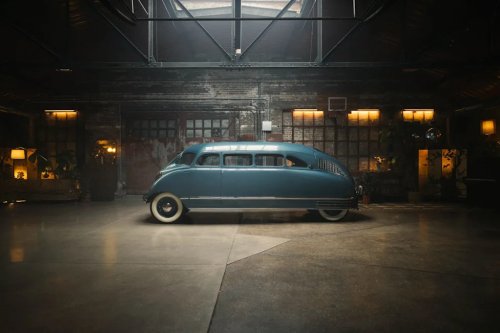


















The Stout Scarab Was Too Unusual To SurviveKevin Netz (Kevin Netz)The Stout's nose features a scarab-­beetle likeness. The bug wings are vented to allow air to flow into the cabin.Kevin Netz (Kevin Netz)I'm riding with a frozen-custard magnate through the frozen-custard capital of the world in a 1936 vehicle inspired by an ancient Egyptian dung beetle. The car has a ball of excrement designed into its logo, as seen on the hubcaps and steering wheel. Yes, it's been a weird day.This story originally appeared in Volume 35 of Road & Track.The custard king is Ron Schneider, owner of Leon's Frozen Custard, which serves many thousands of gallons of the stuff every year. The city is Milwaukee. The vehicle is a Stout Scarab, which was designed and built by the genius inventor William Bushnell Stout. Only nine Scarabs were made, all in 1935 and '36, and five exist today. Schneider owns two of them, and the one we are in is arguably the most accurately restored Scarab on earth.AdvertisementAdvertisement"Is there such a thing as a Scarab owners club?" I ask Schneider."Yeah, I'm it," he says, laughing. "I own 40 percent of the existing Scarabs. I have our annual meeting by myself in this car."On the go in one of five existing Scarabs. This example is arguably the most accurately restored.Kevin Netz (Kevin Netz)The Scarab flopped when it hit the market. It got little press coverage. Today, a Scarab as painstakingly restored as Schneider's could fetch$2 million. Why? It is a vehicle so strange that it has become the stuff of legend among a tiny coterie of passionate enthusiasts. More important, the Scarab can teach us a lot about the past. It might even be able to teach us some things about the future.From the wheel, Schneider weaves together the Scarab's story. It begins with Stout himself. Born in 1880, Stout was a car engineer, a journalist with the Chicago Tribune, a memoirist, a poet, and a first-rate eccentric. He was a pioneering designer of all-metal airplanes, including the Ford Tri-motor in the Roaring Twenties. During the Great Depression, Stout designed a collapsible mobile home—roughly 300 square feet of living space, complete with a bathroom and a refrigerator, that folded into a box and could be towed behind a vehicle. Today, Schneider also owns the only existing Stout foldable house.The owner of this vehicle, frozen-­custard magnate Ron Schneider, has driven it from coast to coast.Kevin Netz (Kevin Netz)In the Thirties, Stout saw what all the car companies were doing—one had an idea, and everyone else copied it. He figured he could do better. "Suppose that instead of copying we originate," his Scarab sales literature said, "instead of accepting public appraisal as final we recognize it for what it is: emotional, critical, non-analytical and non-creative."AdvertisementAdvertisementStout's idea was to rethink everything, as only someone from outside the automotive industry could do. At his engineering laboratory in Dearborn, Michigan, he created the Scarab. "Work on it began in orthodox aviation manner," he later wrote. "First I drew the contour of the car full scale on the floor in chalk."(top) The interior features a wicker headliner, a rear window that rolls down, and ambient lighting that was way ahead of its time. (lower left) With no running boards and minimal overhang, the Scarab looked like nothing else on the road in the Thirties. (bottom right) Powering the Scarab is a Ford flathead V-8 that could conveniently be serviced at Ford dealerships.Kevin Netz (Kevin Netz)Stout placed the engine in back, on top of the rear axle; keeping the engine's weight over the driven wheels helped with traction. He invented his own independent suspension system for all four wheels—novel at the time. He crafted the body with streamlined door handles, for aerodynamics but also to reduce wind noise. A low center of gravity allowed for better cornering.Hearst Owned (Hearst Owned)The Scarab has been called the first minivan because its inventor had the idea to blow out the interior. Stout designed the body with a 137-inch wheelbase, little overhang, and no running boards or fenders so he could maximize space inside the cabin.The Scarab has been called the world's first minivan and also one of the world's weirdest cars.Kevin Netz (Kevin Netz)He took the name for his car from the insect world, mainly because of its shape but also due to its steel tube frame, which resembled a buglike exoskeleton. The most famous type of scarab, the dung beetle, had mythological significance in ancient Egypt, and for the logo, Stout's designers created a beetle pushing a ball of dung. You can clearly see the depicted feces within the red icon on the hubcaps.AdvertisementAdvertisementThe finished Scarab had a Ford flathead 221-cubic-inch V-8. "Stout wanted owners to be able to service it at any Ford dealer," Schneider says as he shifts through the three gears. With a pair of Stromberg carbs, the motor pumps 85 hp.(left) Detail of the interior illuminates the care that went into this Scarab's restoration. (top right)William Bushnell Stout was obsessed with practical engineering, not to mention ornamental art deco styling. (bottom right) The engine is mounted above the enclosed rear wheels for optimal traction.Kevin Netz (Kevin Netz)To get the word out, Stout created an advertisement that appeared in the November 1935 issue of Fortune magazine with a tagline: "A Challenge and a Prophecy." The challenge was to the big car companies and the status quo. The promise was bold: that the radical features of the Scarab "will be adopted by all makers of fine cars within three years." Stout priced the vehicle at $5000, a fortune during the Great Depression and 10 times that of a mainstream Chevrolet.The Scarabs went to Stout friends and investors, including Philip K. Wrigley, the chewing-gum tycoon and Chicago Cubs executive, and Robert Stranahan, co-founder of Champion spark plugs. Stranahan was the original owner of the Scarab that Schneider now drives, according to his research.Stout charged $5000 for the Scarab, a fortune during the Great Depression and one reason why it didn't sell.Kevin Netz (Kevin Netz)To prove the concept, Stout road-tripped his own Scarab all over the United States. Everywhere it went, it drew attention—but not the sales kind. Stout recalled, "Word came back to us very definitely that the industry was not interested in that kind of car." The styling was too weird. People couldn't understand the concept of a rear engine, and they didn't want to be stared at everywhere they went.AdvertisementAdvertisementAnd then, the entire story faded into the rearview. Stout built a follow-up, fiberglass-bodied Scarab prototype in 1946 and died in 1956. With the exception of a few eccentric car enthusiasts, few people today are aware that the Scarab ever existed. Why do all things Stout mean so much to Schneider? "Stout is such an unsung hero," Schneider says. "The engineering is fascinating. The Ford connection is a big part too."(top) With ample windows and no long hood, as Stout put it, "the visibility was perfect." (bottom left) Care for a smoke? The Scarab came with two ashtrays and three lighters. (bottom right) Yes, that's a dung beetle pushing a ball of dung.Kevin Netz (Kevin Netz)Schneider insists that the Scarab is not just an oddball relic of the past but also a meaningful manifestation of how a disruptor can serve industry and society. It turns out that Stout was right about a lot. Many of the ideas he engineered into the Scarab eventually became more mainstream: moving the engine from the front of the car, maximized interior space, a lack of running boards, an aircraft-inspired chassis, flush body construction, an independent suspension.Getting the Scarab into this photo space is a terrifying story all its own.Kevin Netz (Kevin Netz)The same questions Stout asked himself while dreaming up the Scarab can serve us well nearly a century later. What if we rethink how a car can be designed and built, how it can be propelled down a road, and what its interior should offer us? What if we pay attention to the ideas of disruptors from outside the industry and the status quo? What if we spend as much time studying others' failures as we do copying their successes?Genius is a funny thing. When it shows up at the right time, it can change the world. When it shows up at the wrong time? It becomes but a footnote in the annals of the past. But footnotes sometimes offer the most fascinating information. The Scarab was too far ahead of its time. Perhaps incorporating a ball of excrement into the logo wasn't the best idea after all.See our full photo gallery of the Stout Scarab here.[image id='07114309-3514-4efb-8db2-b68befcf7ebc' mediaId='a71b59a3-0921-40e1-8b71-7a8acd81bfd2' align='center' size='medium' share='false' caption='AdvertisementAdvertisementA car-lover's community for ultimate access & unrivaled experiences.JOIN NOW ' expand='' crop='original'][/image]You Might Also LikeIf You Can Only Own One Car, Make It One of TheseThese Are the Most Popular Cars by State