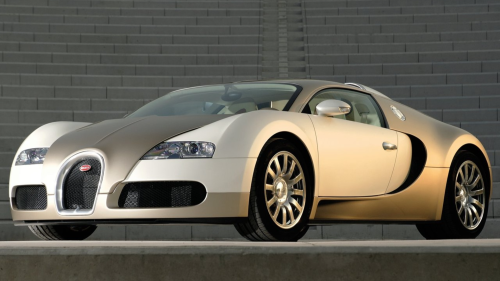
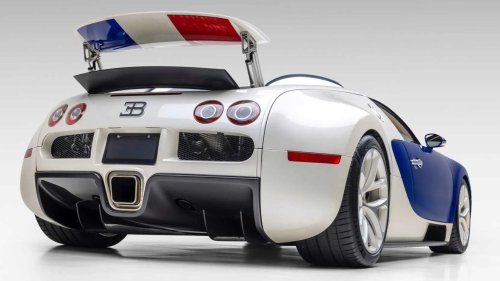
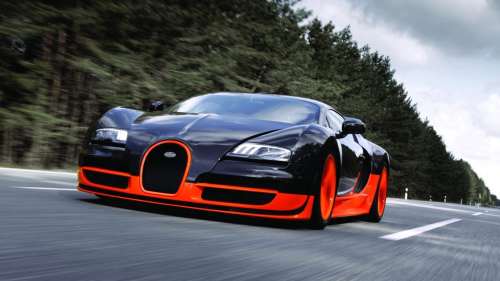
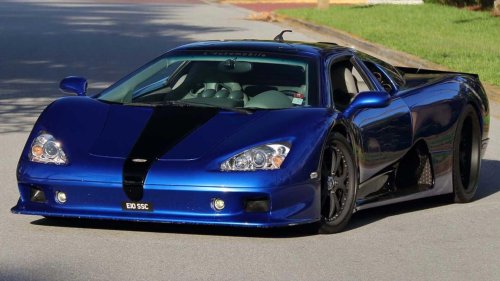
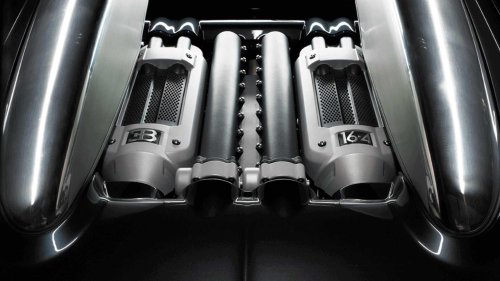
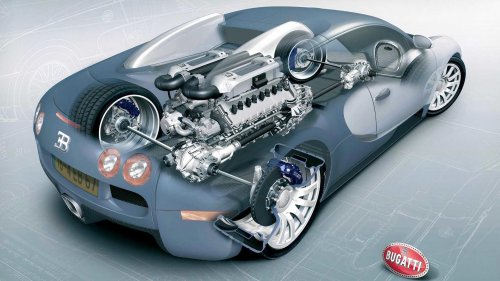
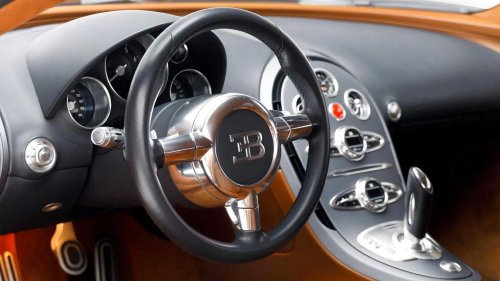
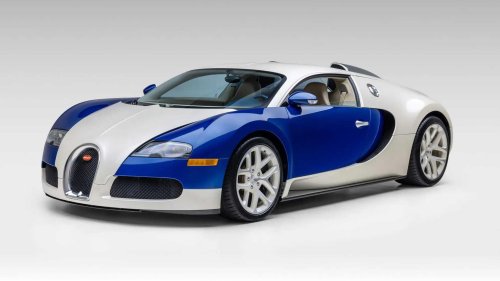
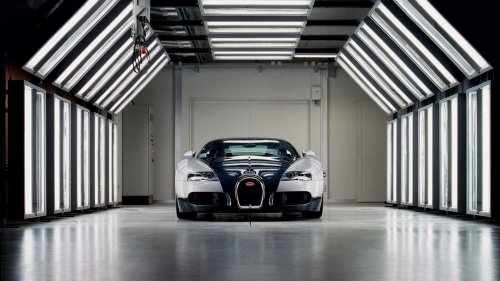























Manufacturers of the world's fastest cars are always looking for marginal gains, a couple of mph here, a millisecond faster there. But in the 2000s, one high-end carmaker decided enough was enough, and set out to blow the established supercar elite out of the water. The aim was simple: build a car that wasn't just a little bit faster than the competition, it would be so quick that it would take years for anyone to catch up. And just to add insult to injury, the company behind this all-conquering machine made its name building cheap cars that you see on every street corner.... Supercars Were Out Of Control In The '90s BugattiThe'80s may have been the era of excess, but the early '90s were one massive hangover. Bankers and stockbrokers were waking up, bleary-eyed, to the economic downturn that followed, and suddenly those fat bonuses were evaporating faster than the bubbles in afternoon champagne glasses. Once a symbol of '80s exuberance, Porsche was struggling, helping out with cars like the RS2 to help line the coffers, and cars like the Jaguar XJ220 were being launched to empty showrooms.But out of the flames of the exotica industry came a new breed of hypercar. The McLaren F1 was a car for the ultra elite, with a 240 mph top speed and a near $1 million price tag. The Ferrari F50 was an uncompromising F1 car for the road, with a $519,245 sticker, and the Porsche GT1 was the rear of a 962 Le Mans racer with a 993 front and some number plates. The rulebook had changed for supercars — and crazy was the name of the game. VW Wanted To Destroy Every Supercar On The Planet Via: Bring a Trailer Seeing that supercars were coming back into fashion, albeit on steroids, Volkswagen had a plan. The German manufacturer, which started out making the People's Car Beetle, a spluttering rear-engine machine for the masses, was in its stride, Hoovering up car companies such as Škoda and Seat, and building an empire that also included Audi. Why not buy an ancient supercar badge and build something that would make the GT1s, F50s, and F1s of this world seem pedestrian, and thus stamping its authority on every single corner of the automotive cosmos? It made perfect sense, but it would be a headache even for a megalodon like Volkswagen. How The Veyron Made Other Cars Seem Slow BugattiFor many, the McLaren F1, conceived in 1988 and released in 1992, was the ultimate mike drop moment. This was McLaren Automotive's first foray into road cars, and for the competition it might as well have been their last. The 240-mph F1, with its 618-horsepower 6.1-liter BMW S70/2 V12, was so far advanced from most other supercars, it earned a new moniker: the hypercar.True, the Jaguar XJ220, with its 3.5-liter twin-turbo V6, could hit 217 mph, but the F1, with its central driving position and exotic race-bred technology, seemed like the ultimate expression of performance car technology. Even the Ferrari F50 of 1995 only went 202 mph, and its successor, the Enzo, had a top speed of 217 mph in 2002. When Volkswagen bought Bugatti in 1998, its sole aim was to make all of these cars seem old hat. The 254-mph Veyron of 2005 did exactly that. No Competition At launch, nothing in the showroom universe could really touch it. The closest rivals — cars like the Ferrari Enzo and Porsche Carrera GT — were lighter, rawer, and arguably purer, but neither cracked 220 mph or breached the 1,000-horsepower barrier. However, the Veyron completely rewrote the rules seemingly overnight: every new “fastest car in the world” claim after it had to be measured against Bugatti’s 254-mph mic drop.MecumIt wasn’t until the arrival of the SSC Ultimate Aero TT that the Veyron’s top-speed crown was officially snatched, with a verified 256.18 mph run. But even then, Bugatti answered back with the 1,200-horsepower Super Sport, before the conversation shifted again when the Koenigsegg Agera RS and later the Bugatti Chiron Super Sport 300+ pushed both power and velocity into previously unthinkable territory. The Veyron's Engine Was On A Different Planet Via Bugatti In 2026, a time when pick-up trucks have more than 1,000 horsepower, having a four-figure output doesn't seem that impressive. But in the mid 2000s, when the all-wheel-drive Veyron was launched, it was a massive deal. So much so, that Bugatti had to develop a quad-turbo 8.0-liter W16 engine from two narrow-bank 4.0-liter V8 mills, packing 1,001 horsepower and 921 lb-ft of torque. Zero to 60 mph takes around 2.5 seconds, 0-124 mph takes 7.3 seconds, 0-186 mph takes 16.7 seconds and the top speed is a whopping 254 mph. The Veyron Was Full Of Pioneering Technology Bugatti The Veyron was the first production vehicle to have a full carbon-fiber monocoque, and its torsional rigidity of 60,000 Newton meters per degree was unheard of in production cars. The seven-gear twin-clutch gearbox was one of the fastest transmissions in the world with shift times of less than 150 milliseconds. There are ten radiators just to keep it cool. Then there were carbon ceramic brakes, and a rear spoiler which doubles as an additional air brake. The braking is just as dramatic as the acceleration, the car coming to a complete standstill from 60 mph in just 31.4 meters or 2.3 seconds. Barely any parts on the Veyron could be taken from another car, with virtually everything made from scratch. The 16.4 Super Sport, with 1,200 horsepower, set a new world record top speed of 267.86 mph in 2010. The Veyron Was A Different Type Of Hypercar Bring A TrailerBut what really made the Veyron stand out from the competition was the way it was to live with. Whereas the F1 and F50 were uncompromising machines, with spartan, no-nonsense cockpits, the Veyron was an S-Class (or let's say Phaeton) in comparison. The interior is a wash of opulence, with an Art Deco flava that is finished in a specially developed aluminum alloy and pristine leather. The light metal steering wheel with a leather rim is a jewel-like work of art. In short, the Veyron was designed to be as much of a GT as it was a world-crushing hypercar. It does weigh around 4,162 lbs, though, compared to 2,712 lbs for an F50, but that is the price of luxury. Buying A Bugatti Veyron Today Via: Bring a TrailerThis is probably the bit where people say, if you need to ask...it's probably too expensive. And for most of us mere mortals, buying one of the 450 Veyrons constructed really is out of reach. A base Veyron 16.4 will cost you $1,300,000 million in good condition, says Hagerty, with a 1,200-horsepower Super Sport costing $1,750,000. That all said, the Veyron may have destroyed the competition with its performance, but these days it doesn't quite have the impact of a McLaren F1 or an Enzo on the used market, with these cars going for $20,500,000 and $3,650,000 respectively. Even Owning A Veyron Is Eye-Wateringly Expensive Bugatti It's not just buying a Veyron that's expensive, either — the cost of ownership alone would be enough to bankrupt us even if we got one free. It costs $6,400 to replace each individual turbo and the labor involved is priced around $9,000 per pair, Road and Track reported, with a fuel tank costing $42,000 to replace. Another report (Motor1.com) said that yearly fluid changes cost $25000, while the wheels have to be replaced every 10,000 miles to the tune of $50,000. A set of tires? That will be $42,000. Speaking of fuel, you'll empty the tank in around 12 minutes at top speed. If five-figure annual motoring sounds a bit steep, it might be better off sticking to buying a Mustang Dark Horse for what looks like a year of motoring in a Veyron.Sources: Hagerty.com, Motor1.