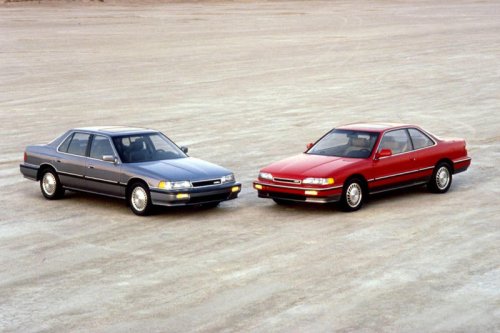
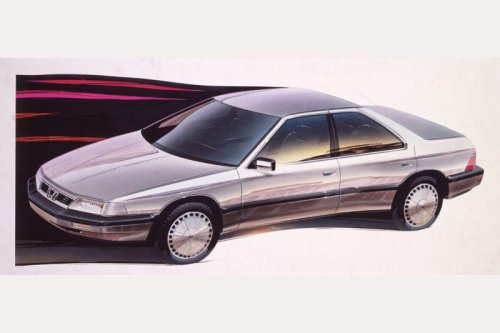
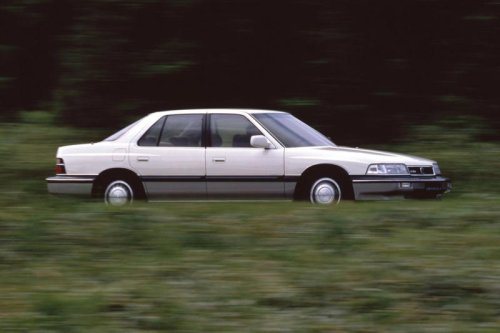
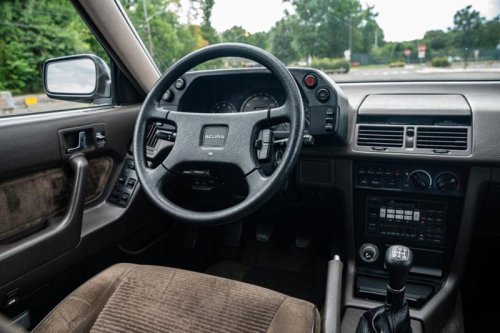
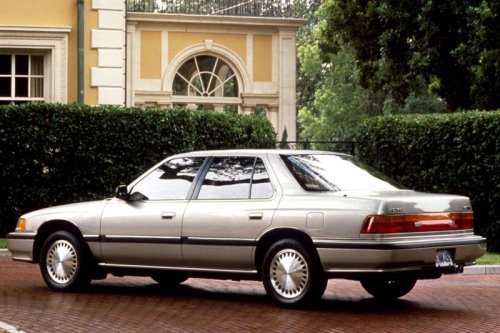
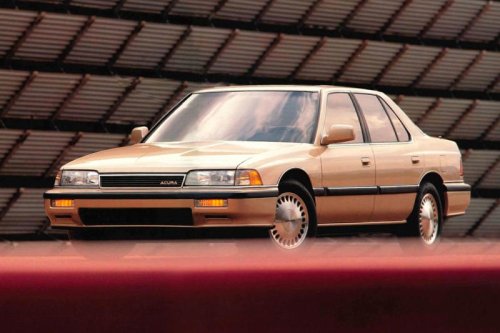
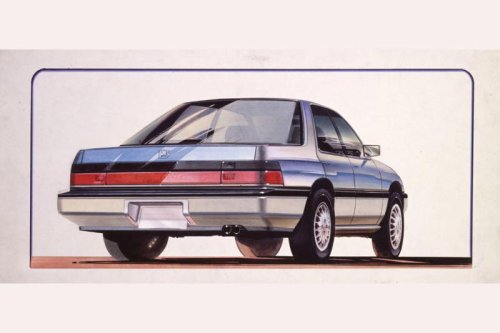



















Happy 40th, AcuraMarch 27, 1986, marked the official brand launch of Acura. But, prior to that, it was introduced. It was Honda's way of saying it was ready to take on the luxury establishment, not just the Europeans but also the Americans. The cars that started it all were the Integra and Legend, and without those, Acura might be an entirely different company today, or not exist at all.The Legend represented Acura's ambitions as its flagship sedan. These days, it's often the second-generation model that springs to mind when the name is mentioned. The first-generation coupe also has a pretty strong fan base, but the original sedan is barely mentioned despite its significance. Unless your name is Tyson Hugie, you won't find much content about the first-gen Legend compared to the second one. Still, we wouldn't call it a forgotten car by any means, but we say it deserves more attention. You Can Thank the Brits for the LegendIf we were to trace the roots of the Legend, one can say that the British were instrumental in getting the ball rolling. Honda planned to release a flagship sedan to compete with the Toyota Crown and Nissan Cedric in its home market, while the Austin Rover Group, then called British Leyland, was in desperate need of a successor to the Rover SD1. British Leyland reached out to Honda, which was just then drumming up a bold plan to offer a luxury sedan for America and the world.The two companies soon tied the knot with Honda lending its 1981 Civic Sedan to the British to create the Triumph Acclaim. But the two companies would take the relationship to the next level with Project XX, or HX for Honda. Development kicked off in November 1981, and Honda would be out of the gates first when it premiered the Legend on October 22, 1985. The Acura version debuted during the brand launch, and the eventual Rover 800 was formally introduced on July 10, 1986. Honda and Acura Similarities and DifferencesThe Honda Legend came in a wide variety of trims and lengths to suit the local taxation brackets. It was also available with either a 2.0-liter V6 or a 2.5-liter V6, the latter becoming the sole engine choice for the first batch of export models, including the Acura. The 2.0-liter models had shorter bumpers and slimmer fenders, while the larger-engined versions had longer ones and more prominent wheel arches. Later in its life, the Japanese-market models gained a turbocharged 2.0 V6 option dubbed the Wing Turbo with 188 hp and 178 lb-ft. At first glance, the Acura Legend looked pretty much identical to the Honda, albeit coming with a completely naked front grille in '86. It got a V6 24 Valve badge in the bottom-left corner in '87, which was replaced by an Acura wordmark in '89. In contrast, the Honda Legend prominently wore the H logo from the start.Under the hood, it had the same 2.5-liter V6 from the Japanese and 'Rest of World' models, but the Acura's power output was choked due to emission regulations. North American models made 151 hp and 157 lb-ft, while everyone else had 163 hp and 156 lb-ft. Transmission options were the same, though: a four-speed automatic or a five-speed manual. The difference here is that the Japanese market never received manuals for the 2.5-liter, a rare win for the U.S. version. Innovative Where it CountsUnderneath the first-gen Legend's formal exterior were a host of innovations that made people fall in love with the engineering aspect of Honda and Acura products at the time. For starters, it had a double-wishbone front suspension that was largely reserved for sportier vehicles. Also, most of its peers were still using 12-valve six-cylinder engines, but the Legend came out swinging with 24 right off the bat.Aero was the name of the game in the '80s, and while it doesn't look too slippery to the eye, it was to the air. It had a low drag coefficient of just 0.32, getting close to much more expensive European models such as the Audi 5000 and Mercedes-Benz 300E. Another innovation was the first use of Honda's Programmed Fuel Injection (PGM-FI), which made the Legend reasonably efficient for a six-cylinder. Continuous ChangesThe Legend was initially offered in just one trim, but an additional variant, the V6 L, was added in 1987. That one added leather, a power driver's seat, dual illuminated vanity mirrors, and heated side mirrors. That same year, the Legend Coupe was introduced, with some of its features trickling down to the sedan.In 1988, it gained the larger 2.7-liter V-6 from the coupe, boosting power up to 161 hp and 162 lb-ft. It also benefitted from the revised four-speed automatic transmission and the addition of the V6 LS, which came with a driver-side airbag, 10-way power seats, an onboard monitoring system, and anti-lock brakes. Curiously, the fuel door was moved rearwards for this update.Acura doubled down on mechanical upgrades in '89 by giving the Legend a double-wishbone rear suspension as well. It also got a restyled front bumper and a new set of front and rear lights, which now aligned it with the international Honda-badged version. 1990 was the final model year for the first-gen Legend, and the only change was burr walnut trim in the V6 LS. The Original Luxury Disruptor Forward-thinking and thoroughly modern for the '80s, the Legend retailed for $19,298 and just a hair under the $20,000 mark with destination in 1986. 40 years ago, that was pretty serious money, as that's roughly $60,000 in today's money. However, most, if not all, of the models it was up against started in the mid-$20,000 mark, which is about $75,000 today.Even in its final year, the Legend still undercut the competition, priced from about $23,000 to $30,000, or approximately $60,000 to $75,000 today. Compare that to a Lincoln Continental or a Cadillac Seville from the same vintage, and the Acura still offered better value. Similarly-sized offerings from Europe had either more power or felt more polished, but generally lacked the standard kit offered by Legend and cost way more.You can see why Acura, and eventually Lexus and Infiniti, disrupted the luxury car game coming into the '90s. While Lexus is often credited with really shaking up the establishment, Acura helped open the door for that and showed the U.S. market that Japan is more than capable of building premium products. Yes, the Integra did its part, but as its flagship product, the first Legend sedan truly flexed Honda's brainpower. For that alone, it deserves more mentions.