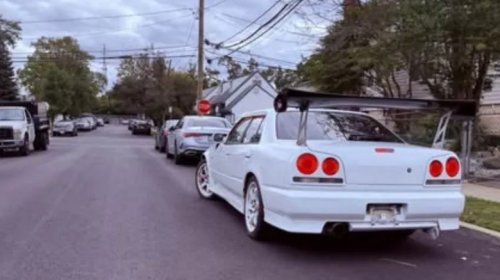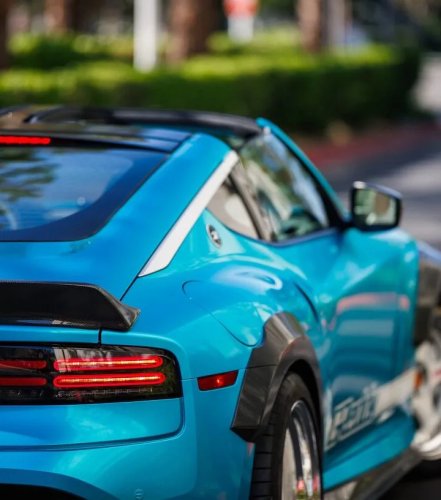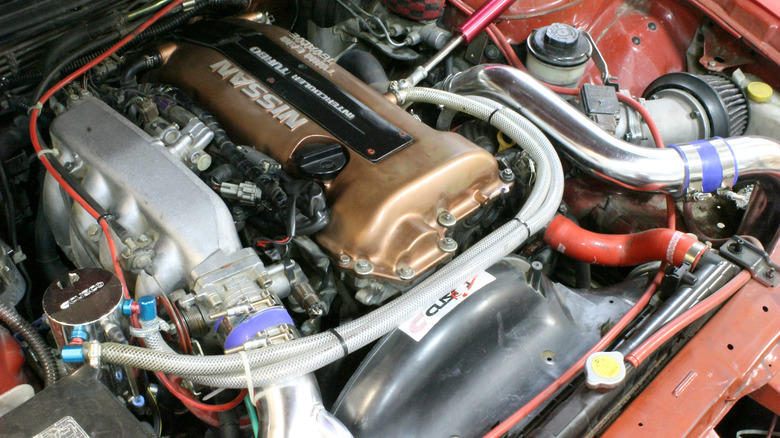
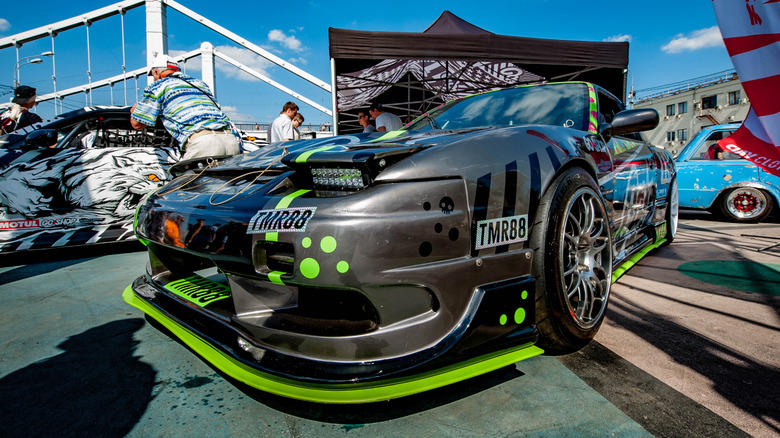
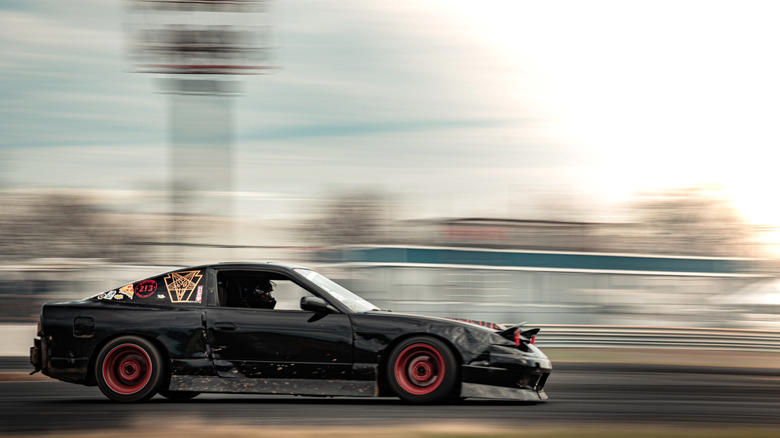



















Its FR PlatformIt's handy to start with the obvious, and when it comes to drifting there are obvious advantages to the 240SX's front-engine, rear-drive platform, which was relatively uncommon among Japanese performance cars of the era. Drifting is simply more naturally suited to rear-wheel drive, and while it's possible to drift in a full-wheel drive car, the various techniques amount to something more akin to maintaining a controlled slide. Calling it "lift-off oversteer" doesn't change the fact that you're controlling the drift with brake and handbrake rather than throttle, and the experience isn't as satisfying by most accounts. RWD drifting is where you want to be, even if that means taking on the track in a Ford transit van.Engine placement is also a big deal. In a June 2020 edition of SportsCar Magazine, North American Touring Car Champion and four-time SCCA World Challenge GT champion Randy Probst explains it with a clear metaphor: a spinning ice skater. Extending your arms in a spin slows the turn while pulling them in close to your center of rotation (like a mid-engine car) speeds up the spin. The trouble is that the mid-engine spins too readily and too fast. You'll hear mid-engine drift cars referred to as "twitchy" or "snappy" for this reason.The rear-engine car puts weight over the driven wheels, which is desirable in most motorsports contexts but not ideal for drifting — when you want to break the rear tires loose in the corners. And when you do break a rear-engine drift car loose, it can be hard to get back under control.Its ideal weight distributionExperts, both real and aspirational, will quibble over it, but the 240SX is generally regarded as having a near-perfect weight distribution for drifting, at 55:45, front-to-back. This is especially true of the JDM 180SX with its lighter aluminum engine block. Simply put, the 55:45 split keeps the steering grounded while giving the backend a little room to step out. Sounds like drifting.How important this is probably varies according to the level of the equipment, driver, and technicians. A non-pro-drift driver is probably going to benefit from a near-equal weight distribution than a professional team with the resources and skill to compensate for minor (or even major imbalances). The potential depth of suspension tweaking is enormous, and much of it can counter any front-to-rear weight distribution imbalance.Still, as a platform it makes sense to start out as close to neutral as possible, maybe with a touch more weight at the front to bolster steering.Its KA24DE (American market) engineThe original engine for the American market S13 240SX was widely panned as an awful piece of machinery. But its 1991 replacement, the KA24DE, quickly gained a reputation for tuner excellence. And the turbocharged version is lauded by some as possibly even better than the JDM engines.But the KA24E was not an auspicious start. The cast-iron truck engine left sports drivers unimpressed, and it became common to replace it as a matter of course on competitive 240SXs. That engine swap could come in any of a number of flavors, maybe most commonly for minor gains with a CA18DET from the JDM 180SX or for major gains with a GM LS V8.The KA24DE was also underwhelming in stock form, picking up 15 HP, with peak power at 5600 rpm and peak torque at 160 lb-ft at 4400 RPM. It also kept its cast-iron block, which was heavy but allowed aggressive tuning. Enter the turbocharged KA24DE-T, the label commonly used for a KA24DE with an aftermarket turbocharger. This made 350-400-HP KA24s possible, and it's not hard to find drivers who prefer it to the legendary SR20DET.