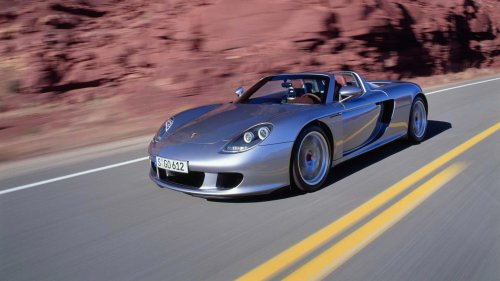
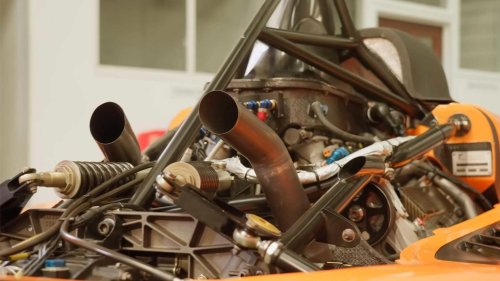
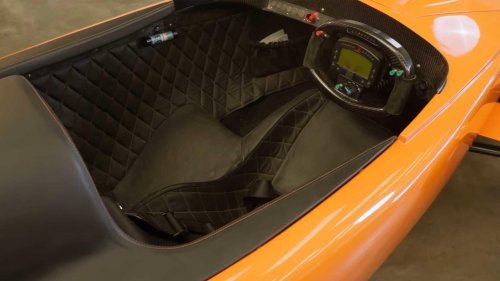
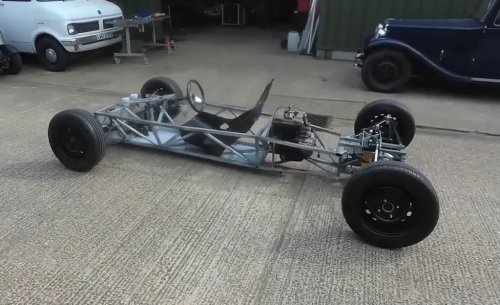
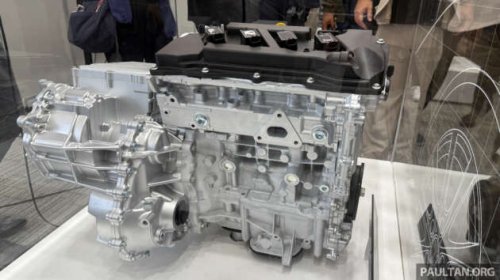
In the early 2000s the supercar conversation was dominated by heavy, expensive machinery. The Bugatti Veyron tipped the scales at over 4,000 lbs and needed a 1,001 horsepower W16 engine just to reach its performance targets. Ferrari, Lamborghini, and Koenigsegg were all operating on the same basic assumption. That extreme performance required extreme mass, and that the way to go fast was to overwhelm the physics with enough power to compensate. One small British company had a different idea. They did not need more power. They needed less car. UPDATE: 2026/04/25 09:13 EST BY JARED SOLOMON This article has been updated with more information on why this car was road legal. When 500 HP Required 3,700 Pounds: The Supercar Weight Problem Porsche In 2006, a road car with 500 hp was exotic almost by definition. The Ferrari 599 GTB had 611 hp and weighed 3,726 lbs. The Lamborghini Murcielago LP640 had 631 hp and weighed 3,671 lbs. Even the Porsche Carrera GT, considered one of the most focused performance cars of the era, weighed 3,042 lbs with its 605 hp V10.All of these cars were fast. None of them came close to the power-to-weight ratio of a Formula 1 car, and none of their manufacturers claimed otherwise. The standard assumption was that a road car simply could not operate at racing car mass, because a racing car offered none of the structural safety, comfort, or weather protection that road use required.That assumption turned out to be more fragile than it looked. The engineers who had built the McLaren F1 already knew it. The performance landscape of the 2000s was about to be redrawn by a car most people have still never seen in person. Meet the Caparo T1: The Road Car That Weighed a Thousand Pounds CaparoBen Scott-Geddes and Graham Halstead both worked on the McLaren F1, the car that redefined what a road car could be when Gordon Murray applied racing principles to a street-legal machine in 1992. When they left to found their own company, they took the same philosophy with them and pushed it further. Their founding company, Freestream Cars, was acquired in 2006 by Caparo, a British industrial conglomerate with deep roots in steel and aluminum manufacturing for the automotive and aerospace sectors. The acquisition gave the project both a name and access to materials expertise that few small car companies could call upon.The orange prototype that appeared at Top Marques Monaco on 20 April 2006 was not chosen for its color by accident. Caparo painted it in the same shade as the historic McLaren racing cars from the Bruce McLaren era, a deliberate signal from Scott-Geddes and Halstead about where this car had come from and what it was trying to achieve. Murray Walker, who had commentated on the McLaren F1's racing career, was present at the unveiling. The car had not yet turned a wheel in anger, but pedigree alone wouldn't be enough for what they were planning to attempt.The Caparo T1 had a dry weight of 470 kg, or 1,040 lbs. It was 42 inches tall, lower than a Caterham Seven. Its carbon and aluminum honeycomb monocoque chassis, open-wheel layout, and twin-element front wing made it look less like a road car than a Le Mans prototype with headlights, which was more or less the point. At launch it was the first production road car to break the 1,000 hp per tonne barrier, achieving a power-to-weight ratio of 1,045 hp per tonne. The Bugatti Veyron, with its 1,001 hp engine, managed 521 hp per tonne, meaning the T1 had roughly double that figure while using barely half the engine displacement.It could sprint to 60 mph in under 2.5 seconds and to 100 mph in under five, with a top speed of 205 mph depending on aerodynamic configuration. At 150 mph the T1 generated more aerodynamic downforce than the car itself weighed, meaning it could theoretically drive through a tunnel inverted, though Caparo was careful to frame that claim as aerodynamically possible rather than something they recommended trying. The adjustable front and rear wings could be configured for different levels of downforce depending on whether the car was being used on track or road. Production cars came with a front-axle lift system for clearing speed bumps, which would become relevant. The Engine Nissan Built For The Racetrack DriveTribe/YouTube The 3.5-liter V8 at the heart of the T1 was developed with Menard Competition Technologies in the United States, and its origins lie in the Nissan VRH35ADE IndyCar engine that powered the Infiniti Indy car program. Caparo detuned it from full racing specification for road use, dropping the peak rev limit to 10,500 rpm for extended reliability and calibrating it to run on 98 RON pump fuel rather than racing methanol.In that configuration it produced 575 hp and 310 lb-ft of torque, with a flat-plane crankshaft, 32 valves, and a dry-sump lubrication system borrowed directly from racing practice. The six-speed Hewland sequential gearbox weighed around 30 kg and could shift up in 60 milliseconds. The entire powertrain package was a purpose-built racing system adapted, as carefully as possible, for a car that also needed to be road legal. Why The Caparo T1 Was Road Legal For all its racing-derived engineering, the Caparo T1 was not a track-only special. It was homologated for road use in the UK under Individual Vehicle Approval (IVA) regulations, which allowed low-volume manufacturers to certify cars without full mass-production crash testing. This is the same regulatory pathway used by manufacturers like Ariel and Caterham.To meet legal requirements, the T1 was fitted with headlights, indicators, mirrors, a horn, and a catalytic converter to comply with emissions standards. It also ran on 98 RON pump fuel rather than race fuel, and production cars included a front-axle lift system to increase ground clearance over speed bumps and uneven road surfaces.However, compliance did not make it conventional. The T1 had no doors, no windshield in the traditional sense, and no roof. Occupants wore helmets in most driving conditions, both for safety and comfort at speed. The seating position was fixed, with pedal adjustments used to accommodate different drivers, mirroring formula car design. There was no luggage space, minimal weather protection, and limited thermal insulation from the engine and exhaust systems.Noise regulations were met, but only narrowly. The naturally aspirated V8 operated at extremely high engine speeds, and the car’s lack of sound insulation meant that mechanical and intake noise were effectively unfiltered. Similarly, while the car passed lighting and visibility requirements, its extremely low ride height and open-wheel layout made it less visible to other road users compared to conventional vehicles.In practical terms, the T1 occupied a regulatory gray area between road car and race car. It satisfied the legal definition of a road-legal vehicle, but its usability on public roads was heavily constrained by its design priorities. This distinction is central to understanding both its engineering achievement and its limited commercial appeal. What a Caparo T1 Is Worth Today DriveTribe/YouTubeCaparo planned to build 25 cars per year. They sold 15 in total before the company entered administration in 2015. A small number of examples have surfaced for sale since the collapse, including one in Japan in 2019 and at least two in the UK from 2021 onward. With no established auction market given the production numbers, and none currently advertised for sale, it's difficult to accurately value. That being said, asking prices converted to dollars from previous UK listings sit above $250,000 for standard T1s in documented condition, with prices climbing significantly for exceptionally low-mileage or fully sorted examples.With only around 15 cars in existence and no prospect of further production, the T1 occupies a category of its own. It is less a collector car in the conventional sense and more an artifact from a specific moment in British engineering history that did not get to finish what it started. For comparison with the era's other extreme performance machines, the T1 remains one of the most extraordinary low-production cars of the 2000s. Why It Caught Fire And Why That Mattered The Caparo T1 became notorious before most people had driven one, and the reason was television. In October 2007, racing driver Jason Plato was testing a T1 prototype at Bruntingthorpe aerodrome for a Fifth Gear segment when the car caught fire at approximately 160 mph. Plato described looking in the mirror, seeing smoke, and then finding himself sitting in the center of a fireball. He escaped without serious injury. Presenter Vicki Butler-Henderson delivered the news that Caparo had attributed the fire to a faulty oil sealing component, which it stated had been identified and corrected.A few weeks later, on Top Gear, Jeremy Clarkson was driving the car when a floor panel came loose at speed. In the same episode, Clarkson referenced two further incidents: a front suspension failure at the press launch that sent a Dutch journalist into the gravel, and a stuck-open throttle at the Goodwood Festival of Speed.These were all pre-production prototype cars. Caparo maintained, with some justification, that the production versions with adjustable ride height, electronic driver aids, and resolved engineering fixes were categorically different machines. But the damage was done. The T1 had been branded unreliable and potentially dangerous in front of the two largest automotive television audiences in the world, and no amount of correction could undo that. The Top Gear Power Board lap time tells the rest of the story: the Stig lapped the test track in 1:10.6, six seconds faster than the previous record held by the Koenigsegg CCX. Clarkson announced the time, placed it on the board, and then immediately removed it because the car could not clear a speed bump. Caparo pointed out that the prototype lacked the adjustable ride height fitted to production cars. The record stood nowhere officially, which was a reasonable metaphor for how the whole project went. The Company That Built It and What Happened Next DriveTribe/YouTube Caparo plc, the parent company, entered administration in October 2015 as the UK steel crisis devastated the business. More than 450 jobs were lost across five sites in the immediate aftermath. On 8 November 2015, CEO Angad Paul was sadly found dead in London in what was reported as a suicide. Caparo Vehicle Technologies, the division that built the T1, had no viable path forward and was dissolved in 2019. A T1 Evolution had been announced in 2014 with a planned output of 700 hp and updates to the chassis, aerodynamics, and driver aids. It was never built.What remains is 15 road-legal cars, a lap record that was never officially recognized, and an engineering argument that has never been refuted. The T1 demonstrated conclusively that a road car could achieve racing car power-to-weight ratios if the engineers were willing to treat weight as the primary enemy rather than an acceptable compromise. That argument has since been made by the Gordon Murray Automotive T.50 and the Aston Martin Valkyrie, both of which owe something to what Scott-Geddes and Halstead proved was possible in a small workshop in Basingstoke. Neither of those cars costs less than seven figures. The T1, for all its difficulties, sold new for around $400,000. That it failed commercially says more about the timing, the television incidents, and the fragility of a small company operating without a financial safety net than it does about the idea at its core.Sources: Caparo, Car & Classic







































!['What the [Expletive] Is That?:' Customer Complains Car is 'Shaking Like Crazy.' Then His Mechanic Takes a Closer Look At The Tire](https://cdn.topcarnews.net/thumb/id/aHR0cHM6Ly9jZG4ubW90b3IxLmNvbS9p-bWFnZXMvbWdsLzQwRTk0cS9zMS9tYXpk-YS1taWF0YS1vbi1zdHVkZGVkLXdpbnRl-ci10aXJlcy10ZXN0LmpwZw/79e14514a276098b50ad4c871b42cc60.jpg?t=20261008&post_id=3458)
!['What the [Expletive] Is That?:' Customer Complains Car is 'Shaking Like Crazy.' Then His Mechanic Takes a Closer Look At The Tire](https://cdn.topcarnews.net/thumb/id/aHR0cHM6Ly9jZG4ubW90b3IxLmNvbS9p-bWFnZXMvbWdsL01rWVFNNC9zMS9pbWdf-ODY0Mi5qcGc/6f1ec4b4318a8b257cc3e8a877ffe35f.jpg?t=20261008&post_id=3458)
!['What the [Expletive] Is That?:' Customer Complains Car is 'Shaking Like Crazy.' Then His Mechanic Takes a Closer Look At The Tire](https://cdn.topcarnews.net/thumb/id/aHR0cHM6Ly9jZG4ubW90b3IxLmNvbS9p-bWFnZXMvbWdsL2xFM3dsVy9zMS9pbWdf-ODY0OC1jb3B5LmpwZw/347bc674f00c1700fd29d2c57e842287.jpg?t=20261008&post_id=3458)
!['What the [Expletive] Is That?:' Customer Complains Car is 'Shaking Like Crazy.' Then His Mechanic Takes a Closer Look At The Tire](https://cdn.topcarnews.net/thumb/id/aHR0cHM6Ly9jZG4ubW90b3IxLmNvbS9p-bWFnZXMvbWdsL2JnMTJHdi9zMS9tYXpk-YS1taWF0YS1vbi1zdHVkZGVkLXdpbnRl-ci10aXJlcy10ZXN0LTAxLmpwZw/93bb67d2c8cc97fba8d2ff15175061ca.jpg?t=20261008&post_id=3458)
!['What the [Expletive] Is That?:' Customer Complains Car is 'Shaking Like Crazy.' Then His Mechanic Takes a Closer Look At The Tire](https://cdn.topcarnews.net/thumb/id/aHR0cHM6Ly9jZG4ubW90b3IxLmNvbS9p-bWFnZXMvbWdsL3BiM3E5by9zMS9tYXpk-YS1taWF0YS1vbi1zdHVkZGVkLXdpbnRl-ci10aXJlcy10ZXN0LTAyLmpwZw/99624eda68d3f45fcbd7939f0443e37f.jpg?t=20261008&post_id=3458)
!['What the [Expletive] Is That?:' Customer Complains Car is 'Shaking Like Crazy.' Then His Mechanic Takes a Closer Look At The Tire](https://cdn.topcarnews.net/thumb/id/aHR0cHM6Ly9jZG4ubW90b3IxLmNvbS9p-bWFnZXMvbWdsL1hCNlBYVi9zMS9tYXpk-YS1taWF0YS1vbi1zdHVkZGVkLXdpbnRl-ci10aXJlcy10ZXN0LTAzLmpwZw/544d73fd805018640d3a35252e9dbb76.jpg?t=20261008&post_id=3458)