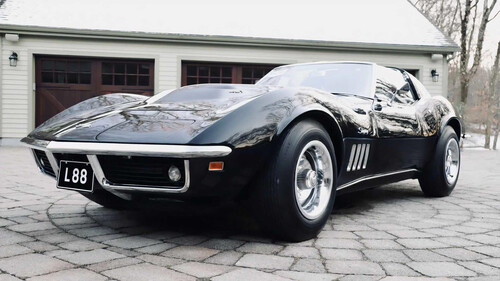
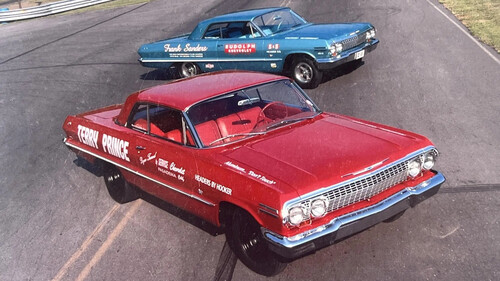
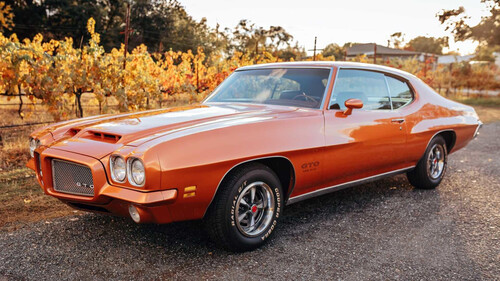
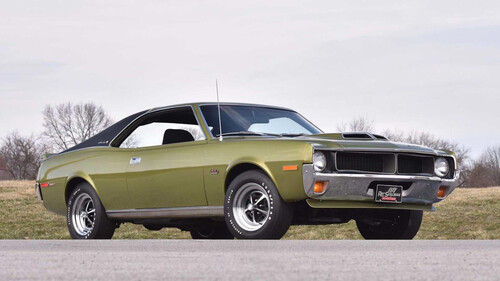
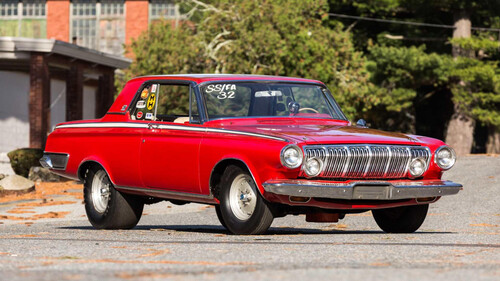
Since the invention of the automobile, or at least its availability to the masses, people have been trying to figure out how to make them go faster. Factory offerings were never really about performance, besides the luxury segment, so the home mechanic was born to squeeze every last pony out of an otherwise sensible vehicle. This, of course, gave rise to racing, because there's really no point in making a car faster if it can't be used to embarrass somebody else's souped-up ride. Many of these cars may still have been emblazoned with an Oldsmobile or Plymouth badge, but they were stripped of everything unnecessary for speed.The moonshiners wanted to see who had the fastest revenuer-evading set of wheels and that eventually became NASCAR. The SoCal hotrodders settled their beefs on the dry lake beds of the Los Angeles area, which led to the formation of the National Hot Rod Association (NHRA) and professional drag racing. In the early years, race cars were basically cobbled together by drivers or teams, but in the early 1960s, Detroit started offering awesome track-ready cars straight from the factory. Even better, these ungodly powerful cars were technically street legal and one very special Chevrolet managed to rewrite the record books. Factory Drag Car Frenzy Dodge Drag racing really started to gain popularity in the early 1960s, but it was still basically a hobby in which drivers were on their own with their cars. Some automakers provided support like high-performance parts or technical advice, but nobody was handing out whole cars that were ready to rock a quarter-mile. That all changed in 1963, when it seemed like everyone was building factory drag cars. Pontiac had "Swiss Cheese" Catalina Super Duty, followed by the Ford Fairlane Thunderbolt and Mercury Comet A/FX, all of which were pushing ETs in the low 12s and high 11s. Mopar started out with the Hemi-powered Coronet A990, but then realized the 426 cubic-inch V8 could do more damage in a compact and unleashed the '68 Hemi Dart. With few exceptions, all of these insane cars were sold through dealers and, amazingly, were street legal. Qualified For Street Use Bring A Trailer There's a lot of confusion over the term "street legal" with many people assuming it has something to do with how powerful a car is. The reality is, a car just needs to be a car with basic things like bumpers, working headlights, tail lights, and turn signals, which are often deleted in race cars to lighten the load. It also needs a VIN, something race cars often lack when they are built soley for the track. Every state has different requirements to register a vehicle, but stuff like horns, brakes, and mirrors are usually in the mix. Most factory drag cars of the 1960s had everything needed for street use, with maybe the exception of their exhausts, or lack thereof, but it's easy to put a muffler on a Ford Fairlane 500 R-Code to use it as a daily driver. Voluntary Racing Ban Mecum The Automobile Manufacturers Association (AMA) was a trade group that was created to promote the common interests of carmakers, but really they were more like a psychotic Home Owner's Association or a Karen collective. In the late 1950s, they got all American automakers to agree to withdraw from supporting motorsports and to refrain from building super-powerful passenger cars. While the Big Three signed on to this persnicketiness, they turned a blind eye as their divisions formed racing teams and cranked out fearsome street machines. In 1963, however, GM decided to go along with the AMA's racing ban, but not before the ultimate Chevy could make some history on the straight track. Third-Gen Chevrolet Impala Mecum The Chevy Impala was introduced in 1958 and was produced all the way until 2020, being everything from a full-size luxury ride to a compact weenie-mobile. It is one of the all-time best-selling Chevy nameplates and an iconic American car, but its greatest era was the short-lived 1961-1964 third generation. This was the first Impala to ditch the dated '50s styling cues for a long sleek body that was dripping with cool, with miles of real estate on the hood and decklid. Also introduced in the third-gen was the SS performance trim, which took the Impala from a smooth cruiser to a street bruiser with some serious big-block V-8 power. Low-Rider Legend Bring a Trailer Nobody could have guessed at the time, but the third-gen Impala, which was at the forefront of American performance, would eventually become the slow-rollin' low rider's car of choice. There are plenty of classics that have gotten the hydraulic hop treatment, but nothing beats a '61 to '64 Impala cruising down the avenue. The reason why low rider culture was so attracted to the third-gen Impala is simple, because Chevy made a ton of them, and they have traditionally been cheap, leaving plenty in the budget for customization. Later on, hip-hop artists flocked to the money-gen Impala low rider, specifically the '64, and the best explanation we've found for that is that it's really easy to rhyme with "six-four" or "six-foe." The Fabulously Ferocious 409 Mecum Long before War's 1975 hit "Low Rider" celebrated the chill cruising culture, the Beach Boys touted the Impala's street cred with their 1962 song "409." Released as the B-side to “Surfin’ Safari”, the tune was a shout-out to the Chevy 409ci V-8, which was the standard engine for the 1962 Impala SS. Producing 409 horsepower, the Chevy big-block was one of the most powerful engines created for a passenger car until that point, but the Beach Boys should have held off a year with that tune because the engine was about to get even crazier. A 1963 dual-quad variant of the 409 jammed out 425 ponies and 425 pound-feet of torque, making for one of the few 13-second full-sized rides of the Golden Age. The Heavyweight 1963 Chevrolet Impala Z11 Lightweight Mecum Also, in '63, Chevy built a factory drag car that made the Impala SS 409 look like it was standing still. The car, known as the Impala Z11, was perhaps the result of Chevy knowing that GM was about to shut down high-performance among their divisions and an effort to get out one last great ride before the corporate hammer came down. The Z11 was a lightweight race car designed for the drag strip and NASCAR, but it was completely street legal, though not a very practical daily driver. Unlike most factory drag cars that stripped out almost anything unrelated to blowing off doors, the Z11 shipped with full interiors, and curiously bench front seats.The Z11 went on a diet with aluminum body fenders, body panels, and bumpers, shaving about 400 pounds off from a standard Impala. The unconventional sheet metal of the Z11 is the reason why it wasn't the world's greatest grocery-getter because it easily dented, with some drivers even painting warnings on the exterior telling people to keep their grubby hands off of it. Completing the Z11 package was a 427 cubic-inch dual-quad V8 that was conservatively rated at 430 horsepower and 575 pound-feet of torque. This was the greatest power-to-ratio ride that had ever existed until that point. Approximately 50 Z11's were made, and maybe a dozen still exist, making it a true Chevy Holy Grail car. First Factory 10-Second Car via Bring A Trailer There's a misconception that the Z11's 427 was a Corvette engine, but the C2 wouldn't get a big-block like that until 1966. The Z11's engine was a 409 cubic-inch V8 that was stroked out to 427 cubic inches. It also had a high-rise aluminum intake manifold, dual Carter AFB carbs, and a 13.5:1 compression ratio, making for the baddest engine of the day. Fast drag car passes in '63 were of the 12 and 11-second variety, but the Z11 dropped it down to the 10's. Though no official test drives exist for the '63 Impala Z11, nor drag strip receipts, this amazing Chevy is widely reported to have obliterated a quarter-mile in 10.8-seconds and there's no reason to believe that's not true. With that, the Impala Z11 became the first factory car to break into the 10s and that's probably worthy of a Nobel Ass-kicking prize. Street Use is Heavily Discouraged Mecum While the '63 Impala Z11 was technically street legal, just because you can do something doesn't always mean you should. Chevy never intended these rocket cars to be used on the street, but they built them so they could be, and they were ordered mostly through dealerships, so there's an almost 100% chance at least a few of them raised some hell locally. Most of the Z11s that have been offered up for auction are known race cars and painted as such, but that black beauty pictured above seems like it may have been someone's pink slip collector back in the day. The Mecum Kissimmee 2017 list notes several drivers who have owned this car, but the complete lack of sponsorship on the exterior says this wasn't always a track monster. For what it's worth, the car sold for $340,000, which is actually a steal because these are half-million-dollar rides all day long. Impala Z11 Had GM Rethinking Street Performance via Mecum GM was actually less than pleased with the Chevy Impala Z11 as well as the '63 Pontiac Catalina Super Duty drag car. They didn't like the idea of cars that powerful and were undoubtedly worried about the liability of selling monsters like them to the general public, where inexperienced drivers would most certainly kill themselves and others. In one of the weirdest moments in automotive history, GM sent cease and desist letters to both Chevrolet and Pontiac, demanding they stop production at once on their factory drag cars. Rumor has it that Pontiac still had a few "Swiss Cheese" cars in the pipeline and finished them even after GM told them to stop. Involuntary Big Engine Ban Mecum GM had agreed to refrain from motorsports per the AMA's pressure, but was well aware that their divisions were neck-deep in racing. In 1963, GM decided to enforce this legally non-biding agreement and put a stop to any racing support or development. Part of this corporate edict included banning its divisions from equipping engines over 400 cubic inches of displacement in intermediate-sized or smaller cars. Muscle car mania exploded the next year and an ensuing horsepower war broke out, but Buick, Chevy, Olds, and Pontiac were handcuffed by the GM big engine ban. This arbitrary move handed the Golden Age and the streets over to Mopar, whose massive-horsepower 426 Hemis and 440 Six-Pack cars were unbeatable thanks to a silly GM rule.Sources: GM, Chevrolet, Mecum