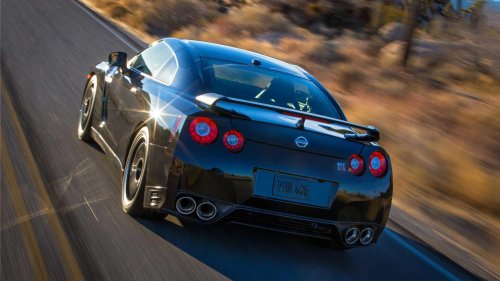
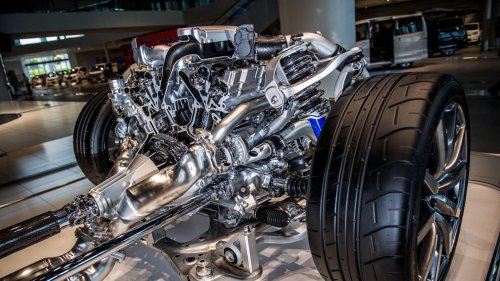
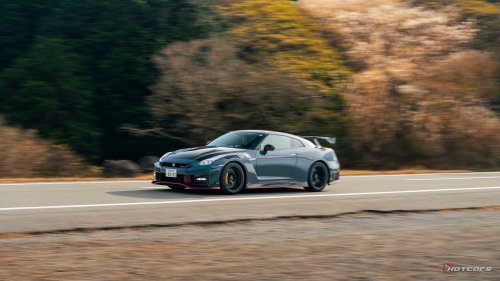



















By the late 2000s, the American performance hierarchy looked settled. Chevrolet had the C6 ZR1 with a supercharged 6.2L V8 and 638 hp. Dodge had the Viper SRT10. Ford was preparing its own answer. The drag strip, at least in this country, was an American institution. Nobody expected that to change. And then Nissan showed up.The car that arrived at US dealerships in late 2008 looked like something out of a video game. It had a Japanese license plate in the press photography and a price tag that seemed almost too reasonable for what it was threatening to do. Period reviewers noted that it looked aggressive but not outlandish, the kind of thing you might park next to a Charger without anyone flinching. What they were about to discover on track told a completely different story. When Japan Came To Play Claire-Kaoru Sakai, Ayesh Seneviratne / HotCars American performance in 2008 was measured in displacement and rear-wheel drama. The recipe had not changed meaningfully in decades: big-block V8, rear-wheel drive, manual transmission if you were serious about it. The Corvette ZR1 was the benchmark, and it ran the quarter-mile in 11.2 seconds at 130.5 mph according to period testing. That was considered extraordinary. The Viper was in the same territory. The Shelby GT500 was running 12.8 seconds and considered fast for a pony car.Into this environment came a twin-turbocharged V6 from Japan, displacing just 3.8 liters, mounted in an AWD coupe that weighed close to 3,900 pounds. The power rating was 480 hp and 430 lb-ft of torque. On paper, it did not look like something that should be rewriting the rulebook. The reality was something else entirely.The ATTESA E-TS all-wheel drive system was the key. It distributed torque electronically between axles and could react faster than any driver. Combined with a dual-clutch transmission that launched harder than most humans could manage, the result was a 0-60 time of 3.3 seconds in testing. These were among the most underrated performance cars of their era, and this one was about to prove it at the strip. The Nissan GT-R R35 and Those Quarter-Mile Times Nissan USA.The 2009 Nissan GT-R ran the quarter-mile in 11.5 seconds at 124 mph in a four-way comparison test against the Corvette Z06, Viper SRT10 ACR, and Porsche 911 GT2. It was the cheapest car in that test by a significant margin, and it ran within fractions of its far more expensive competition. The ZR1, with 158 more hp, ran 11.2 seconds. A gap of 0.3 seconds separated a $70,000 Nissan from a $105,000 Chevrolet at the strip.For context, the Viper cost over $90,000 and ran 11.6 seconds. The Shelby GT500, America's poster car for accessible performance, was more than a second behind. That gap is enormous in drag racing terms. What made the GT-R's numbers genuinely shocking was the combination of how it achieved them. No massive displacement, no supercharger, no rear-wheel drama. The AWD system and dual-clutch transmission simply put power down with a consistency that RWD muscle cars could not replicate in standard trim. Every run looked like the last one. The Engine Nissan Didn't Fully Explain Nissan USAThe VR38DETT is a 3.8L twin-turbocharged V6 built around an aluminum block with plasma-sprayed cylinder bores to reduce friction and improve thermal capacity. The pistons, connecting rods, and crankshaft are all forged steel. Nissan's Continuous Variable Valve Timing Control System manages the intake valves. Every engine was hand-built by the Takumi, a team of nine master technicians, and each unit leaves the factory with a nameplate bearing the builder's name.The official 2009 rating was 480 hp at 6,400 rpm and 430 lb-ft at 3,200 rpm. Independent dyno testing confirmed the figures were broadly accurate, with results showing the GT-R's peak output matched that of a same-rated Porsche 911 Turbo on the same dyno.The twin IHI turbochargers were purpose-developed for this application. Boost built early and held across a wide rev range, meaning the car never fell out of its powerband mid-run. Paired with the dual-clutch transmission's launch control, the GT-R hit its peak numbers reliably and consistently.Nissan increased output to 530 hp for 2012 and 565 hp for later models, while the Nismo variant reached 600 hp. The block architecture was robust enough that the aftermarket community has extracted figures north of 1,000 hp from stock displacement units, which says everything about the margins Nissan built in from the start. Why The GT-R Changed The Conversation Nissan The GT-R did not just win comparison tests. It reframed what performance per dollar meant in the US market. A $70,475 car running 11.5-second quarter miles alongside purpose-built supercars costing 40 to 50 percent more forced the entire industry to reconsider its assumptions. As the conversation around Japanese performance cars shifted, American manufacturers responded with more serious horsepower and more technically sophisticated launches in subsequent model years.The broader significance was what the GT-R represented about how performance could be engineered. The AWD system, the dual-clutch transmission, the hand-built engine with conservative power ratings and massive headroom. None of it was exotic for its own sake. Every decision served the objective. The car was serious in a way that the performance industry had not seen from a volume manufacturer at that price point.Nissan built the R35 for 18 years, from 2007 to 2025. The final car rolled off the Tochigi assembly line in August 2025, finished in Midnight Purple. Production records confirm just under 48,000 R35s were built across the entire run, with roughly 15,700 sold in North America. Nissan has confirmed a next-generation GT-R is in development, though no timeline has been given. Production numbers this low, combined with the model's cultural weight, make the early cars in particular a strong case for long-term value. The Nissan GT-R R35 and What It's Worth Today Nissan USAMarket data suggests the R35 has found its floor. Current valuations place base GT-Rs in excellent condition at $59,500, and the trajectory has turned upward since the end of production in 2025. The 2009 model year is the one to watch. It was the first year of US availability, carries the founding-spec VR38DETT at 480 hp, and stock unmodified examples are genuinely rare. A 2009 car with under 2,000 miles sold in 2023 for approximately $60,000, close to its original MSRP of $70,475. That is a modest depreciation curve for a 15-year-old car, and the trajectory now points in only one direction.The Nismo models occupy a different tier entirely. The 2015 GT-R Nismo in good condition is valued at $129,000, with excellent examples reaching $162,000. A 2024 Nismo with 29 miles sold at auction for $346,000. These are no longer used cars. They are collected objects. The challenge on early cars is finding an unmodified example. The GT-R's tuning accessibility means many have been through boost maps and supporting modifications, which complicates provenance and can affect values. A clean, stock, documented 2009 commands a meaningful premium over a comparable-mileage modified example. GT-R R35 Trim Levels and What To Look For Claire-Kaoru Sakai, Ayesh Seneviratne / HotCars The R35 came to the US in three primary trim levels across its production run. The base GT-R covered the fundamentals with the VR38DETT, ATTESA E-TS AWD, Brembo brakes, and the dual-clutch transmission. The Premium added Recaro leather seating, a Bose audio system, and upgraded interior specification. The Black Edition, introduced for 2012, added forged RAYS wheels and carbon fiber interior trim. The Track Edition, offered from 2017, deleted rear seats and added enhanced cooling for sustained track use.The Nismo variant sits apart from the rest of the range. It received a higher-output version of the VR38DETT, stiffer suspension, wider bodywork, and aerodynamic upgrades developed from Nissan's Super GT program. For buyers today, the 2009-to-2011 cars represent the first-generation spec and attract the highest collector interest.The 2012 power bump to 530 hp makes those cars better daily performers. Market data shows that service history, original color retention, and unmodified status are the primary value drivers. Documented service from a GT-R-certified dealer adds credibility. Budget for specialized maintenance, the dual-clutch transmission requires experienced technicians, and Nissan's parts pricing has risen sharply since the end of production.