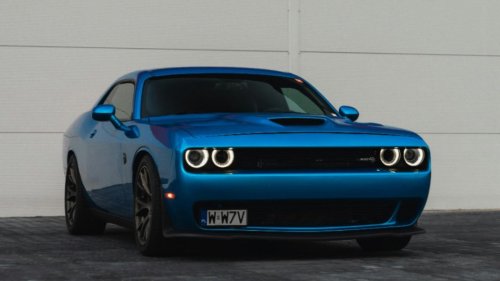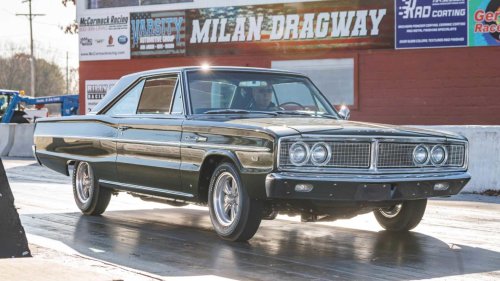
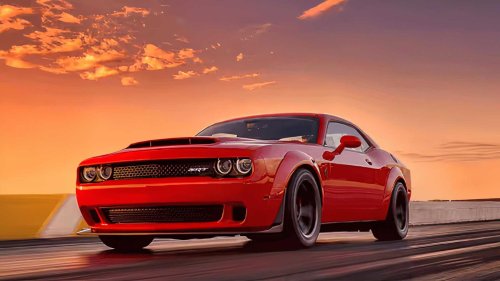
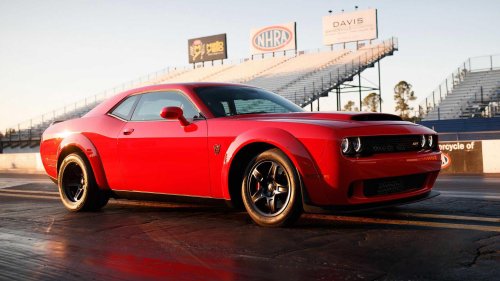
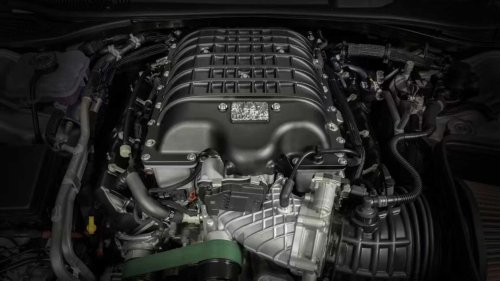
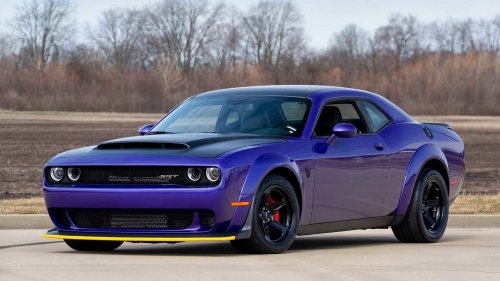
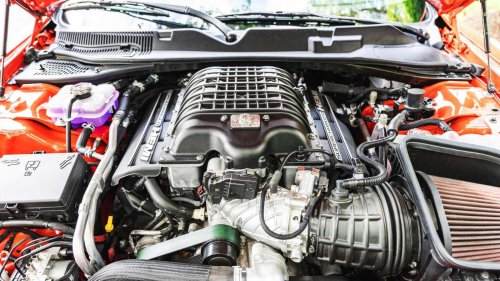
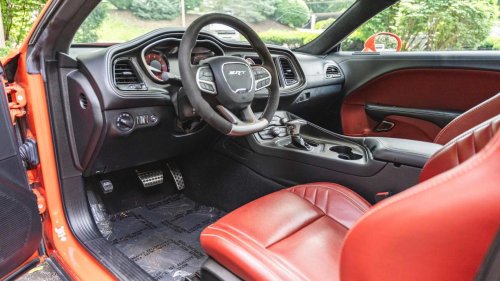



















Many moons ago, achieving those really impressive quarter-mile times wasn't so easy as visiting your local dealership. These days, you can buy a new, street-legal weapon off a salesperson who looks like they've just buried their head in a bucket of hair product, and that would be that. But back in the day, much greater effort and graft were required. Instead, you went to a workshop. You stripped weight, bolted on more power, and built something barely road legal, if it was even legal at all.Like Mary Shelly’s Frankenstein, these machines weren’t born “complete” as such. They were created and pieced together in garages and backstreet workshops where AC/DC would be playing out of a faulty portable CD player. For a long time, crossing that 10-second-quarter-mile benchmark meant building your own monster. This was until 2018, when Dodge decided to assemble one you could actually buy, not in a greasy garage, but a Grade-A factory. This Was the Moment Street Cars Crossed Into Drag Racing Territory MecumFor decades, the quarter-mile was for two different types of car to tackle, and a very clear dividing line separated the men from the boys, so to speak. On one side were the road cars. Quick, powerful, and refined enough to live with. On the other were the drag racing machines. These were stripped out, brutal and uncompromising, and built for one purpose alone. Between them was a number that defined everything. Ten seconds.It wasn’t just a benchmark, it was a barrier, and breaking it meant stepping beyond what a factory-built car could do. It required sticky tires, extensive modifications, and often a willingness to sacrifice comfort, reliability, and sometimes even legality to get there. That’s why, for road-going cars, it remained out of reach for so long. While they looked impressive on a performance spec sheet, the quarter-mile required more than chasing horsepower figures and top speed records.Reaching or even undercutting that elusive figure required a level of intent that blurred that dividing line, but it was a very unhinged version of the Dodge Challenger that had that line disappear entirely. While it was brutally effective, it also had a license plate. Oh, and even space to ferry your in-laws around, if that can be considered a good thing. The Dodge Challenger SRT Demon Became the First to Break the 10-Second Barrier Dodge Officially listed as the first production car to break the 10-second barrier was the Dodge Challenger SRT Demon, recording a 9.65-second pass at 140 mph. This achievement was partly thanks to what it had lurking under the hood, a heavily reworked version of Dodge’s 6.2-liter supercharged Hemi V8. But this wasn’t just a power bump over the Hellcat. Instead, this was a rethink of how to deliver that power. With up to 840 horsepower, the Demon featured the largest functional hood scoop ever fitted to a production car, feeding a 2.7-liter supercharger that produced up to 14.5 psi of boost. The engine also featured several upgraded components, such as a new crankshaft, pistons and valve train.But raw power alone doesn’t win drag races unless you know how to fully unleash it, and it’s here where the Demon changed the game with a factory-installed TransBrake. A feature previously reserved for dedicated drag cars. A TransBrake locks the transmission output shaft, allowing the driver to apply full throttle while the car is held completely still. Meanwhile, Torque Reserve commonly found in agricultural tractors, takes this a step further. Building supercharger boost before the car even moves, the SRT Demon is able to deliver instant and explosive acceleration off the line, and enough for a zero to 60 sprint in just 2.3 seconds.Dodge Of course, for these features to meet their maximum potential, they needed to be paired with some serious rubber for drama-free traction. Instead of conventional performance tires, the Demon rode on Nitto NT05R drag radials, making it also the first production car to come shipped with dedicated drag tires from the factory. These weren’t designed for longevity or comfort, but for maximum grip off the line.Weight reduction played its part too. Dodge stripped out the passenger and rear seats (though these could be re-fitted as an option), and reduced sound insulation in a bid to shave every precious pound. The result was a car engineered not for balance and versatility, but for a single, brutal objective. It was to get to the end of a quarter-mile faster than anything else wearing a license plate.The most alarming thing about it? For all of its capabilities and weight saving, the NHRA banned it from competition in stock form, just like another Dodge from the 1960s. This wasn't because it broke any rules, but rather because it was simply too fast to run without additional safety equipment like a roll cage. Dodge Challenger SRT Demon Performance Specs This Car Was Engineered Specifically to Dominate the Drag Strip Stellantis The SRT’s TransBrake, drag radials, and weight-reduction strategies may have been headline features, but there are many more impressive aspects to this car we can’t neglect to mention.One of the other most significant changes came in how the Demon manages weight transfer. Under full throttle, Dodge designed it to shift weight towards the rear, pressing those tires harder into the tarmac to maximize grip off the line. This is achieved via its suspension setup, which allows the nose to rise under acceleration thanks to softer damping up front. It’s basically the same principle used in professional drag racing, only this time applied to something you can technically do a school run in.Then there’s the drivetrain. Unlike traditional performance setups that prioritize balance, the Demon is unapologetically rear-biased in its approach. In addition to those factory-fitted drag tires, there is a carefully calibrated traction control system and aggressive gearing, allowing the Demon to deploy all of its power and torque cleanly to the ground, without it trying to kill you.To keep things cool during repeated hard launches, Dodge also reworked the intake cooling system. Dubbed as a “Power Chiller”, this clever system works by using the air conditioning to cool the intake charge, helping the engine maintain consistent performance run after run. The Demon’s Performance Came With Trade-Offs Most Drivers Couldn’t Ignore Mecum For all its straight-line capabilities, the Demon was never designed to be an easy car to live with, despite it being allowed on public roads. In fact, much of what makes it so devastating off the line is what works against it everywhere else, making it a sort of victim of its own success.Those drag radials, for instance, are very good at what they do for proving grip on a prepared surface, but out there in the real world? Not so much. In everyday conditions, especially in the wet, their soft, specialist compound and minimal tread can quickly go from being a gift to a liability. Then there’s the fuel. To unlock the car’s maximum power output, that upgraded V8 Hemi demands 100-octane fuel, which is hardly something you’ll find at your local gas station.Cars and Bids And while its TransBrake is a highly capable feature, it isn’t foolproof like a more conventional launch control system found on most other performance cars. It demands precision and restraint, with throttle inputs carefully managed to avoid overwhelming the rear tires and getting that perfect start. Get it right, and it’s explosive. Get it wrong, and you’re fighting for traction, and sorry for even trying.In addition to its talents on the drag-strip, it’s these caveats that also define the Demon. It’s not just fast, it’s demanding, like a high-maintenance dog. It’s a machine that delivers its best only when everything, from the surface beneath it to the driver behind the wheel, is working in perfect harmony. For most of us casuals, that's a big ask. The Dodge Demon Has Become a Highly Valuable Collector’s Car and a Muscle Car Icon Cars and Bids Limited to just 3,300 units globally, the Dodge Challenger SRT Demon was always destined for collector status, but what is surprising is just how quickly values have climbed since it arrived in 2018. Examples on the used market now regularly command six-figure sums, with low-mileage cars often listed well above their original $85,000 MSRP. At the time of writing, one is listed for almost $130,000, having only done just over 1,000 miles.It’s easy to see why these numbers are being asked for today. The SRT Demon wasn’t just another limited-run muscle car. Rather, it was the first street-legal one to crack the 10-second quarter mile, and it’s those kinds of milestones that make cars, like the Dodge, part of automotive history.