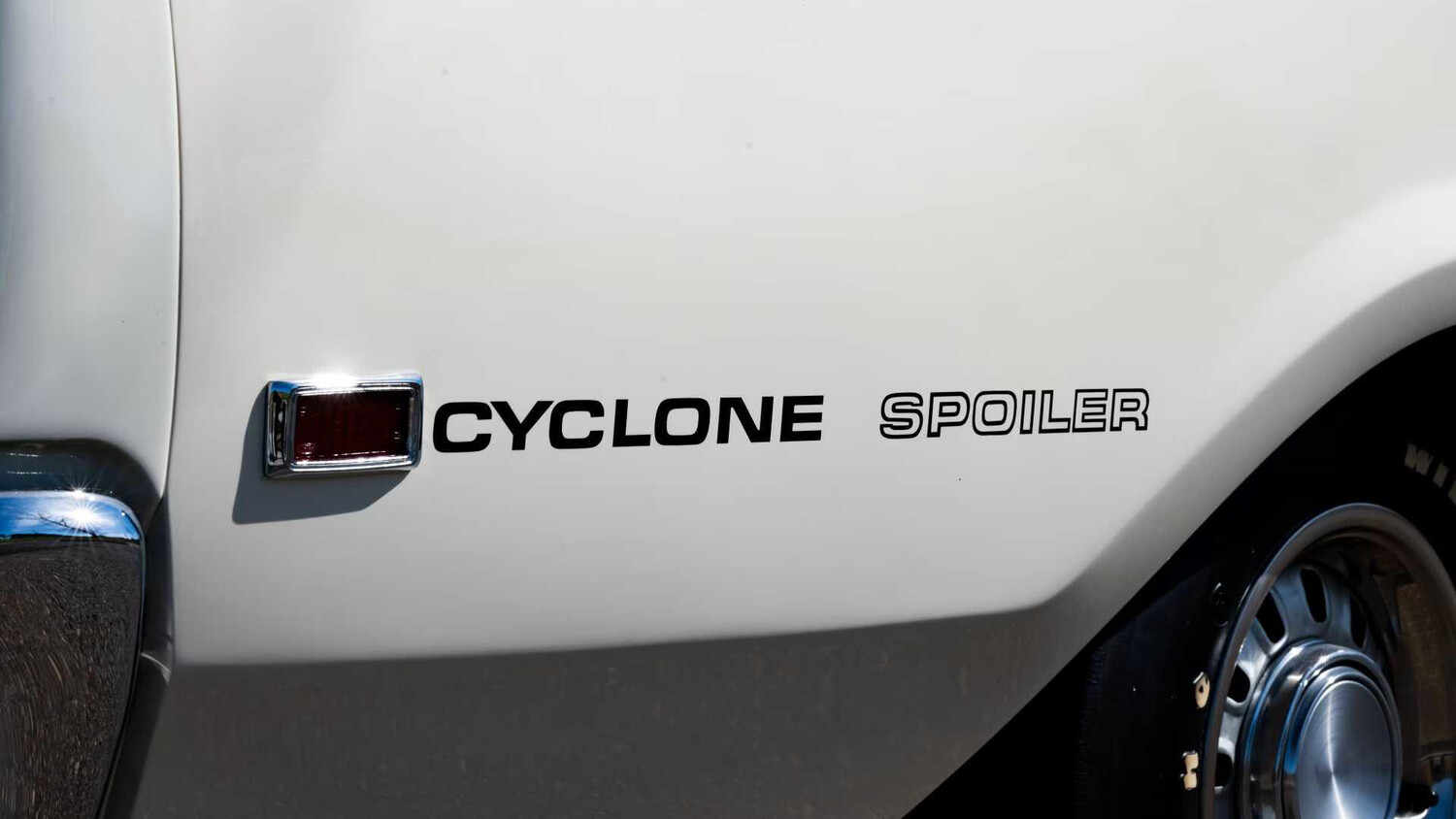
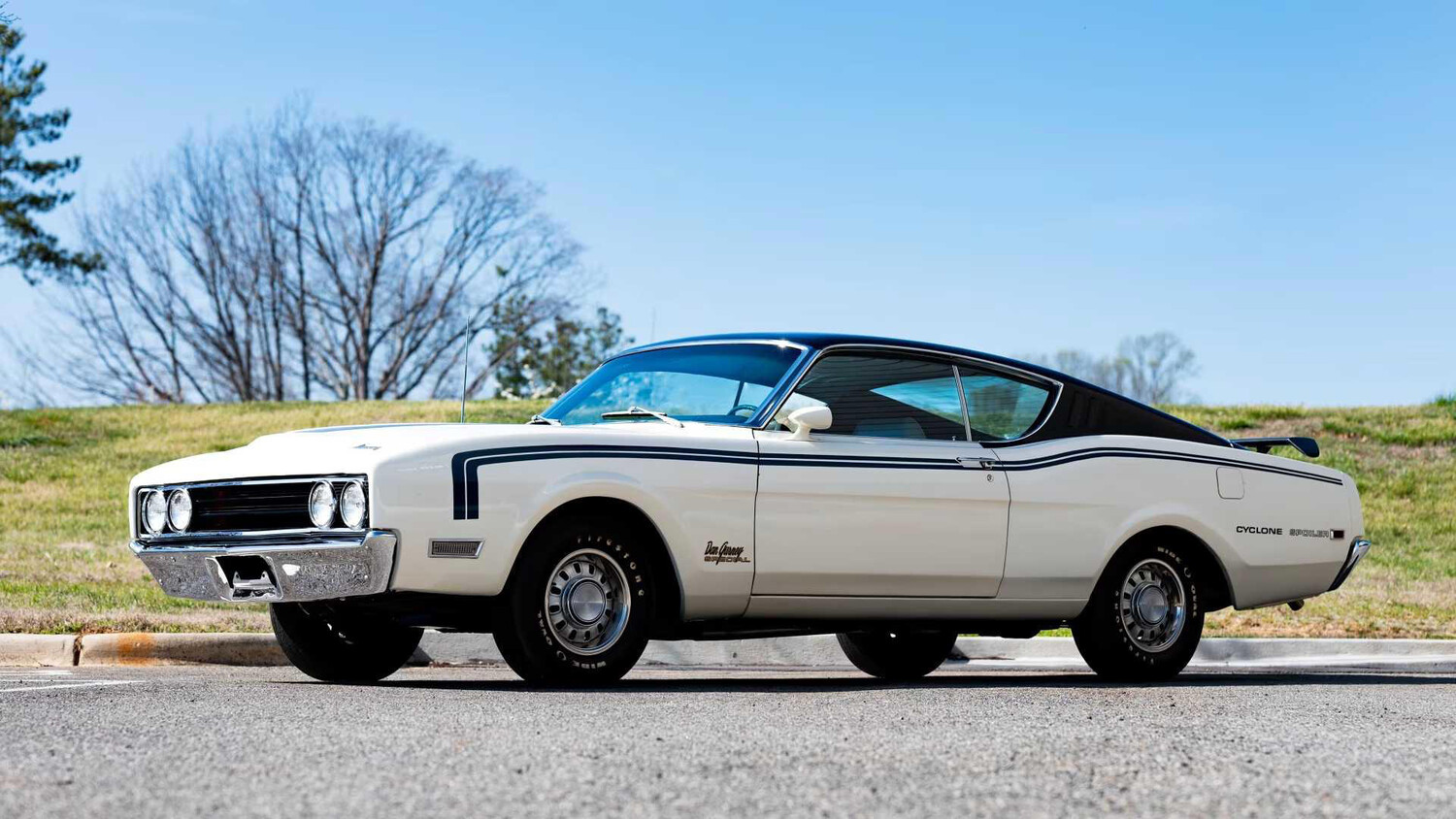
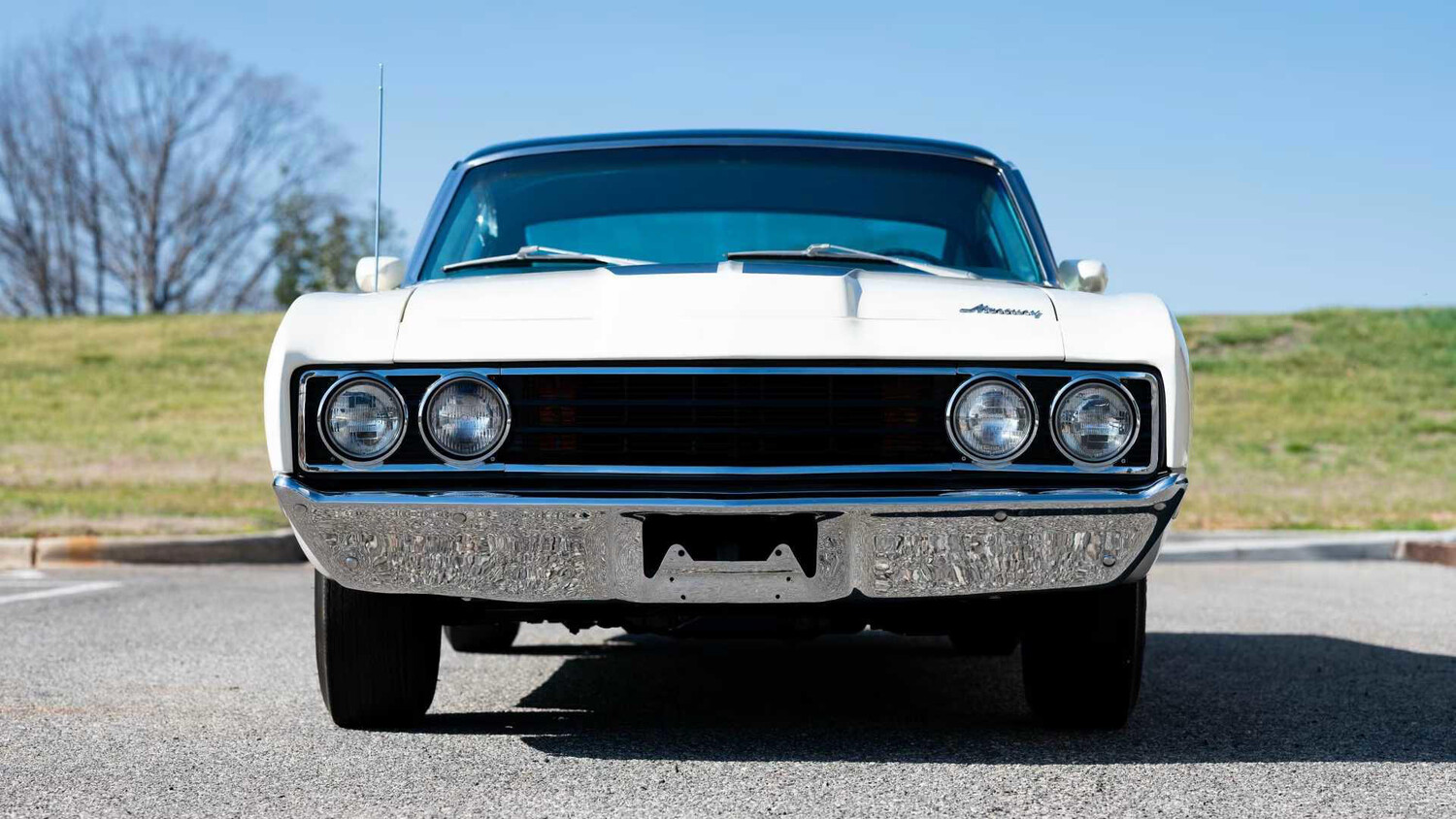
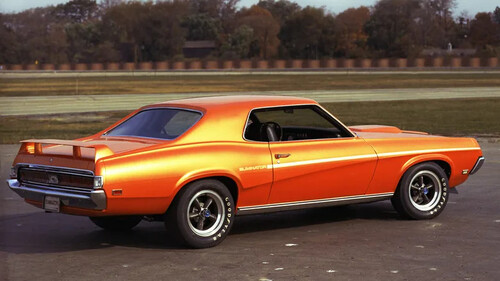
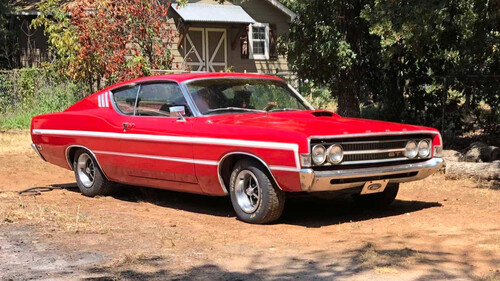
In 1969, the fastest way to win at Daytona was not to build a bigger engine. It was to cheat the wind. NASCAR's rules had opened a door, and the manufacturers who understood aerodynamics walked straight through it. Dodge went high and wide, with a pointed nose and a wing tall enough to park a bicycle under. Ford took a different approach entirely, cutting the air with a longer, lower, sculpted nose that kept everything closer to the ground. Its engineers applied that thinking to two cars simultaneously, one wearing a blue oval and one wearing a slightly different badge that most people outside the enthusiast community forget Ford even had. That second car is the one the real collectors track down. Mercury built barely 500 of them, all with the extended aero nose that made them unlike anything else on a showroom floor. And almost nobody noticed at the time. When NASCAR Forced Detroit to Get Serious About Aerodynamics Mecum The 1969 NASCAR season arrived with a specific problem for Ford and Mercury. Dodge's 1968 Charger had proved aerodynamically poor on superspeedways. Its recessed rear window and sunken grille created lift at speed, leaving Dodge teams chasing the Fords and Mercurys that already ran well at high velocity. Stung by a disappointing 1968 campaign, Dodge went back to the drawing board and produced the Charger Daytona: a radical, winged machine that immediately threatened to shift the balance of power. NASCAR's homologation rules required manufacturers to build a minimum of 500 street-legal production examples of any body configuration they wanted to race. That rule existed to keep competition tied to production reality, but it also created an unexpected side effect: some of the most focused, purpose-built street cars in American automotive history. The Aero Wars, as the period became known, produced machines that existed primarily to satisfy a counting requirement and then go racing.The stakes were not abstract. Winning at Daytona and Talladega in this era meant national exposure, dealer traffic, and a marketing claim that Ford and its divisions were not going to surrender quietly. The engineering investment in homologation cars was real, and the resulting street vehicles carried genuine aerodynamic work that distinguished them from anything else on a showroom floor. Two of those cars came from Ford's stable for 1969, and while the Ford version drew most of the attention, its Mercury counterpart was the more aerodynamically aggressive of the two. Mercury's Answer to the Wind Tunnel Mecum Mercury occupied an unusual position within the Ford family in 1969. It was a performance-capable division without the cultural weight of Ford itself, lacking the Mustang's visibility and the Torino's volume. What it had was a competitive intermediate platform and a NASCAR program that needed street-legal hardware to justify it. The Cyclone fastback was the right starting point: a wide, low roofline on a proven chassis with the engineering team already in place. The problem was the front end, which used an inset grille and recessed headlights that created significant aerodynamic drag at racing speeds. Fixing that problem for the track meant producing enough street cars to satisfy NASCAR's counters.The Ford Torino Talladega, Mercury's homologation sibling, addressed the same issue by extending its nose and fitting a flush grille, and it did so with the 428 Cobra Jet under the hood. Mercury went further on the body and chose a different engine entirely for its street cars, a decision that would become one of the more curious footnotes of the era. That choice, and everything else that followed, is why the Mercury version remains the more interesting collector proposition today. The Mercury Cyclone Spoiler II: Built for Daytona, Sold to Civilians MecumThe car was the 1969 Mercury Cyclone Spoiler II, and it was built in two named editions only: a Cale Yarborough Special in Candyapple Red over Wimbledon White, and a Dan Gurney Special in Wimbledon White with Presidential Blue on the roof and upper surfaces. Both editions wore column-shifted automatics and bench seat interiors, because the Spoiler II was not built to be a street performance car. It was built to satisfy a rulebook and then race. The production total sits at either 503 or 519 units, depending on who you talk to. One valuation source records 519 sold. Registry research and the Over-Drive Magazine fact sheet independently cite 503 assembled during a short production window at Mercury's Lorain, Ohio, plant in early 1969. Both figures tell the same essential story: this car barely existed.The performance table highlights exactly what the Spoiler II was and was not. Its 290 hp is modest against the Talladega's 428 Cobra Jet, and the Road Runner's 383-cubic-inch V8 matched that same 335 hp output with far greater sales volume. The body was the story. Both the Spoiler II and the Talladega used extended noses of similar overall length, but the Spoiler II's hood slope was cut at 35 degrees versus the Talladega's 30 degrees, giving it a fractionally more aggressive aerodynamic profile. The front end extensions were welded from new stamped sheet metal onto the existing Cyclone fenders, with a flush grille shared with the Talladega eliminating the drag created by the standard car's inset headlight arrangement. The result was a car that cut through air at superspeedway speeds in ways its standard-nose counterpart simply could not. On the street, the aerodynamics meant very little at normal velocities. On the banking at Daytona, they meant everything. Cale Yarborough and Dan Gurney: Two Editions, One Purpose Mecum Mercury chose its two most prominent NASCAR drivers of the era to front the homologation editions. The Cale Yarborough Special accounted for approximately 285 of the total production run, finished in Candyapple Red over Wimbledon White with a red vinyl interior. The Dan Gurney Special, finished in Wimbledon White with Presidential Blue on the roof and upper surfaces and a blue interior, made up approximately 218 units. Both figures come from registry documentation, and they represent Mercury's entire output for this model. There was no third trim, no base-specification version without the livery, and no option to spec the car differently. Every Spoiler II was either a Yarborough or a Gurney. The gap between the 503-unit registry total and the 519 figure recorded by collector valuation sources is a well-documented discrepancy in the record. The most likely explanation involves a small number of cars assembled in standard Cyclone Spoiler livery to supplement the count during NASCAR's inspection process, a story that has circulated among historians for decades without definitive resolution.Both editions shared identical mechanicals. The 5.8-liter, 351-cubic-inch Windsor V8 with a four-barrel carburetor, rated at 290 horsepower and 385 lb-ft of torque, was the only engine available. An FMX three-speed automatic was the only transmission. There were no factory performance options because the car was not designed to be customized. Mercury's engineers had done the work they needed to do on the nose and the body. The rest was a production exercise. The Aero Engineering Mercury Brought to Daytona Mecum The Spoiler II's front end modification was not a cosmetic exercise. Mercury's team welded new sheet metal extensions onto the standard Cyclone fenders, adding approximately six inches of length ahead of the firewall, with a flush grille that eliminated the aerodynamic drag created by the original car's inset headlight arrangement. The rear deck spoiler, from which the Spoiler name derived, added downforce at high speed. The overall package was wind tunnel validated and intended to operate effectively at velocities well above anything achievable on public roads. On the NASCAR circuit, the Spoiler II raced initially with the FE 427 side-oiler engine before transitioning to the Boss 429 once it was homologated later in the season, and the bodywork proved its worth: the model claimed eight Grand National victories across the 1969 and 1970 seasons, matching the total achieved by the Plymouth Superbird.Against the Dodge Daytona and Plymouth Superbird, the Spoiler II's aero philosophy was notably different. Dodge and Plymouth went for maximum downforce with towering rear wings and dramatically extended nose cones that made the cars visually unmistakable. Mercury's approach was more subtle. The Spoiler II looked fast rather than cartoonish, and its slightly longer extended nose gave it a fractional aerodynamic edge over its Ford sibling at superspeedway speeds. That restraint is part of what makes the car interesting today. The Spoiler II carries real NASCAR engineering history without announcing itself the way the Mopar aero cars do. What a Mercury Cyclone Spoiler II Costs Today MecumThe valuation picture for the Spoiler II is incomplete by necessity. Concours examples are valued in excess of $100,000, with the full condition breakdown sitting behind a membership login. What the auction record confirms is a market that takes condition and provenance seriously. A Cale Yarborough Special sold at Barrett-Jackson Scottsdale in January 2025 for $51,700 including the buyer's premium, reflecting a car described as original and highly correct. The same car was subsequently listed by a private seller at $87,000, a number that reflects what documentation and condition command rather than any sudden spike in baseline values. Tracked auction results for Spoiler II examples run from $62,232 to $100,730, with the average sitting in the mid-to-high $60,000s for documented survivors.These cars do not change hands often. When they do, they tend to move through established collector channels rather than the online auction format that drives traffic for more common muscle cars. The supply constraint is real: owners who find a documented, numbers-correct example rarely let it go, and the pool of available cars shrinks further with each passing year. What that means in practice is that the Spoiler II's current pricing reflects a floor, not a ceiling. The Ford badge commands a premium over Mercury in today's market, and the Talladega's values reflect that. The Spoiler II is built in smaller numbers, carries the same racing credentials, and trades at a discount. That gap has a shelf life. Why Collectors Are Quietly Chasing It Now Mecum The Cyclone Spoiler II holds a specific position in the aero car story that the Superbird and Daytona do not. Those cars are famous, frequently discussed, and priced accordingly. The Spoiler II is the insider answer to a question most people are not asking. It participated in the same engineering moment, achieved the same number of NASCAR wins as the Superbird, and was built in comparable or smaller numbers, yet it sells for a fraction of what either Mopar aero car commands. A Plymouth Superbird in comparable condition routinely exceeds $200,000. A Dodge Daytona is in the same territory. The Spoiler II, at its current market range, offers access to the same historical narrative at a substantially lower entry point.That disparity will not last indefinitely. Mercury's collector market has strengthened as the generation that grew up with these cars reaches peak buying power, and the documentary record surrounding the Spoiler II is better than it has ever been. Registry data confirms individual cars. Marti Reports verify factory specifications. The provenance infrastructure that serious collectors require is in place. What has not yet caught up is mainstream visibility, and that gap is precisely where the enthusiasts who know this car are operating. Finding a documented, numbers-correct Spoiler II in either Yarborough or Gurney specification requires patience and a network. It is not the kind of car that surfaces on general classified sites in clean condition. But for the collector who understands what they are looking at, that scarcity is the point.Sources: Hagerty, Classic.com, Mecum.