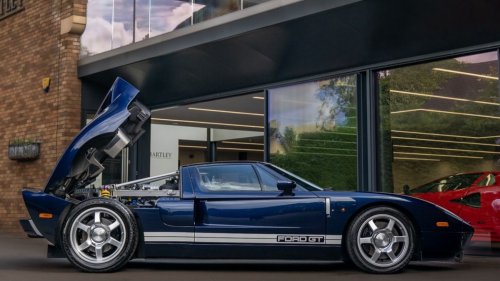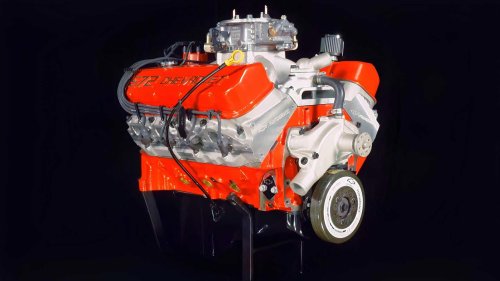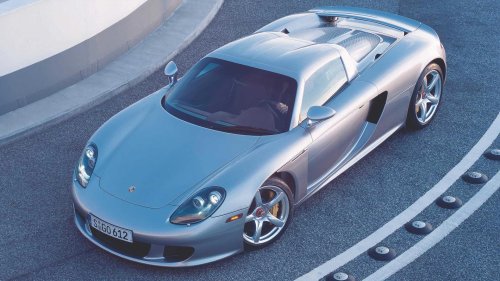
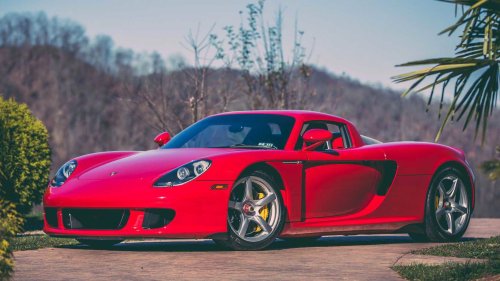
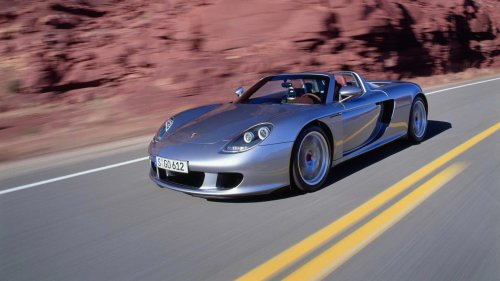
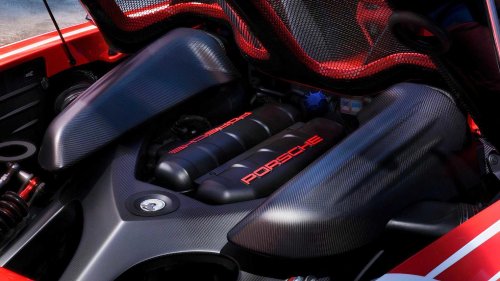
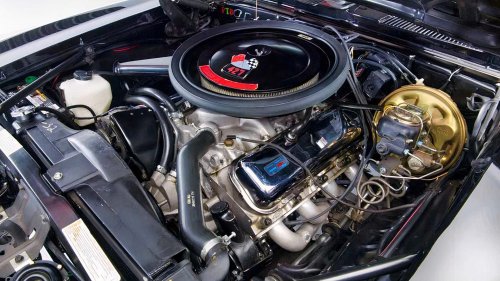
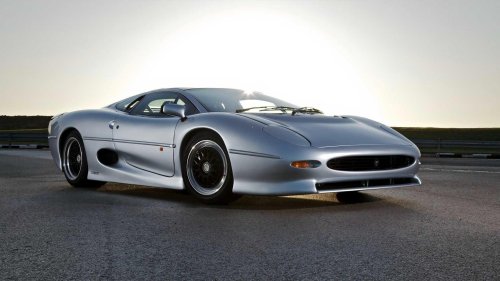
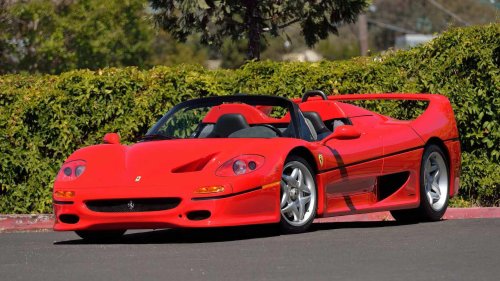
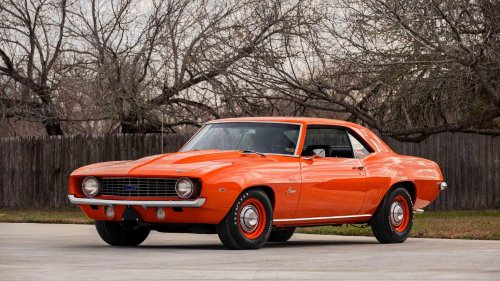


















It's not uncommon for high-performance road cars to have engines that were originally developed for racing. Plenty of sports cars, supercars, and muscle cars can trace the origins of their engines back to motorsports competition. However, not many have such an interesting story as the car we're talking about here. It's widely regarded as one of the greatest supercars of all time and one of the last cars of its kind. Today, it's worth a fortune, but the reason why its engine came to exist has been mired in rumor for over two decades. The Porsche Carrera GT Is One Of The Last Of The Analog Supercars PorscheIn the world of supercars, there aren't many that are more venerated than the Porsche Carrera GT. It's widely considered to be the best car Porsche has ever made. There are a lot of good reasons why people think that. This is a raw, properly old-school performance machine, powered by a screaming engine and with a proper manual transmission. It's also one of the fastest cars Porsche has ever made. 0-60 mph takes just 3.5 seconds, and its official top speed is 205 mph. That's thanks to its incredible and unique engine — an in-house 5.7-liter V10 that produces 603 hp and 435 lb-ft of torque.The Porsche Carrera GT went into production in 2003, and its production lasted until 2006. During that time, 1,270 cars were produced. That makes it a genuinely rare 2000s supercar. Analog Supercar Champion via mecum The Porsche Carrera GT wasn't just a cool halo car for Porsche. It was actively supposed to compete with the best cars that the other top sports car and supercar manufacturers were offering in the 2000s. This included the Ferrari Enzo, the Mercedes-Benz SLR McLaren, the Lamborghini Murcielago, and the Ford GT. While the Carrera GT may not be the most powerful car in that lineup (that accolade goes to the SLR, with its 617 hp in standard form), it could definitely still keep up with or beat all of them.The Carrera GT was also the most 'analog' choice out of them. The Ferrari Enzo exclusively had the paddle-shift "F1" transmission, the Lamborghini Murcielago also gave customers the option of an automated manual, and the Mercedes-Benz SLR McLaren only came with the 5-speed automatic that was standard-issue on AMGs at the time. The Ford GT did have a manual transmission like the Porsche Carrera GT, but its supercharged V8 was definitely not as exciting as the Carrera GT's V10. It Had A Reputation For Being Difficult To Drive Porsche While the Porsche Carrera GT is an incredible supercar that could easily compete with the best of its time, it wasn't the easiest machine to handle. The Carrera GT actually has a reputation for being very difficult to drive. It doesn't have any modern electronic driver aids, its race-spec clutch requires a "no gas" starting procedure that is completely alien to most drivers, and its handling is known to be unstable. As a result, even experienced professional drivers are scared of pushing the Carrera GT to its limits. An Engine Originally Designed For Racing The Porsche Carrera GT may be an interesting car just on its own. But the coolest and most interesting part about why it exists has to be its engine. It's unusual enough that it's a road-going Porsche with a V10. The reason why it has that V10 in the first place is one of the oddest stories in automotive history! This V10 can trace its design all the way back to the early 1990s, near the start of Formula 1's V10 era. The Footwork F1 team had a contract with Porsche to supply it with engines, and it had been using V12s. When the 1992 season was coming around, Footwork asked Porsche to design it as a V10. Porsche actually managed to do it, creating a 3.5-liter unit that fit within Formula 1's regulations, but the project died off before the engine could even be put into a car.Porsche Not wanting to let the engine go to waste, Porsche bumped the design up in size to 5.5 liters and built an LMP1-class endurance racer around it. This was known as the Porsche LMP2000, and a working prototype was actually built with that 5.5-liter engine in it. But, like the failed Footwork project with the V10, the LMP2000 got shelved before it even raced. Once again, Porsche didn't want this engine to go to waste, so it was redeveloped into a road-legal 5.7-liter unit for the Carrera GT. Internal Politics May Have Nearly Killed It One of the big questions you might have now is how this engine managed to survive a development period of over a decade. Well, it very nearly didn't. The closest it came to being killed off altogether was the cancellation of the LMP2000 project. That project's death has always been mired in rumor and controversy.It's been suspected for many years that Porsche cut a deal with the rest of the Volkswagen Group (Volkswagen was a partial owner of Porsche at the time) to kill off the LMP200 project in favor of other programs that benefited VW as a whole. If you believe those who are adamant on this theory, this included collaborating with Porsche on developing the Cayenne SUV (which ended up becoming Porsche's best-selling car and, along with the original Boxster, financially saving the company) and leaving space for Audi to be the only VW Group brand in endurance racing. The Carrera GT Is Incredibly Valuable With how rare and incredible the Porsche Carrera GT is, it's not surprising that it's become one of the most valuable supercars on the used market. As things are right now, the average used value for a Carrera GT is $2.2 million. That average value is definitely on its way up, too. An example was recently sold by RM Sotheby's for just over $3.3 million! That might seem like an absolutely preposterous price for a 2000s supercar. But, with how special the Porsche Carrera GT is and the fact that those values are definitely going up, it could be a price worth paying if you've got the money to invest in one. Other Cars With Engines That Belonged On The Racetrack Bring A Trailer The Porsche Carrera GT, having an engine that really belonged on the racetrack, isn't an isolated incident. There have been plenty of different cars over the years that have engines that were developed from units built for racing. A few of those cars ended up becoming legendary. That was often thanks to those engines, and the crazy power (and sounds!) that they had. Jaguar XJ220 JaguarThe Jaguar XJ220's engine has often been viewed as a bit of a disappointment. The original plans, after all, were for it to have a V12. But, its twin-turbocharged V6 does still have some cool racing pedigree. It was derived from the engine that powered the MG Metro 6R4 Group B homologation special. That might be a slightly odd choice of engine, but it still produced enough power to make the XJ220 one of the fastest cars in the world in its day. Ferrari F50 MecumThe Ferrari F50 often plays second fiddle to the F40 that came before and the Enzo that came after. But, it's still a brilliant halo car from Maranello. Like the Porsche Carrera GT, the Ferrari F50 has an engine that was derived from an F1 program. This time it's a 4.7-liter V12, derived from the V12s Ferrari used in the early '90s. That means the F50 has fantastic noise, something that enthusiasts are valuing more and more in the age of electrification! It's also almost as fast as the Porsche Carrera GT. 0-60 mph takes 3.8 seconds, and Ferrari claimed it could go on to a top speed of 202 mph. 1969 Chevrolet Camaro ZL1 Via Mecum AuctionsThere aren't many muscle cars that are more legendary than the Chevrolet Camaro ZL1. A child of the notorious COPO program, this car gave enthusiasts something they wanted that Chevrolet wouldn't initially give them due to company policy. That was a proper, big-block V8 engine. This ultra-rare engine (also called the ZL1) was derived from a Can-Am unit and designed for maximum performance on the drag strip. That's exactly what it delivered. That 430 hp factory rating is generally believed to be wildly under-rated - its actual power is estimated to be over 500 hp.Sources: Car & Driver, Chevrolet, Classic.com, Ferrari, Jaguar, Porsche, RM Sotheby's