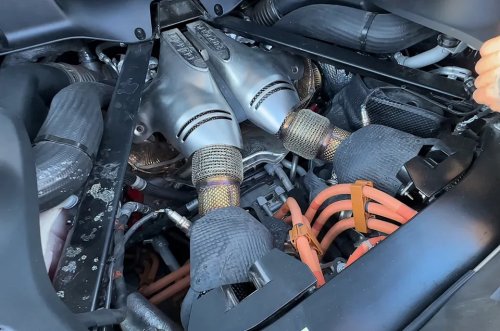
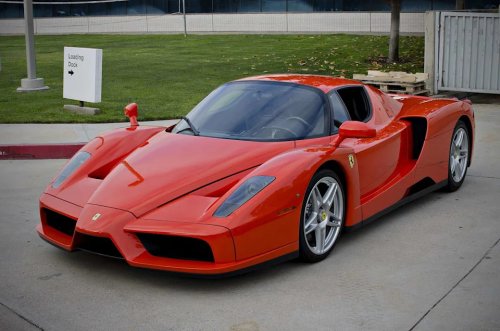
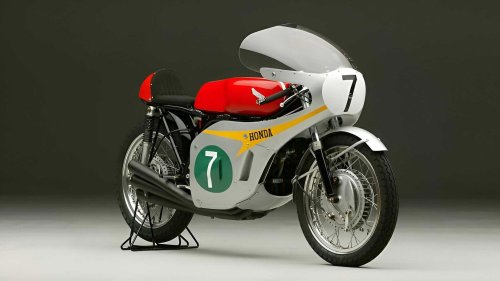
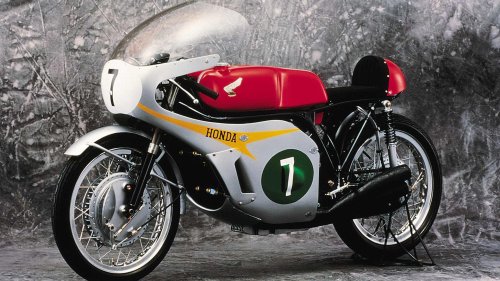
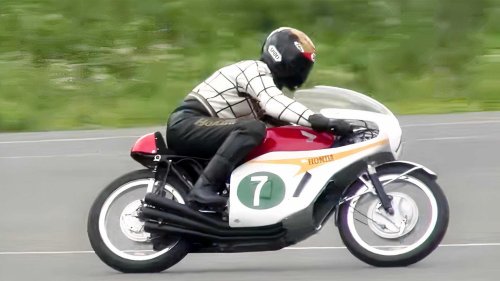
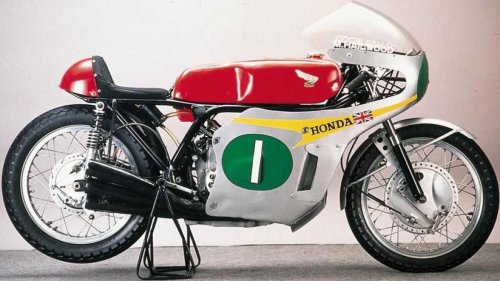
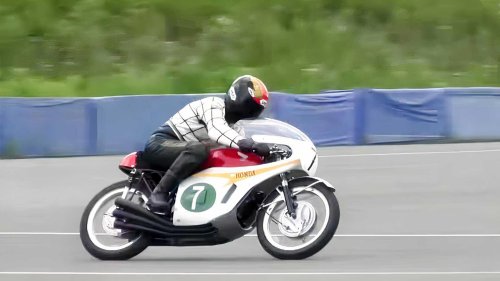
In the mid-1960s, the Ferrari factory in Maranello was the undisputed cathedral of high-performance engineering. Enzo Ferrari’s V12 engines were the gold standard for specific output and mechanical music, defining the limits of what was possible with internal combustion. Yet, while the Italians were perfecting their 3.0-liter masterpieces, a team of engineers from Honda in Japan was quietly developing a machine that would make the finest European race engines look like agricultural equipment. It was not a supercar or a heavy-duty GT, but a tiny 250cc racing bike that operated at a scale so small it required the use of x-rays just to inspect the oil passages.The project was born from a desperate need to reclaim dominance in Grand Prix racing against a rising tide of lightweight two-strokes. The solution was not to increase displacement, but to pursue a philosophy of extreme miniaturization and astronomical rotational speeds. The result was an engine that revved to nearly triple the redline of a contemporary Ferrari and featured internal components no larger than a thimble. It was a mechanical middle finger to the establishment, proving that a 250cc four-stroke could out-rev and out-power anything on the grid. The Formula For Impossible RPMs Honda To beat the two-strokes, one Japanese manufacturer realized they had to double the frequency of their power strokes. Since a 250cc four-cylinder was reaching its physical limits at 14,000 rpm, the engineering team decided to split the displacement across more cylinders. By moving to a six-cylinder layout, the pistons became smaller and lighter, reducing reciprocating mass and allowing for a shorter stroke. This was the only way to achieve the target of 18,000 rpm without the connecting rods disintegrating under the centrifugal force.The precision required for this engine was unheard of in the 1960s. The crankshaft was a 13-piece assembly, and the valves were so small that they were often compared to the size of a pencil eraser. This engine was a testament to the fact that while Europe focused on the idea that there is no replacement for displacement, Japan was busy proving that there is no substitute for precision. This era of 1960s racing innovation laid the groundwork for every high-performance engine that followed. The 1966 Honda RC166 And The Seven-Figure Valuation HondaThe machine that resulted from this obsession was the Honda RC166. It is widely considered the most technically significant motorcycle ever built. In the 1966 season, it won all ten races it entered, securing the World Championship and cementing Mike Hailwood's status as a racing legend. The RC166 was not just a bike; it was a 65 hp, 18,000 rpm technological sucker punch that the competition never saw coming.In the current 2026 market, an authentic RC166 is virtually impossible to price because they rarely change hands publicly. Most reside in Honda’s private collection or national museums. However, recent 2026 auction data from Mecum shows that authorized continuation models, such as the RC174 George Beale replicas, have reached prices as high as $330,000. Experts estimate that a verified, race-ridden original would easily crest the $1,000,000 mark. Shaming The V12 Establishment Image via Deckay_F YouTube Channel.The real metric that made Ferrari engineers take notice was specific output. In 1966, a high-performance Ferrari V12 was producing roughly 85 to 95 hp per liter. The Honda RC166 produced 260 hp per liter. If you extrapolated the RC166 engine to a 3.0-liter displacement, it would have produced 780 hp. That is nearly triple what the contemporary Ferrari Formula 1 cars were making at the time.This was achieved through the use of 24 tiny valves and six 22mm carburetors that had to be tuned with surgical precision. The engine didn't even have a traditional flywheel. The throttle response was so instantaneous that a single blip could send the needle from idle to 18,000 rpm in a heartbeat. It was a level of responsiveness that even the best naturally aspirated supercars struggle to match today, with the Leuxs LFA being one of the only few with a similar level of responsiveness. Miniaturization As A Performance Weapon Honda The RC166 engine was a masterpiece of packaging. Despite having six cylinders, it was only about 14 inches wide. Every component was a study in miniaturization. The oil passages were as narrow as 0.5mm, requiring x-ray inspection to ensure they were clear. The crankshaft was so delicate that it could reportedly be bent by hand if mishandled, yet it survived the stresses of 300 rotations per second.This obsession with the philosophy of miniaturization is what defined Honda's early years. They were proving that Japanese metallurgy and machining could outperform the world's best. The RC166 remains a high-water mark for the internal combustion engine. It is a machine that proved that sometimes you have to engineer smaller to think bigger. This legacy of extreme engineering continues to influence modern hyperbike design. The Screaming Legacy Of The Honda Six Image via Deckay_F YouTube Channel. When the RC166 was fired up, it did not sound like a motorcycle. It sounded like a tearing piece of silk or a low-flying jet. The exhaust note became a psychological weapon on the track, signaling to rivals that the four-stroke was dominant. Although Honda eventually withdrew from the 250cc class when the rules changed to limit cylinder counts, the RC166 had already done its job. It proved that a small displacement engine could achieve figures that supercar manufacturers would not reach for decades.For enthusiasts today, the RC166 is the ultimate "what if" machine. It represents a period where the only limit on performance was the imagination of the engineers. It remains the most potent example of how motorcycle technology often leads the automotive world in efficiency, with Honda eventually bringing this tech to the street with the six-cylinder CBX.Sources: Hagerty, Classic.com, Honda Global Heritage, Mecum, Rider Magazine.



















 +32 others