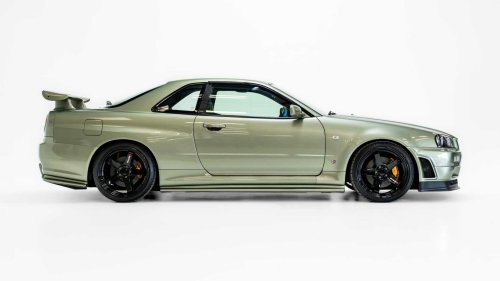
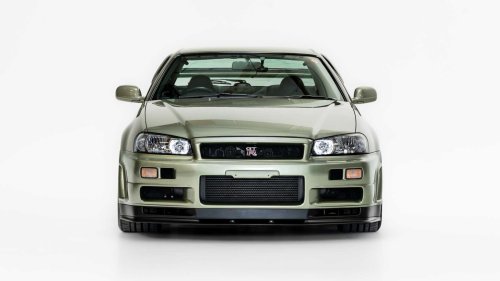
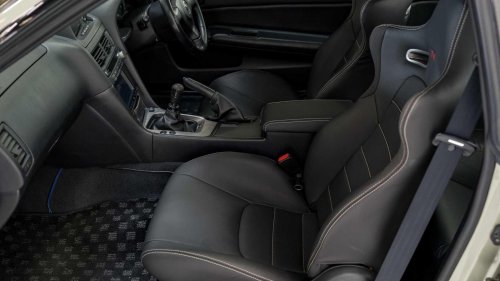
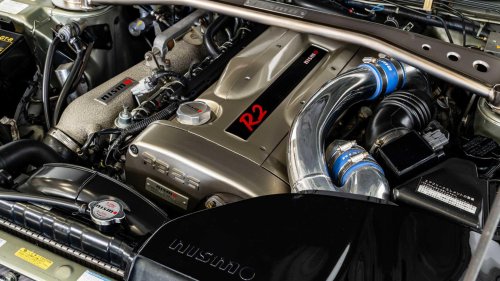
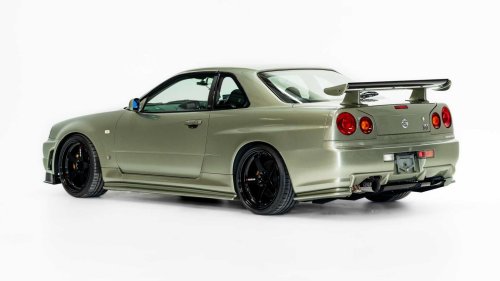
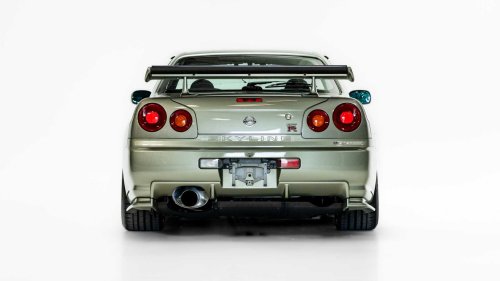
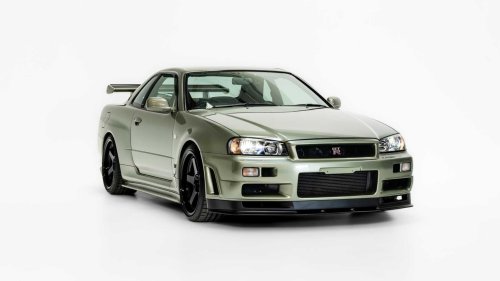



















A generation of American enthusiasts spent decades watching cars they could never legally own. Not because those cars were rare, or expensive, or even particularly exotic by modern standards, but because federal law drew a hard line between the US market and a class of Japanese sports cars that were doing things Detroit and Europe simply were not. One of those machines arrived in 1999 carrying technology in its center console that would not become standard in performance cars for another decade or more. Nissan built it, but most people who know the car still have not fully reckoned with what it actually was. Why 2026 Is Different From Every Other Import Year Bring a Trailer The 25-year import rule, established under the Imported Vehicle Safety Compliance Act of 1988, operates on a rolling eligibility basis tied to the exact month and year of manufacture, not the model year. A car built in April 2001 becomes federally eligible in April 2026. A car built in November 2001 becomes eligible in November 2026. The distinction matters because NHTSA applies the rule at the month-of-manufacture level, and buyers who do not verify build dates before purchasing risk importing a car before it legally qualifies.What the rule actually delivers, when a car hits its date, is significant. Vehicles qualifying under the 25-year exemption bypass NHTSA and EPA compliance requirements entirely, which typically cost between $9,500 and $28,500 for a registered importer to complete on a non-compliant vehicle. They also qualify for exemption from the 25% Section 232 tariff under HTS code 9903.94.04, leaving only the standard 2.5% base duty on passenger cars. Buyers should verify current tariff classifications at point of import given the shifting trade landscape, but the savings relative to grey market or pre-25-year routes are substantial. This is not just a calendar milestone. It is a genuine inflection point in what these cars cost and how easily they can be brought over. For context on the broader import landscape, few cars arriving in 2026 carry the cultural weight this one does. The Car That Was More Advanced Than Anyone Admitted Bring a Trailer During the era when the cars in question were built, the prevailing story about Japanese performance cars was simple: they were fast, they were tunable, and their manufacturers quietly agreed to cap official output at 276 horsepower while actual figures ran higher. That story is true, and it became the dominant frame through which most Western audiences understood cars like the Mitsubishi Lancer Evolution and the Subaru Impreza WRX STI.But one car from the same era was doing something in its interior that had nothing to do with output figures or turbocharger sizing. It was putting live performance telemetry on a full-color LCD screen in the center of the dashboard. Not as an aftermarket addition. Not as a dealer-fitted accessory. As standard equipment on every version of the car, from the first model produced in January 1999. The McLaren P1 arrived in 2013 with a reconfigurable digital instrument cluster celebrated as a breakthrough for road car interiors. That screen appeared fourteen years after Nissan had already fitted a data display to a production car retailing for the equivalent of roughly $45,000 in today's money. The R34 sits among the most technically significant Japanese cars of the modern era, and that status is still being fully understood. The Nissan Skyline GT-R R34 Was A Race Car With A Race Cockpit Bring a TrailerThe Nissan Skyline GT-R R34, known internally as the BNR34, launched in January 1999 as the third generation of the twin-turbocharged Skyline GT-R lineage. Every variant from the base model upward came fitted with a 5.8-inch full-color LCD Multi-Function Display mounted in the center of the dashboard. The screen showed live readings of boost pressure, oil temperature, water temperature, intake temperature, throttle position, and g-forces, with individual configurable alert thresholds that turned each readout red when a driver-set limit was exceeded. A serial data port allowed owners to download the logged data to a laptop for post-session analysis using Nissan's own MFD Analyser software. This was a factory data logger in 1999, on a production road car available for under $50,000, well before that capability existed commercially.Period testers responded with consistent surprise. The combination of the RB26DETT engine, the ATTESA E-TS Pro all-wheel-drive system, and a substantially stiffened chassis produced a car that reportedly lapped the Nürburgring Nordschleife in 7 minutes 52 seconds, an unofficial time credited to Nissan test driver Kazuo Shimizu that was faster than a Ferrari 360 Modena and a Porsche 911 Turbo in contemporary testing. The screen in the center console was the part of the story that tended to get lost. The RB26DETT And The Systems Around It Bring a Trailer The engine at the center of the R34 GT-R is a 2.6-liter twin-turbocharged DOHC 24-valve inline-six RB26DETT, with individual throttle bodies for each cylinder and a cast-iron block. Nissan officially rated it at 276 horsepower and 289 pound-feet of torque under Japan's informal manufacturer agreement, but independent dyno testing across multiple examples has consistently measured output closer to 320 horsepower at the crank in stock form. The six-speed Getrag V160 gearbox was new to the R34, replacing the five-speed unit used in the R32 and R33 generations.The chassis package was equally considered. ATTESA E-TS Pro defaulted to rear-wheel drive in normal conditions and could transfer up to 50% of torque to the front axle within milliseconds. Super-HICAS four-wheel steering turned the rear wheels up to one degree in either direction. An active rear limited-slip differential on V-Spec models managed torque split between the rear wheels independently. The Nür editions, introduced in February 2002, brought the most significant mechanical upgrade: their RB26DETT was based on the N1 racing engine specification, with revised camshaft timing, larger turbochargers with steel turbine wheels replacing the standard ceramic units, and ball-bearing centers for faster spool. These cars are immediately identifiable by their gold valve covers and matching gold VIN plate. Total R34 GT-R production across all variants reached 11,577 units between January 1999 and August 2002. What The R34 GT-R Costs Right Now Bring a TrailerMarket data for R34 GT-Rs shows a wide spread depending on variant and condition. Base standard cars have sold from around $69,000 at the lower end of the auction market for higher-mileage or modified examples, with a current benchmark closer to $150,000 for a clean, unmodified standard car. V-Spec examples average around $206,000, while V-Spec II cars range from $110,000 for modified or high-mileage examples up to $235,000 and beyond for low-mileage originals. Market data for Nür variants shows an average sale price around $380,000, with a V-Spec II Nür achieving $549,000 at auction for a near-zero-mileage example.The import eligibility picture is important to understand precisely. Cars built between January 1999 and December 2001 are federally eligible now on a rolling monthly basis. The 366 base M-Spec cars, which went on sale from May 8, 2001, are becoming eligible through 2026. The 285 M-Spec Nür and 718 V-Spec II Nür cars, which went on sale from February 26, 2002, do not become US-legal until 2027. California requires additional CARB and BAR inspections even for federally exempt vehicles, and state registration requirements vary. The standard base duty of 2.5% applies, with Section 232 tariff exemption available under HTS 9903.94.04 for qualifying imports, though buyers should confirm current policy at the time of import. The Variants That Matter And What To Know Before Buying Bring a Trailer The R34 GT-R model hierarchy runs from the base Standard through the V-Spec, V-Spec II, M-Spec, V-Spec II Nür, and M-Spec Nür, with the 19-unit Nismo Z-Tune sitting entirely outside the production run as a post-manufacture conversion. The Standard is the entry point: all the core technology including the MFD, RB26DETT, ATTESA E-TS, and six-speed Getrag, but without the active rear limited-slip differential or carbon fiber hood of the V-Spec variants.The V-Spec added the active LSD, carbon fiber hood, ATTESA E-TS Pro, and aerodynamic extensions. The V-Spec II, introduced in August 2000, refined the suspension further, upgraded the rear brakes, and brought the carbon fiber hood with a NACA duct. The M-Spec, which went on sale from May 2001 and is now entering US eligibility through 2026, took the V-Spec II platform and reoriented it toward comfort: Ripple Control dampers, a stiffer rear stabilizer bar, heated leather seats with gold stitching on the steering wheel, gear knob, and handbrake lever. The 366 M-Spec base cars represent a distinct buying proposition for someone who wants the full GT-R package with a more livable character.The Nür editions, available in both V-Spec II and M-Spec specifications from February 2002, added the N1-derived engine and are the most sought-after R34s on the open market. Within the 285-unit M-Spec Nür production run, just nine cars were finished in paint code EY0 Silica Breath, a warm gold metallic exclusive to the M-Spec range, making it one of the most extraordinary color-variant combinations in the entire 11,577-unit run. Millennium Jade was spread across a wider proportion of the 1,003 total Nür cars. Colors such as Midnight Purple II and Midnight Purple III command premiums of 20 to 40% over equivalent cars in standard colors. The rarest production variants include the 18-unit V-Spec II N1, purpose-built for circuit use. Why The R34 GT-R Matters Beyond The Poster Bring a Trailer The car most people know from video game covers and film posters was, in engineering terms, more serious than its mythology usually conveys. A factory data logger connected to a six-speed gearbox and an electronically intelligent all-wheel-drive system, built on a chassis stiff enough to outpace contemporary European sports cars around the Nürburgring, and sold at a price point that European and American manufacturers were not prepared to match. The MFD was not a novelty feature. It was a working tool that owners could connect to a laptop and analyze lap by lap. That capability did not become standard practice in road car design until the following decade.The 25-year wait created a mythology around the R34 that sometimes obscures what it actually was. Now that most of the production run is federally eligible, buyers entering the market for the first time should spend as much time understanding the engineering as they do understanding the pricing. The car rewards that attention. Not Just The R34: The Full Class Of 2001 Is Coming YouTube - Larry Chen The R34 GT-R anchors the 2001 JDM import class, but it does not define it alone. The Mitsubishi Lancer Evolution VII, which went on sale in February 2001, is now eligible and brings the larger CT9A chassis, the Active Center Differential that the US market never received, and a rally-derived all-wheel-drive system that could toggle between tarmac, gravel, and snow modes. The JDM version is categorically different from the Evo VIII that eventually reached US dealers. The Honda Integra Type R DC5, unveiled at the 2001 Tokyo Motor Show, brought the K20A 2.0-liter i-VTEC engine producing 217 horsepower at 8,000 rpm with a seam-welded chassis and a helical limited-slip differential, sold only in Japan, Australia, and New Zealand. The Subaru Impreza WRX STI in JDM specification made 276 horsepower and 275 pound-feet of torque from a 2.0-liter turbocharged flat-four with a six-speed manual and symmetrical all-wheel drive.The contrarian case for the 2001 import class is that legal importation actually makes these cars more accessible, not less. Before the 25-year rule applied, grey market and Show and Display routes involved significant compliance costs, legal risk, and annual mileage restrictions. A standard 25-year import costs 2.5% base duty, requires no compliance modifications, and carries no mileage limits. For buyers who want the R34 experience without the six-figure entry point, the Evo VII, DC5, and STI make the same argument in a different register: Japanese performance engineering from the same era, at a fraction of the price, now legally and cleanly importable for the first time.Sources: Hagerty, Classic.com, Bring a Trailer, GTR Registry, NHTSA.