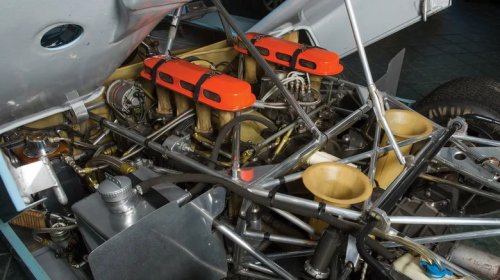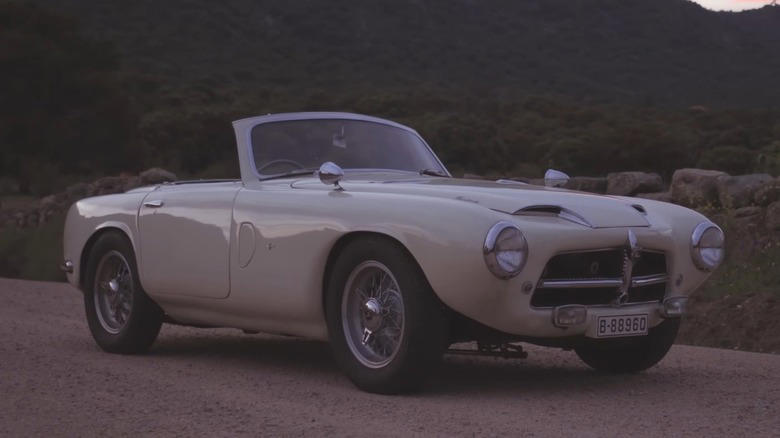
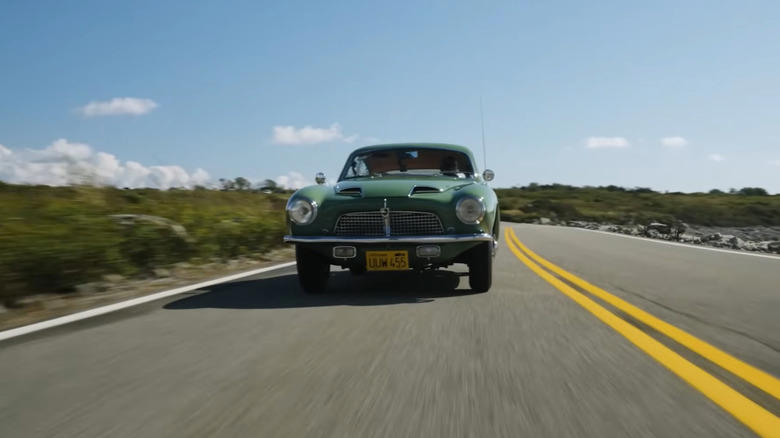
















Petrolicious/YouTube Following the second World War, the Spanish government acquired the then-defunct Hispano-Suiza facility in Barcelona to set up a new technical school and wide-ranging manufacturing facility. ENASA, the Empresa Nacional de Autocamiones S.A., was spun up in the facility to build a fleet of new diesel trucks for government use. Those trucks, lightly updated copies of pre-war Hispano-Suiza trucks, were built and distributed under the name Pegaso. The company's chief engineer, Wilfredo Ricart, had previously worked at Hispano-Suiza before joining Alfa Romeo's special projects division in 1936, working with Vittorio Jano and Enzo Ferrari to build a supercharged flat-twelve-powered Grand Prix car. Clearly, his engineering prowess would never be sated simply by making industrial trucks for the Spanish military. The Spanish-born Wilfredo Pelayo Ricart Medina, just a few years into his Pegaso tenure, became enamored with the idea of building Spain's answer to Enzo Ferrari's new upstart brand. Technologically advanced for its time, Pegaso developed and launched the Z-102 sports car with double wishbone and torsion bar front/DeDion racing rear suspension, a five-speed rear-mounted transaxle, and a 2.5-liter all-aluminum dual-overhead camshaft V8. The Pegaso sports car was developed effectively as a racing car that could be driven on the road, in keeping with Ricart's history and more or less directly copying Ferrari's homework. The standard single-carburetor model could produce a stellar-for-the-time 165 horsepower, but Pegaso offered a variety of V8 trims, including a supercharged competition-spec 3.2-liter version making an almost-unbelievable 300 ponies. With a lightweight drilled-steel tube frame and unique-if-ungainly alloy bodywork, it was reportedly the fastest car in the world when it made its debut. To fix the less-than-beautiful aesthetics, Pegaso called in coachbuilders Touring and Saoutchik to develop bodies for the car to great effect. Why didn't the car succeed? Audrain Museum Network/YouTube While the Pegaso's extremely advanced engine, transaxle, and suspension made it a formidable car for the track and an engaging drive on the street, it was extremely expensive to purchase and operate. Dedication to design and aerodynamics, for example, pushed the engine down and back as tightly as it would go in the chassis. This made things like valve adjustments impossible with the engine still in the car, requiring frequent and expensive service. Pegaso refused to cut any corners when it came to the Z-102, but unfortunately, that meant the car was roughly twice as expensive as anything coming out of Ferrari's Maranello shop at the time, and around four times the price of a contemporary Jaguar. Between 1951 and 1958, Pegaso reportedly built between 71 and 84 examples of the Z-102. As it turns out, post-war Spain was hardly in an economic position to see an ultra-high-end sports car succeed. This was easily one of the most advanced cars of the early 1950s, but it was simply delivered at the wrong time to see any kind of adoption at scale. By comparison, Italy's Ferrari was building at least a few hundred cars per year, enough to survive on its own. Imagine a world in which Pegaso beat Ferrari at its own game, and it was Spain that had become an international motorsport legend instead. What a world that might be. Pegaso and Ricart attempted to make amends with a less complex Z-103 sports car in 1955, but it proved itself too little a concession on price and too late an arrival. Just three examples were built, and the car never got off the ground before the company decided to just go back to building the industrial trucks it knew how to make cost-efficiently.