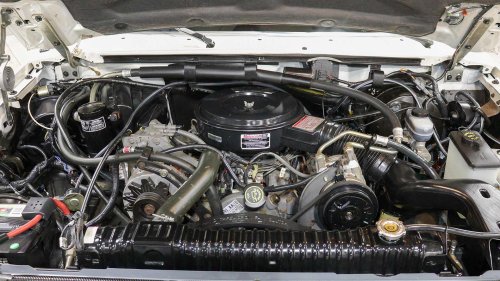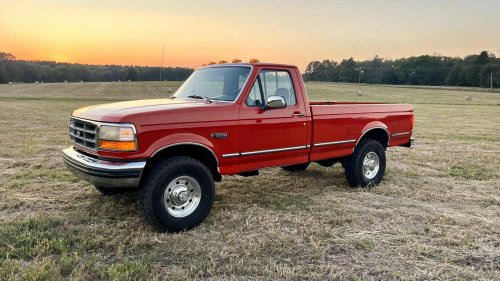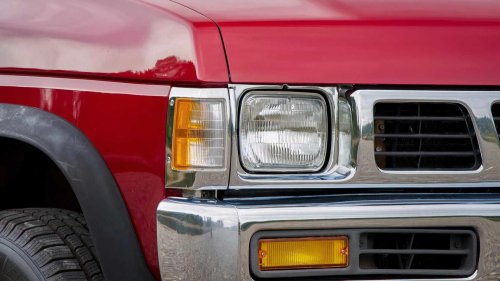
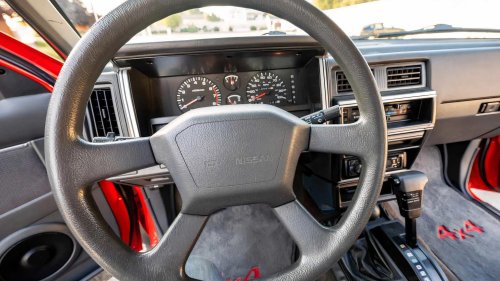
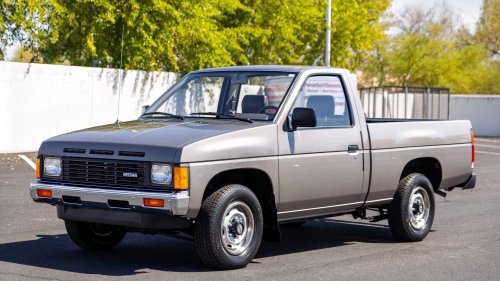
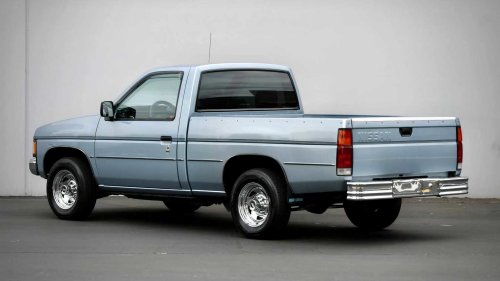
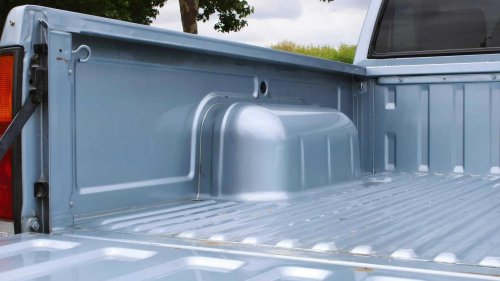
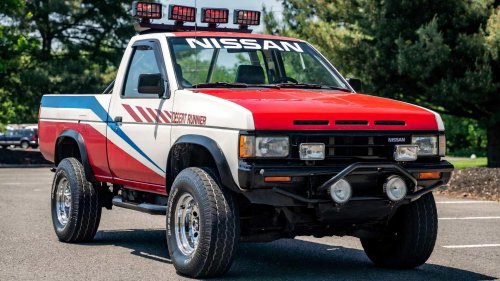
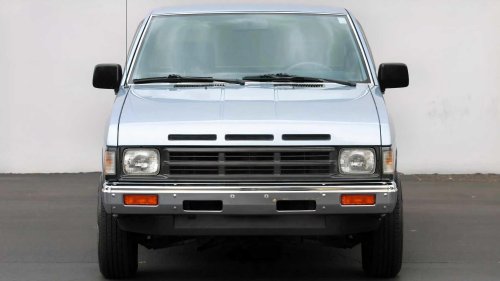


















Pickup trucks reign supreme when it comes to practicality, sure to serve you well as either a reliable workhorse, daily grocery and family hauler or weekend getaway vehicle with off-roading capabilities. That's a big part of what makes them so popular among Americans, and modern truck culture stateside (practically a lifestyle now) is as exciting as it is diverse. You’ve got your high-end OEM performance pickups, custom-made specimens turned into anything from indestructible overlanding rigs to slammed speed demons, and those big old heavy-duty trucks you can always rely on to get the job done. The list could go on, but you probably get the point by now. When Trucks Were No Longer Just About Utility Bring a TrailerToday we’re taking a little trip down memory lane, back to a time when Japanese automakers had just gained some decent credibility in the pickup segment. Their legitimacy had been firmly established by models such as the Toyota Pickup and Datsun 720 when the '80s rolled around, but there was one particular nameplate that spawned a true cultural movement a bit later on. It played a massive role in shaping the truck culture we see today, even without the imposing stature or horsepower numbers of its bigger U.S. counterparts. The 720 was getting a bit long in the tooth by the mid-'80s, and Nissan needed a replacement, yet no one could've imagined the sort of impact it would have. Great Things Come In Small Packages, And Nissan Knew It Bring a TrailerIt demonstrated what it was capable of in the grueling Baja 1000 race, while also earning the adoration of off-roading enthusiasts, tuners and everyday drivers alike. The model had all that sweet Japanese reliability and a robust construction that could handle everything you threw at it, as well as the sort of mechanical simplicity which makes customization a breeze. Racing success, tuning potential and an affordable price tag to make it a viable option for entry-level buyers — that, right there, is the perfect concoction of ingredients for a cult classic legend. Without further ado, let’s see how Nissan took the pickup world by storm four decades ago. Nissan Hardbody — Simple, Compact And Built To Last Bring a TrailerThe model we've been hinting at all along is the iconic Nissan Hardbody, also known as the D21 and produced from 1986 up until 1997. We might as well start with the origin of its name, which references the truck’s sturdy double-wall bed construction. That’s just one of the many features characterizing its beefy anatomy, along with an all-steel body and a body-on-frame design essential in reducing flex on challenging terrain. Sure enough, the Hardbody is already starting to sound pretty interesting right off the bat, but we’re just getting warmed up here. Another defining trait has to do with its proportions — more compact than a lot of other trucks available at the time. But just because it was smaller didn’t mean its appearance wasn’t seriously tough; quite the opposite.All the boxy bodywork was a perfect reflection of the D21's durability, with the added benefit of making it look far cooler than a truck of that size should ever have the right to be. And we’d say this angular aesthetic aged rather well, because it is still what most pickups shoot for to this very day. Besides that, the Hardbody’s simple suspension arrangement made it a prime candidate for off-roading conversions, as well as lowering kits at the complete opposite end of the customization spectrum. With chassis characteristics like those, Nissan’s D21 was destined to become something special ever since day one, and things were also pretty solid in the engine bay.Bring a TrailerBefore 1990, one could get the Hardbody with either a 2.4-liter inline-four good for up to 106 horsepower or a 3.0-liter V6 with 140 horsepower. The engine options became more exciting thereafter, with Nissan’s KA24E four-cylinder widely renowned for its outstanding reliability. It once again displaced 2.4 liters and was able to generate 134 horsepower, but then you also had the 3.0-liter VG30E mustering 154 horsepower and 182 pound-feet of torque. These numbers aren’t too crazy and that’s perfectly fine, because the D21 was never about outright power in the first place. In fact, it comes to show that you can’t judge a car solely by its spec sheet, since mere stats and digits will never tell the full story. Racing Success At Baja And Beyond Bring a TrailerThe engine’s force was fed to a five-speed manual gearbox or a four-speed automatic, subsequently reaching either the rear or all four wheels. Payload capacity was rated at about 1,400 pounds, and the D21 could tow up to a respectable 3,500 pounds. Further strengthening the Hardbody's appeal was its extensive success in off-road racing. It really stole the show in 1987, winning its class at both the Baja 500 and 1000 as well as the Mint 400 and Gold Coast 300. These victories prompted Nissan to release the Desert Runner special edition for 1988, limited to about 1,000 units and featuring things like bold graphics, a roll bar and lifted suspension complemented by massive 31-inch tires. Legacy And Cultural Impact Bring a TrailerIt’s clear that performance trucks on offer today are built in the exact same spirit, no longer thought of as mere tools and instead viewed as a way to have a great time behind the wheel. Tuners went wild with the D21, as well, turning it into just about everything from fully-loaded, rugged off-roaders to slammed attention-grabbers with flashy graphics. Take, for instance, the custom mini-truck movement of the eighties and nineties, characterized by things like lowered suspension, vibrant paintwork and a deep sense of community among builders and owners.The Nissan Hardbody played a key role in shaping that scene, and it was eventually succeeded by the Frontier after 1997. Its impact on the pickup segment can hardly be overstated, as it practically bridged the gap between utility and lifestyle. The model’s affordability and mod-friendly nature were essential to its success, as well, while its potential for stylishness and performance paved the way for later icons such as the GMC Syclone and Ford F-150 SVT Lightning. Besides that, the Hardbody’s significance is also reflected in current market values, as prices on the second-hand market are holding up very well when it comes to clean examples.Bring a TrailerBut you might be able to score one in good shape for less than $10,000 if you’re lucky, and that would give you the perfect basis for a project to keep you busy afterhours. Be prepared to spend over $20k on a low-mileage specimen in mint condition, though, while those sweet Desert Runner variants will set you back around 15 grand. All things considered, the modern-day truck scene might look completely different if it had not been reshaped by the Hardbody many years ago, so take a second to acknowledge and appreciate its legacy next time you get behind the wheel in your Raptor. They often say great things come in small packages, and the D21 was a perfect piece of evidence to back up this claim.