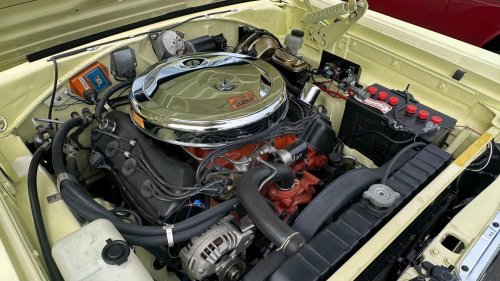
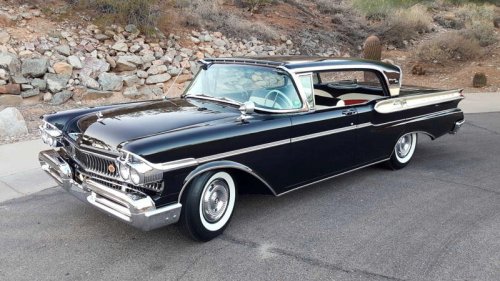
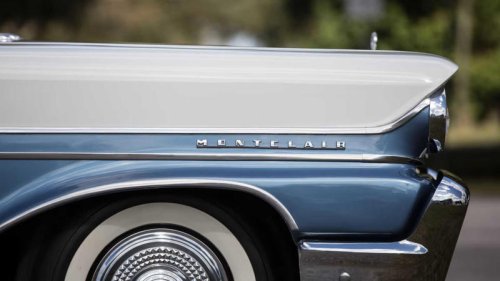
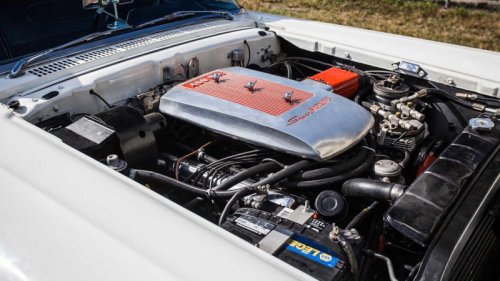
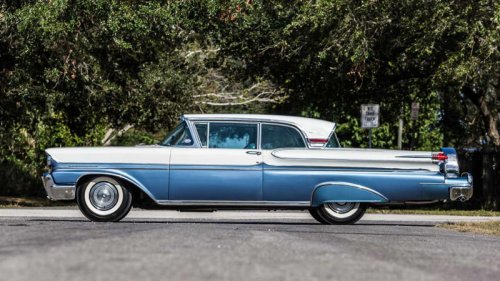
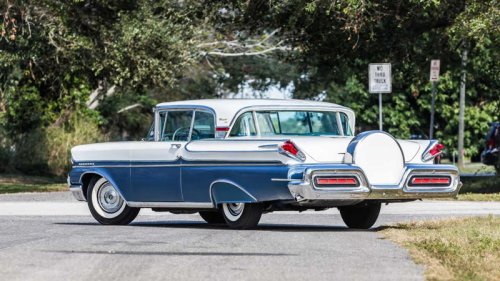
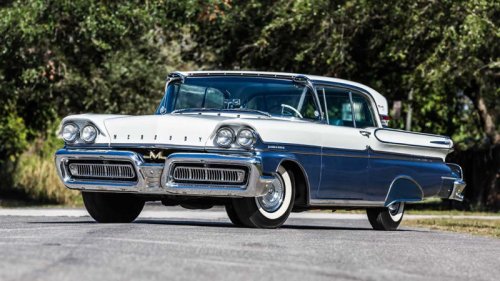
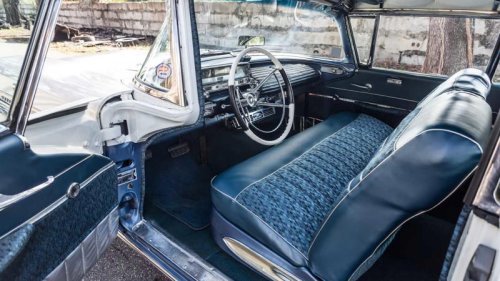



















Muscle cars usually get filed under the 1960s and early 1970s – that was when the formula turned into a full-on street brawl. Midsize bodies, giant V8s, bold stripes, and enough advertised horsepower to make insurance agents reach for aspirin – that was what made muscle power legends. The Pontiac GTO, Chevelle SS, Road Runner, and Hemi cars made performance feel loud, cheap, and available to anyone brave enough to sign the paperwork. That story is mostly true, but it leaves out one strange chapter from a few years earlier, when a huge American car broke the 400-horsepower barrier before the muscle-car era had even found its name.What made that moment so odd was the badge on the hood. The breakthrough did not come from Chrysler’s hard-charging letter-car line, and it did not come from Chevrolet either. It came from a brand Ford created to sit between Ford and Lincoln, a company that sold style, extra trim, comfort, and a smoother ride than raw speed. In 1958, though, that brand decided to flex, and the result was one of the most overlooked power moves of the 1950s. Mercury Was A Style-And-Comfort Brand, Not The Next Horsepower King Bring A TrailerIn the late 1950s, Mercury was stuck in a tricky spot – it was not a bargain brand, and it was not a full luxury name either. Ford sat below it, and Lincoln sat above it. That left Mercury in the middle, where cars had to look upscale, feel comfortable, and still give buyers a good reason to spend more. The firm leaned hard on style during that era, selling big chrome, sweeping lines, plush cabins, and the kind of road presence that made a driveway look more important. It was the brand for buyers who wanted a little extra flash without stepping into full country-club money.That strategy worked when times were good, but the market got rough fast. The late 1950s brought fierce competition in the mid-priced field, and every brand wanted attention. Mercury could not afford to blend in – plenty of cars already offered big bodies, soft seats, and enough bright trim to reflect the whole neighborhood. If Mercury wanted shoppers to remember its cars, it needed more than good looks and a smooth ride. It needed something bold enough to stop people mid-sentence in the showroom.Via mecum.com At the same time, Detroit had started treating horsepower like a billboard. Bigger numbers grabbed headlines, and headlines brought traffic – even buyers who never planned to floor the throttle liked knowing their car had serious punch under the hood. Power had become part of prestige. A strong engine did more than improve acceleration – it gave a car attitude and gave salesmen an easy hook. Most of all, it told the public that a brand was not asleep at the wheel. Mercury saw that shift clearly and realized comfort alone would not carry the whole message.So the brand made a move that felt a little out of character, and that was exactly the point. Instead of staying in its safe lane, Mercury decided to build a car with enough muscle to shake up the entire industry. A real production car from a brand known more for style than speed. And in 1958, that answer arrived in the form of one very unlikely car and one very unlikely engine. The V8 Engine That Finally Broke The 400 Hp Barrier BaTThat surprise came from the 1958 Mercury Montclair, and the weapon under its hood was the 430-cubic-inch Super Marauder V8. At a time when most American performance bragging rights came from brands with a tougher image, Mercury crashed the party with a full-size coupe from a comfort-and-style division and handed it a factory-rated 400 horsepower. That number was almost absurd for the era – it was the kind of figure that made people check the brochure twice, then look at the badge again just to make sure they had not wandered onto the wrong showroom floor.The number looked even bigger when stacked against the era’s headline cars. Chrysler’s 1958 300D packed a 392-cubic-inch FirePower Hemi rated at 390 hp, and Cadillac’s mainstream 365-cubic-inch V8 made 310 hp, with the exotic Eldorado Brougham reaching 335 hp. Chevrolet’s fresh 348 with triple carbs topped out at 315 hp in 1958 passenger-car trim. Mercury beat all of them on paper – and while that did not instantly make the Montclair the king of every road test, it did make Mercury the brand holding the fattest horsepower ad in town.Yet the Super Marauder never earned the same fame as a Chrysler letter car or a later muscle icon. One reason sat in the badge – Mercury did not market performance with the same focused swagger Chrysler used on the 300 line. Another reason sat in the production count – modern reports and auction write-ups regularly put Super Marauder output at around 100 engines for the 1958 model year. That kind of rarity turns a car into folklore fast and also means plenty of enthusiasts know the myth but have never seen one in person. Big power plus tiny numbers equals automotive campfire story. How Mercury Got To 400 HP Mecum The foundation was already stout. Mercury’s 430 belonged to the MEL family, short for Mercury-Edsel-Lincoln, and the standard 430 in Mercury trim already made 360 hp with a single Holley four-barrel carburetor and the same 10.5:1 compression ratio. Bore and stroke measured 4.30 by 3.70 inches. In plain English, Mercury started with a very big engine that already had the lungs and the compression to do serious work.The big change came on top – Mercury swapped in a special intake and a trio of two-barrel carburetors, turning the engine into a factory tri-power setup before that phrase became garage poetry. The look matched the numbers, and the Super Marauder wore finned rocker covers and a cast-aluminum air cleaner assembly that looked like it belonged on a concept car. Former Ford stylist and hot-rod figure Lynn Wineland is often credited with shaping that air-cleaner housing. So yes, the first 400-hp Mercury also had designer under-hood jewelry, and even its air cleaner dressed for the occasion.The official spec sheets also show how much the company leaned into engineering language. The brochure called out a water-cooled intake manifold, “Cool-Power Design” to reduce hot spots, low-friction pistons, and temperature-controlled carburetor air intakes. Some of that reads like salesmanship, because it was salesmanship, but it still matters. The Montclair Was The Best Fit For The 400-HP V8 BaT The Montclair made the most sense because it sat in Mercury’s middle ground. It had more flash and status than the Monterey, but it did not carry the heavier luxury mission of the Park Lane. That gave Mercury a car that looked expensive, felt substantial, and still left room for the engine to be the main shock. The standard Montclair already packed the 383/330-hp Marauder, so buyers wouldn't have seen the Super Marauder as a weird science experiment. They would have seen it as the wildest version of a car they already understood.There was also a practical image reason. In 1958, the Turnpike Cruiser name got folded into the Montclair line, so buyers could order a Montclair with extra gadgets, a special roofline, and all the Jet Age oddness Mercury loved. That meant the Montclair could go two ways – it could be a loaded, gadget-happy showboat, or it could be a cleaner hardtop coupe that let the engine do more of the talking.The best reason, though, is the simplest one. The Montclair looked like a family car – a glamorous one, sure, but still a big six-passenger hardtop with a broad back seat and enough trunk room, as Mercury bragged, for “four steamer trunks.” That contrast gave the Super Marauder Montclair its real charm – a true sleeper before the world even knew what the term meant. It smiled politely, wore bright trim, and then hit the 400-hp mark years before the classic muscle formula went mainstream. How It Compared With The Heavy Hitters Of The Era BaT Against Chrysler’s 300D, the Mercury looked like the odd cousin who suddenly deadlifted the sofa. Chrysler built the 300D with a clear performance image, a 390-hp Hemi, and a hardtop price of $5,173. Mercury matched that era’s appetite for size and luxury, but its base Montclair two-door hardtop carried an original MSRP of $3,284. Even after options, the Mercury attacked the same bragging-rights territory from a lower rung in the market. That made the 400-hp claim even more surprising – Mercury was not supposed to beat Chrysler’s halo car on paper. But it did.GM’s big cars were not close to the numbers. Chevrolet’s hottest 348 in 1958 passenger-car trim made 315 hp, Cadillac’s standard 365 made 310 hp, and even the Eldorado Brougham topped out at 335 hp. Those were serious engines in serious cars, but Mercury still leaped past them by a wide margin. That gap clearly shows the Super Marauder was flat-out exceptional for 1958 Detroit. The company that built the first 400-hp American production V8 was not the obvious one, which is exactly why the story still lands so well today.BaT Of course, every late-1950s horsepower claim needs a little side-eye. These were gross ratings, and the Montclair still carried full-size weight, a smooth-riding chassis, and drum brakes at all four corners. It was not a 1970 Chevelle before the Chevelle existed, but it did point toward the same basic idea that defined later muscle cars – take a regular production car, give it one absurd engine, and let the contrast do the marketing. What A Montclair Cost Then, And How Much It Costs Today BaTIn 1958, a Mercury Montclair still looked expensive, but it was not unreachable. J.D. Power lists the original MSRP for a Montclair two-door hardtop at $3,284 and a four-door sedan at $3,236. Using a 1958-to-2025 inflation multiplier based on official CPI data, that puts the two-door hardtop at roughly $36,485 in 2025 dollars and the four-door sedan at about $35,952. In modern terms, that lands the Montclair closer to a nicely equipped mainstream new car than to some unattainable luxury toy.That base price was only the starting point. Mercury loaded the option sheet with power steering, power brakes, power windows, air conditioning, a four-way power seat, the speed-limit safety monitor, and the wonderfully named Seat-O-Matic memory seat. The Super Marauder itself also required the Multi-Drive Merc-O-Matic, so the real-world price of a 400-hp Montclair would have climbed fast, especially if the buyer also wanted the full late-'50s luxury buffet.Today, ordinary 1958 Montclairs still look like a bargain compared with many better-known American classics. Hagerty’s valuation tool pegs a 1958 Montclair 2-door Phaeton Coupe at $14,800 in good condition, and a 1958 Montclair Turnpike Cruiser hardtop sits higher at $24,200 in good condition.True Super Marauder cars live in a different lane, though, because rarity bends every price conversation. RM Sotheby’s sold a 1958 Mercury Montclair Super Marauder Coupe for $55,000 in 2008, and another 1958 Montclair hardtop coupe with a rare Super Marauder engine brought $33,000 in 2015. Mecum, meanwhile, listed a restored 1958 Turnpike Cruiser Super Marauder that reached an $80,000 high bid in 2015 without meeting the reserve.Source: Mercury, HotRod