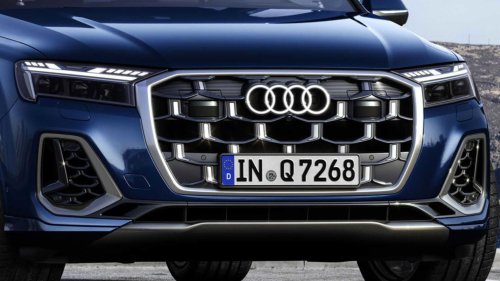
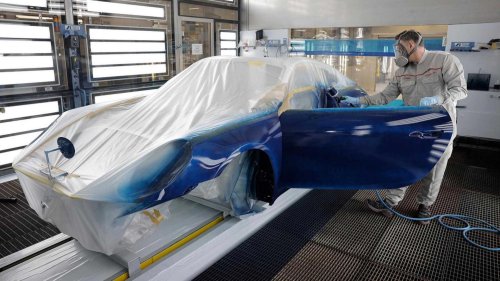
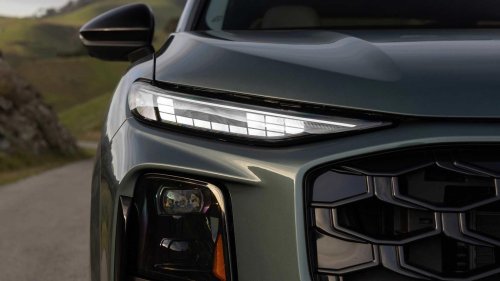

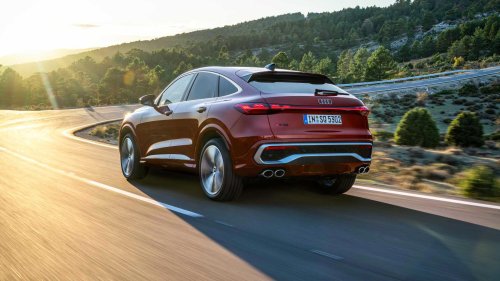



















In the good old analog days, a fender bender might not be much more than an annoying and frustrating inconvenience. If you bumped into a bollard in a parking lot, you could schedule a quick trip to your local body shop for some simple plastic repair, a fresh splash of paint, and a bill that would rarely tick over the four-digit mark. But the auto industry has changed, and today an incident like this can quickly spiral from a minor nuisance into a full-scale electronic catastrophe. Much of this is down to the way that companies build these modern machines, where they will often incorporate advanced driver assistance systems into vulnerable locations and even weave some exotic metallurgy into the very skin of the vehicle.This means that SUVs like the Audi Q7 aren't utilitarian workhorses now but more like rolling supercomputers. Their systems must be constantly on the lookout for risks and exterior panels often serve as high-tech housing locations for radar, sonar, and stereoscopic cameras. And this means that bumpers no longer function as a sacrificial shield in 2026 but must act as housing for sophisticated sensor arrays. That's just one reason why a fender bender could be a lot more than a simple cosmetic fix in 2026. Such a crash may signal the start of a complex surgical procedure featuring proprietary software, specialized hardware, and even operating room levels of precision. Naturally then, the price of repairing our cars is only going one way, up. Bumping The Bumper Is Not A Good Idea AudiConsumers often wonder why insurance premiums are skyrocketing and a lot of this is down to the cost of repairs. As counterproductive as it may sound, OEMs insist on integrating expensive ADAS hardware directly into the most impact-prone areas of the vehicle and this means into the bumpers themselves. In 2026, a standard mid-sized SUV might carry 15 to 20 individual sensors in these vulnerable areas, which can help the vehicle to see or sense the world around it. These may include mid-range radar for blind spot monitoring, short-range ultrasonic sensors for parking, and long-range radar that comes into play for adaptive cruise control systems and autonomous emergency braking. Yes, some of those sensors may help to avoid a much bigger accident when you look at the situation through a larger lens, but the fact that the manufacturers have placed these expensive and delicate components in the bumpers almost guarantees that a minor fender bender can unleash a wave of complications.One of the biggest issues here is not necessarily a direct hit on the electronic component itself, but the fact that when a bumper is even slightly deformed, a sensor may lose its factory-set zero point. If a radar sensor shifts by just a tenth of an inch, it can misinterpret the position of an object by several feet when the vehicle is going at highway speeds. This could potentially cause the car to respond to a non-existent obstacle by swerving or braking when it doesn't need to.Also, whenever a bumper cover comes off, some OEM repair procedures state that the entire ADAS suite has to undergo a calibration. This might involve specific workshop lighting and specialized laser targeting arrays and, as you might expect, that can often add a lot to that bumper repair cost. A vehicle owner is no longer just paying for new plastic but also forking out for technical labor to re-establish the correct horizon. Paint Thickness Blocks The Signal Porsche For sensors like blind spot monitors to work correctly, radar waves must pass through not just the plastic that these monitors sit behind but also the paint. This means that the chemistry of the paint comes into the repair cost picture as an incorrect choice can significantly degrade sensor performance. Body shop technicians have to be very careful when selecting the thickness and metallic content of the paint. They can't use a metallic flake that's just too dense, or the radar sensor may suffer from signal noise.These complications are now starting to lead to a replacement-only culture. When manufacturers insist that repairers avoid the use of traditional body fillers or plastic welding in the transmission zones in front of the sensors, repair shops can be averse to risk. They know that even a slight miscalculation in the thickness of the paint, and perhaps exceeding the 300 µm limit, could lead to calibration failure. They might then need to sand the bumper down to the raw plastic to repaint it or discard the unit entirely. In the worst-case scenario, a relatively simple bump in a parking lot could lead to the total loss of repairable parts due to signal interference. It's little wonder that some "simple" repairs can time into the mid four-figure mark these days due to these unbelievable levels of complexity. Headlamp Repairs Add To The Misery Audi Life was a lot simpler when you could easily replace a $50 halogen bulb if your headlamp blew. Today we are living in the age of matrix LED and laser light technology, and headlamps are no longer just lamps but complicated projection systems instead. They might contain integrated cooling fans and thousands of individually addressable pixels, and they can also integrate with cornering radar or ultrasonic sensors. Again, these levels of complexity mean that a minor clip to the front corner of the vehicle can easily shatter a lighting assembly that may cost $2,500 per side to replace. And as these units are non-reparable and sealed so that moisture doesn't get in, there's no chance of trying to repair them on your kitchen table.Modern adaptive headlights may code to the vehicle's VIN and may need digital beam-aiming calibration, which seems ridiculous on the one hand but may just be a fact of life in today's electronic world. Don't be surprised if an insurance company totals a not-so-old SUV if it incurs damage to two headlight assemblies and a grille-mounted radar, as the repair costs could easily push past industry valuation thresholds. Material Choice Often Confounds The Repair Shop BMW Manufacturers have to meet stringent 2026 fuel economy and emission standards one way or the other and to do so, they'll often engage in an aggressive weight loss program. This is why you don't see many of those traditional mild steel panels anymore, but rather areas that feature high-strength aluminum, magnesium, and boron steel instead. Certainly, those materials may be very good at absorbing energy in a crash, but they are a nightmare for the traditional body shop owner. Those shop owners understand that it's not easy at all to coax aluminum back to its original shape once deformed without it losing its structural integrity or cracking. And so many repair shops will advise full replacement, especially if they don't have any specialized clean rooms that prevent cross-contamination with steel dust. Also, many shops may not have some of the expensive riveting and bonding equipment that they would otherwise need in order to revive some of these newfangled panels.It’s easy to see why a relatively simple dent in an aluminum quarter panel could cost far more to repair today. Instead of pulling and filling as a technician may have suggested in the old days, specialized labor now comes into the picture to try and heat, reform, and bond a new section instead. These labor costs are often double when compared to those old days, meaning that it's also very expensive to structurally repair a vehicle while also bringing it back to full electronic health. The Insurance Ripple Effect And The Total Loss Paradox Audi Consumers are the ultimate victim of these technological evolutions today, and regardless of their safety record, a driver may still have to contend with insurance premiums that seem to be rising at double the rate of inflation. Insurance actuaries are also looking more closely at the repairability index of each vehicle. It is no longer simply a case of how safe these cars, SUVs, or trucks may be and whether they may become involved in an accident at all and this is leading to an era where the likelihood of a total loss proclamation can be quite high.When you consider that SUVs are safer than they ever have been and major accidents seem to be far fewer than before, this insurance situation is surely a paradox. It doesn't really seem sensible to total a vehicle just because its electronic eyes are too expensive to realign. And it's certainly not fair to see another vehicle that's perfectly drivable (from a practical point of view) being sent to the scrap heap because of the cost of its sensors, matrix LEDs, and subsequent multi-day calibrations.It has come to something when the software that you need to aim a bumper is just as critical as the steel you may need to support it. Clearly, bumper sensors can save lives in some situations by preventing collisions, but if there is a collision anyway, those sensors could become a serious financial liability. And this means that while a modern SUV is a masterpiece of safety by almost any determination, it may also be a financial glass cannon.