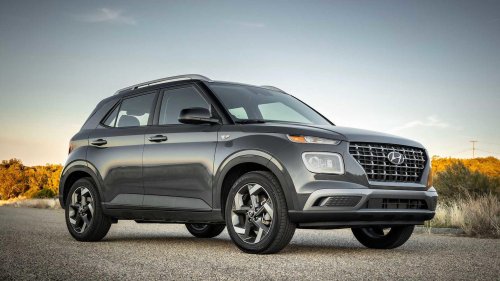
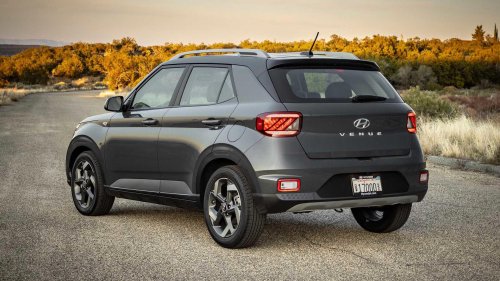
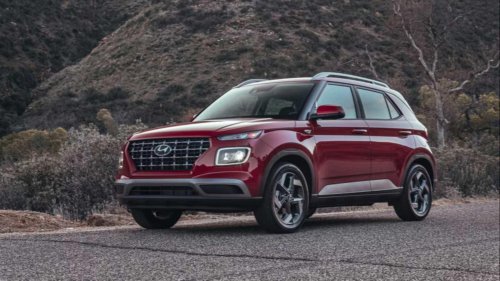
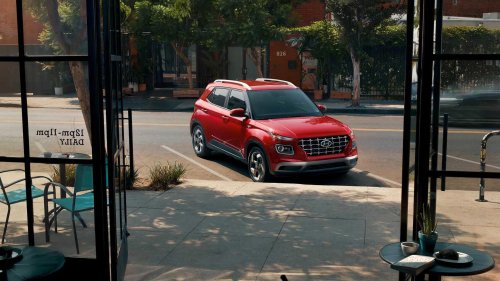
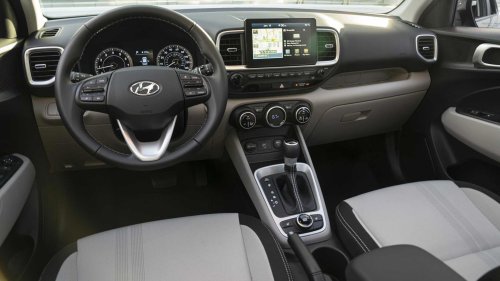
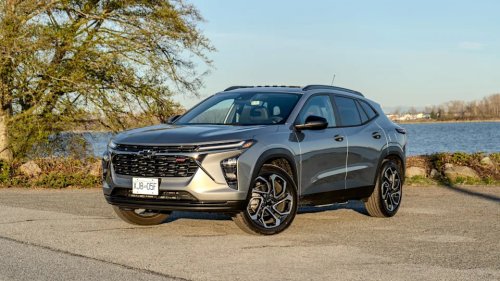
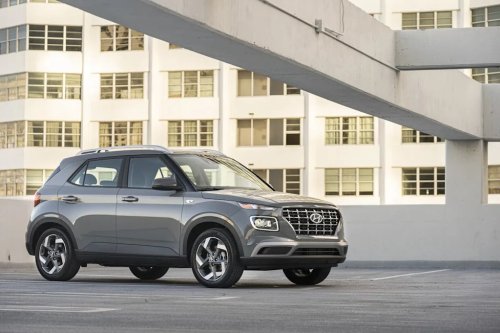
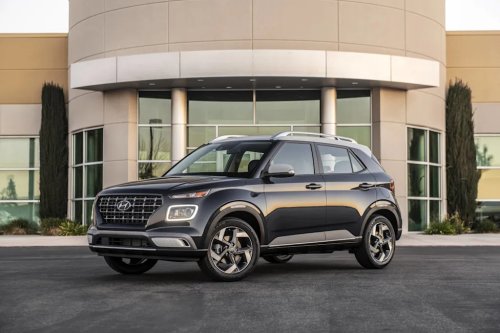
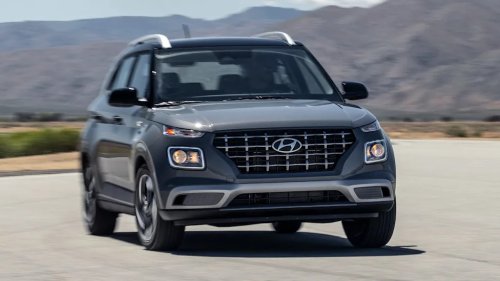
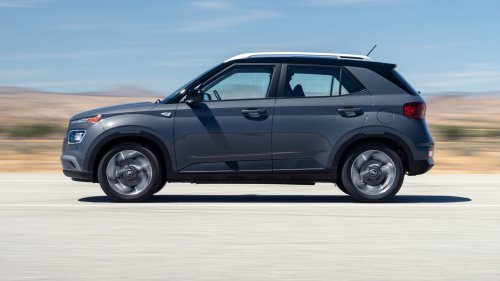
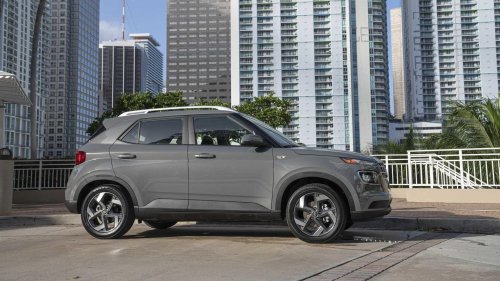
With the Nissan Versa dropping out of the U.S. market last year, the Hyundai Venue is now the cheapest car in America, with a starting price of just $22,150. It is pretty dated at this point, being six years old now, without any real changes other than an updated gauge cluster a couple of years ago. But it has all the bases covered, with a nice, boxy shape to get the most space out of its small dimensions, an eight-inch touchscreen with Apple CarPlay and Android Auto, and enough power to keep up in American traffic. While its sales in 2025 were up 21%, it still only sold 29,805 units, which isn't as many as it should be selling if car buyers are actually tired of high vehicle prices like they say they are.It's small size also keeps it pretty light, which is how it can get away with 116 horsepower and not feel as slow as molasses. That small engine also means it gets a respectable 31 mpg combined, and Hyundai's 10-year, 100,000 mile powertrain warranty ensures that you won't be on the hook for any expensive engine or transmission repairs for a long time. You do have to put up with a CVT transmission, which is fine but not ideal, and there's no all-wheel drive option for those needing extra traction, but those are really the only main shortcomings. If that all sounds good to you, and you're interested in joining the Venue club, let's get into the trims, what you get, and a worst-case scenario of how much you can spend on one of these fully-loaded.All prices listed include destination and freight costs and are for the 2026 model year. Listed accessories don't include their dealer installation costs, which can vary. The 2026 Hyundai Venue, Trim By Trim Ian Wright/CarBuzz/Valnet The Venue lineup is fairly simple, thankfully, with one caveat. It appears that there's only two trims for 2026, the base SE and the fully-loaded SEL, which Hyundai splits into two different trims of "SEL w/ 2-Tone Roof" and the regular SEL. And, strangely, selecting the 2-Tone Roof trim actually saves you $225 over the regular SEL. The reason for this is that last year Hyundai got rid of the Limited trim and essentially bundled the most popular equipment of that group into the SEL, but saved the nicer seats for the 2-Tone version only. The SEL w/ 2-Tone Roof upgrades you from cloth seats to a "Cloth / H-Tex" combo instead, and also tosses out the sunroof the SEL gets for some reason.As you can see, there's not much of an up-charge to go for those higher trims, but for shoppers on a tight budget, $2,050 is significant, so let's break down what's standard and what you get for the extra two grand. As standard, you get things like automatic headlights with auto high-beam control, an eight-inch touchscreen with Apple CarPlay and Android Auto, six speakers, two USB jacks, lane keeping assist, 15-inch alloy wheels, a tilt and telescopic steering wheel, and a 4.2-inch TFT instrument cluster. With the differences between the SEL and SEL w/ 2-Tone Roof already out of the way, let's focus on the upgrades you get going from SE to SEL: Heated front seats & side view mirrors Proximity Key w/ push button start Leather-wrapped steering wheel and shift knob Automatic temperature control Driver's auto-up window Drive Mode Select (Normal → Sport → Snow) Wireless Charging Pad Under floor cargo storage Rear Seat Dual USB Charging Power Sunroof Roof side rails Blind-Spot Collision Warning Rear Cross-Traffic Collision Warning 17-inch alloy wheels Rear disc brakes That's a lot of goodies and very nice upgrades for $2,275, but there's nothing you can't live without either. If you're looking for the most stuff-per-dollar though, the SEL trim seems like the way to go. What Are Our Options? Ian Wright/CarBuzz/Valnet The options list is pretty short for the Venue, with your only choices being the color of the exterior and interior. There's an impressive eight different exterior colors to pick from, with a red, green and two blues available in addition to the usual grayscale. Also pretty surprising is that all the colors are free, other than the Ultimate Red, which costs $500. If you want the 2-Tone though, your choices get narrowed down to only three, Lunar White and Ecotronic Gray that have a black roof, and a Denim Blue that gets paired with a fun white roof.On the inside, you have two main choices for the cloth upholstery colors on the SE and SEL, black and gray. The SEL w/ 2-Tone Roof only comes in black for the "Cloth / H-Tex" combo for the white and gray exteriors, but the Denim Blue gets a cool Denim Blue-colored cloth and leatherette combo. It's not real denim, FYI, but that one would be our pick just because it's unique.As far as dealer-installed accessories go, there's only 11 things to add on: Cargo net — $60 Cargo tray — $130 Carpeted floor mats — $240 Crossbar Kit — $375 First aid kit — $45 All-season fitted liners — $250 Mudguards — $145 Rear bumper applique — $80 Rear seat cup holder — $70 Roadside assistance kit — $75 A very reasonable list of things, and the priciest option, the crossbar kit at $375, is only going to be needed for those that plan to strap things to the roof that require crossbars, with the standard raised roof rails still able to do plenty on their own. The carpeted floor mats are a little pricey at $240, with other companies charging significantly less for these, and some even throwing them in for free, but otherwise, compared to other companies that offer an accessories list that's a mile long, this list is refreshingly simple, straightforward and well-priced. Adding It All Up Hyundai Assuming you went for all the accessories and got the SEL so you could have the privilege of getting the only extra-cost color, here's what you'd be looking at:Not bad still, honestly. And especially for people focusing on price, you can save that $500 just by being willing to have any other color that isn't red, which then brings the loaded price under $26,000. And that's still assuming you wanted to earn the customer-of-the-year award at your dealership by buying every accessory available. Financing Costs Hyundai The other big cost to consider if you're not paying cash for your Venue is financing. Using this auto loan calculator, here's what financing a fully-loaded Venue will actually cost you if we assume a 10% down payment, 5% interest, and a five-year term, with taxes and fees included in the loan:Obviously, these numbers will vary depending on your state and their tax and titling costs, your credit score, loan duration, how much you put down, whether you have a trade-in, manufacturer or dealer incentives, etc. Dealers are also likely to be more willing to deal on the Venue, given its more dated nature and it being a slower seller than most of the newest and more popular Hyundais on the lot. These figures are simply an example and that calculator can provide you with a more personalized estimate using your own numbers. Is A Fully-Loaded Venue Worth The Price? Hyundai Considering the great value to start with, the strong value of the SEL package, and the reasonable amount of accessories and their costs, a fully-loaded Venue looks to be worth the price to us, but, your mileage will vary. If incentives and/or negotiations for some of the other cheapest new cars level the playing field or close the price gap significantly, the Venue's value proposition might begin to look a little weaker.But at MSRP, the next cheapest vehicle in America, the Chevrolet Trax, would run you $28,885 comparably equipped to the Venue SEL, a significant $4,460 increase. The Trax is roomier, more powerful and more high-tech, but it doesn't provide the long powertrain warranty like Hyundai does. There are pros and cons to all of these, but at the end of the day, the Venue's pricing continues to look good regardless of whether you're shopping for a base model or a fully-loaded one.



















 +27 others




















![Hyundai is testing a smaller EV — could it be the IONIQ 4? [Video]](https://cdn.topcarnews.net/thumb/id/aHR0cHM6Ly9pMC53cC5jb20vZWxlY3Ry-ZWsuY28vd3AtY29udGVudC91cGxvYWRz-L3NpdGVzLzMvMjAyNi8wMi9IeXVuZGFp-LUlPTklRLTEtRVYtZnJvbnQuanBlZz93-PTE1MDAmYW1wO3F1YWxpdHk9ODImYW1w-O3N0cmlwPWFsbCZhbXA7c3NsPTE/62d7459438201b3f1399106554e467d7.jpeg?t=20261006&post_id=68203)